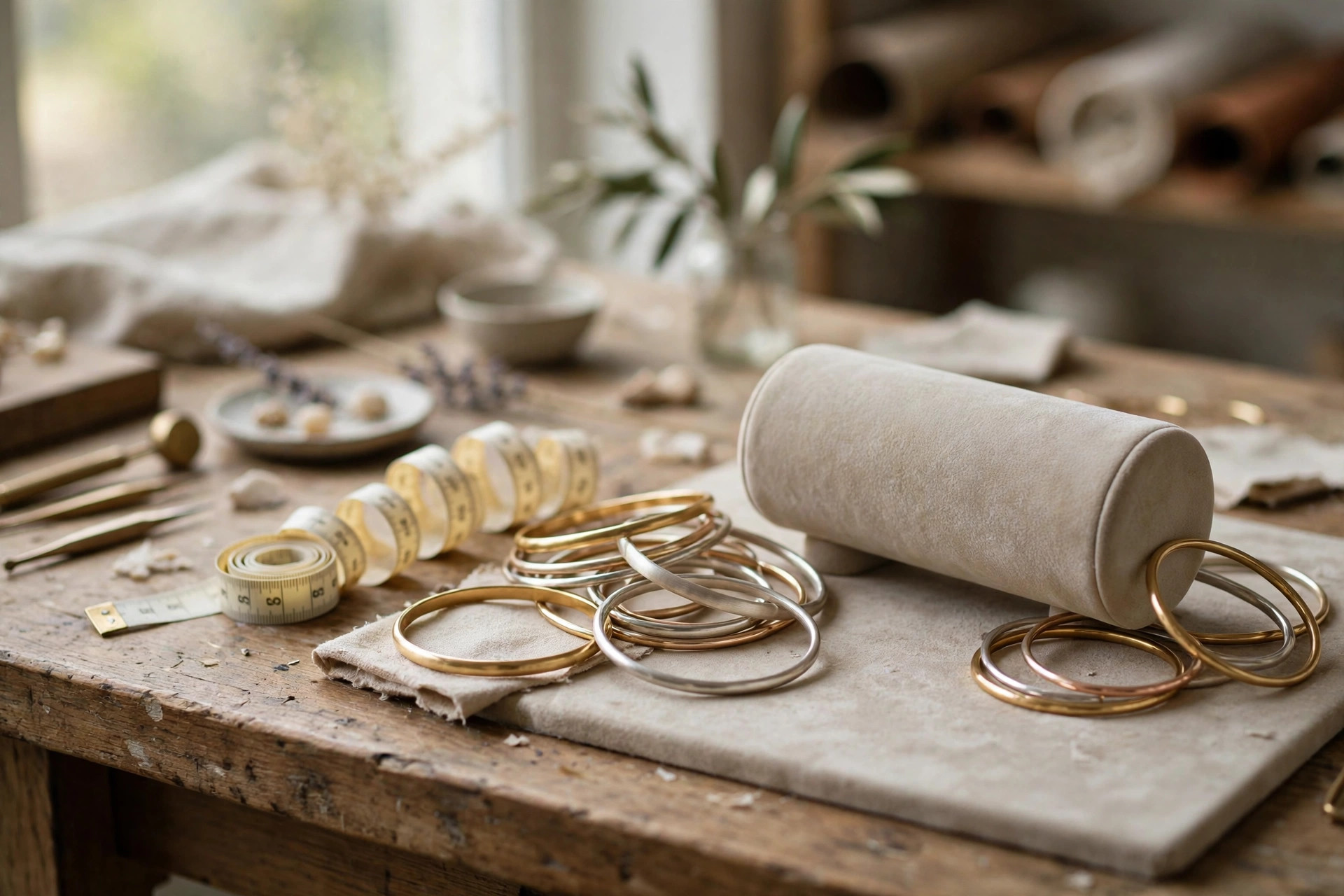
Bracelet sizing starts with one snug measurement of your wrist - but the wrist number is not the bracelet size. Unlike a ring, a bracelet needs wearing ease added: a chain that exactly matched your wrist circumference would not fasten. How much to add depends on the fit you want and the type of bracelet, and for bangles the sizing measurement is not the wrist at all but the hand the bangle must pass over.
Use a soft tape. Without one, wrap a strip of paper or string around the wrist, mark it, and measure it flat - the same strip method used for ring size. Measure the wrist you will wear the bracelet on, just below the wrist bone, at the end of the day when wrists are at their largest.
Step 1: Measure the Wrist Snugly
Wrap the tape around your wrist immediately below the wrist bone - the narrow point where a bracelet naturally settles - with the tape touching the skin all the way around but not pulled tight and not loose. Read the number where the tape meets. This is your wrist measurement, and every bracelet decision starts from it. Common adult wrist measurements run roughly from 5.5 to 8 inches; if your reading falls far outside that band, measure again to be sure the tape sat in the right place.
Measure twice and average if the readings differ. Also note whether you measured over the wrist bone or below it - a bracelet worn higher on the forearm needs more length, and confusing the two positions is the usual reason a correctly ordered bracelet arrives feeling small.
Step 2: Add Length for the Fit You Want
Chain and link bracelets are sold by their end-to-end length. Add to your wrist measurement according to the fit you prefer:
| Fit | Add to wrist measurement | How it wears |
|---|---|---|
| Snug | + 1/4 to 1/2 in | Sits close, little movement; suits slim chains and tennis bracelets |
| Comfort | + 3/4 to 1 in | The standard fit; moves slightly, rotates a little on the wrist |
| Loose | + 1 to 1 1/4 in | Slides up and down the wrist; suits chunky links and charm bracelets |
Worked example: a 6.5-inch wrist in a comfort fit takes a bracelet of about 7.25 to 7.5 inches, which is why 7 to 7.5 inches is the most common women's bracelet length and 8 to 8.5 inches the most common men's. Thick bracelets need the longer end of each range - a wide, stiff piece sits further from the skin than a fine chain of the same measured length. Charm bracelets should be sized with the loose fit in mind, because added charms take up room inside the circle.
Bangles and Cuffs Are Sized Differently
Bangles are rigid closed circles: they do not fasten at the wrist, they slide over the hand. To size one, squeeze your fingers together as if putting on a bangle, tuck the thumb across the palm, and measure around the widest part of the folded hand - across the knuckles. That circumference, not the wrist number, is the bangle size; if it will not pass the knuckles, it does not fit, however perfect it would be on the wrist.
Cuffs sit between the two systems: they are sized by wrist circumference like a chain, but the opening must span the wrist's width, and a cuff that is too round for an oval wrist will rock and catch. When a cuff is sold in S/M/L, your snug wrist measurement from step 1 is the number to compare with the seller's chart. For style and metal choices once the size is set, see the bracelets guide and the gold vs silver jewelry comparison.
Common Questions
- What is the average bracelet size for a woman or a man?
- The most commonly sold lengths are 7 to 7.5 inches for women and 8 to 8.5 inches for men, which correspond to average wrists plus a comfort allowance. Averages are only a starting point for gifts - a snug wrist measurement plus three-quarters of an inch is far more reliable when you can get it.
- How do I size a bangle if I only know my wrist size?
- You cannot convert reliably, because bangles are governed by the hand, not the wrist: the bangle must pass over the knuckles of a folded hand. Measure around the widest part of your hand with the thumb tucked in, and use that circumference as the bangle size.
- Should a tennis bracelet fit snug or loose?
- Snug to low-comfort: a tennis bracelet should stay in place with a small amount of movement - roughly one finger of room between the bracelet and the wrist. Too loose risks catching and uneven wear on the settings; too tight stresses the clasp.
- How can I measure for a bracelet as a surprise gift?
- Measure a bracelet the person already wears and likes: lay it straight and measure end to end, including the clasp, which gives its size directly. Failing that, their watch strap's used length is a reasonable guide, and the average lengths - 7 to 7.5 inches for women, 8 to 8.5 for men - are the safest fallback.
Measure & Convert: The Full Series
This page is part of the Apparel Search measuring and size conversion series. Browse the full series below, or start from the size guides hub.