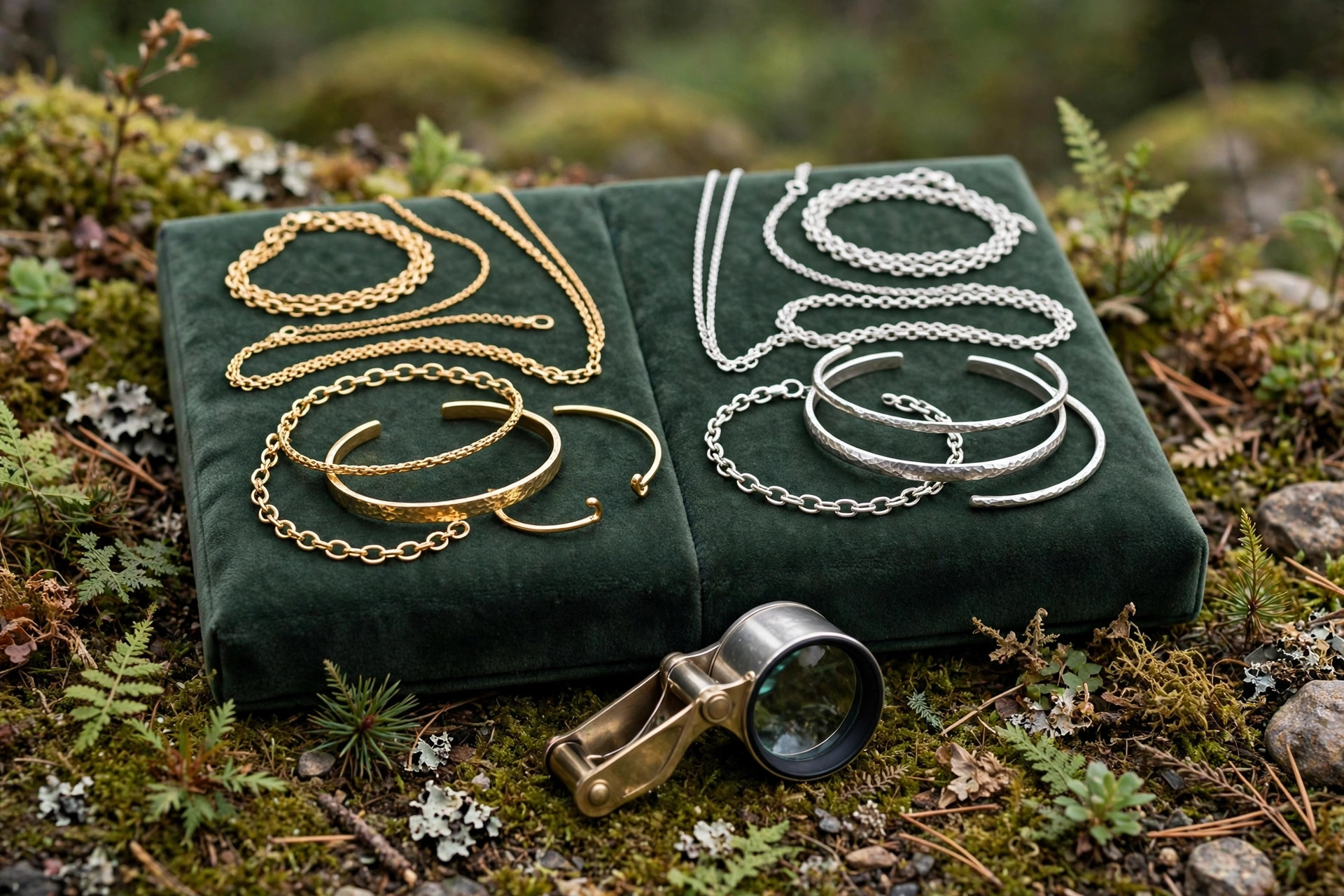
Gold and silver have divided jewelry between them for thousands of years, and the choice still comes down to a handful of practical differences: color, tarnish, hardness, care and price. Gold is warm-toned, essentially tarnish-proof, and expensive; silver is the brightest white metal, far cheaper, softer in price but quicker to tarnish. Neither is better - they are different tools, and most jewelry boxes end up holding both.
Two terminology points first, because they decide what you are actually buying: jewelry gold is almost always an alloy measured in karats (14k and 18k are the standards), and jewelry silver is almost always sterling silver - 92.5% silver, stamped 925. Pure 24k gold and pure fine silver are both too soft for most everyday jewelry. With that settled, the metals compare as follows.
What Gold Jewelry Is
Gold's karat number states its share of pure gold: 24k is pure, 18k is 75% gold, 14k is 58.3%. The remainder is alloy metals chosen for hardness and color - copper warms gold toward rose, nickel or palladium bleaches it to white gold, and silver and copper in balance keep the classic yellow. Higher karat means richer color and higher price but a softer piece; 14k is the durability standard for rings and everyday pieces in the US, while 18k is the fine-jewelry standard in much of Europe. Gold does not tarnish or rust, asks little care, and holds intrinsic metal value, which is why it anchors engagement rings and heirloom pieces. The styles are surveyed in the gold necklaces guide and the gold bracelets guide.
What Silver Jewelry Is
Silver in jewelry means sterling: 92.5% silver alloyed with 7.5% copper for hardness, stamped 925. Sterling has the highest reflectivity of any jewelry metal - a bright, cool white shine that gold's white alloys imitate at many times the price. Its known weakness is tarnish: silver reacts with sulfur compounds in air and on skin to form a dark surface layer. Tarnish is not damage - it polishes off in minutes - but it means silver wants regular wear (which slows it), proper storage, and an occasional polishing cloth. Silver's low metal price makes it the metal of larger, more sculptural and fashion-forward pieces, and of collectible traditions from Mexican to Native American to Scandinavian design. Styles appear in the silver necklaces guide and the silver bracelets guide.
Side by Side
| Feature | Gold (14k-18k) | Sterling silver (925) |
|---|---|---|
| Color | Warm yellow; also rose and white alloys | Bright cool white - the most reflective metal |
| Tarnish | Essentially none | Tarnishes with air and sulfur exposure; polishes off |
| Hardness & wear | 14k is hard-wearing; 18k softer and richer | Moderately soft; scratches and bends more easily than 14k gold |
| Care | Soap, water, soft cloth; minimal | Polish regularly; store sealed/dry; wear often to slow tarnish |
| Price | High - priced by weight and karat | Low to moderate - design labor dominates the price |
| Skin reactions | Rare with 14k+; white gold may contain nickel | Rare; the copper in sterling occasionally marks skin |
| Value retention | Strong intrinsic metal value | Modest metal value; value is in design and craft |
Costume-jewelry caution applies to both: "gold-plated" and "silver-plated" pieces are a thin wash of metal over a base metal and follow neither metal's durability - plating wears through at contact points, fastest on rings and bracelets.
How to Choose
- By color: gold flatters warm coloring and reads classic and formal; silver's cool brightness suits cool coloring, modern and minimal styles, and larger statement pieces where gold's price would be prohibitive.
- By lifestyle: a piece worn daily and never maintained should be gold. A piece worn in rotation and polished now and then can be silver at a fraction of the budget.
- By budget: silver buys design - big, crafted, interesting pieces - while the same money in gold buys small and simple. Collections often start in silver and add gold staples.
- Mix them: the old rule against mixing metals is gone. Two-tone pieces and deliberately mixed stacks are standard styling now; keep the finish and style coherent and the metals can share a wrist or neckline freely.
For sizing the pieces themselves, see how to measure ring size and how to measure your wrist for a bracelet.
Common Questions
- Does real gold tarnish?
- Gold itself does not tarnish or rust. Lower-karat gold jewelry can dull slightly over time because its alloy metals react, but a gentle clean restores it - nothing like silver's dark tarnish layer forms on gold.
- Why does silver turn black, and can it be fixed?
- Silver reacts with sulfur in the air, in some cosmetics and on skin, forming silver sulfide - the dark layer called tarnish. It sits on the surface and is not damage: a polishing cloth removes light tarnish, and dips or a jeweler's clean handle heavy cases. Storing silver sealed and dry, and wearing it often, slows the process.
- Which is more durable for an everyday ring, gold or silver?
- 14k gold. It is harder than sterling silver, does not tarnish, and resists the knocks of daily wear better. Sterling rings are common and attractive but will scratch, and can bend, more readily - one reason silver is favored for pendants, earrings and bracelets over hard-worn rings.
- Is it okay to wear gold and silver together?
- Yes. Mixing metals is an established modern style - two-tone jewelry is designed for exactly that. The result looks intentional when the pieces share a similar finish and weight of design, rather than one delicate chain lost among chunky pieces of the other metal.
Fashion Comparisons: The Full Series
This page is part of the Apparel Search fashion comparisons series, which puts two similar garments, fabrics or materials side by side. Browse the full series below.