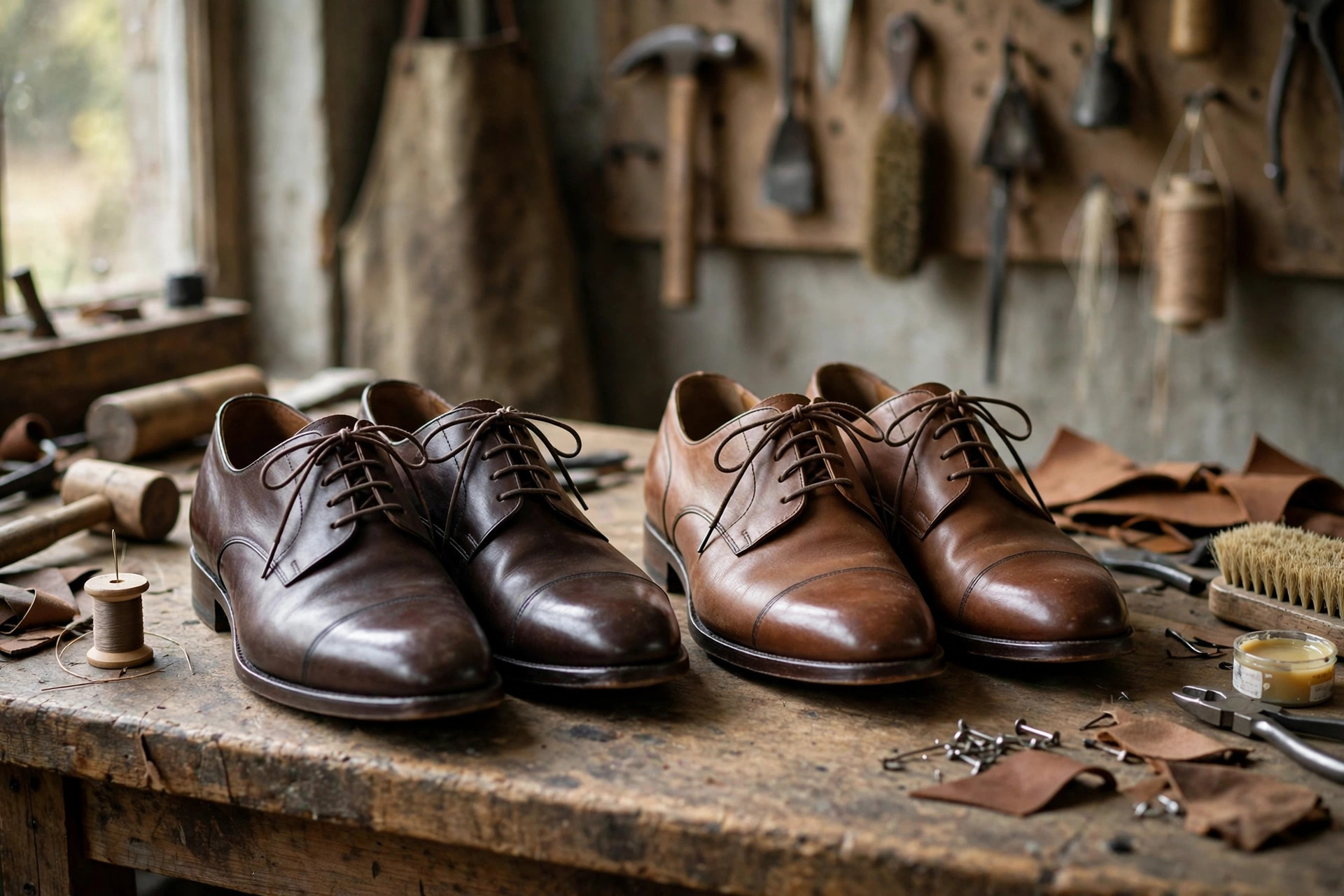
Oxfords and derbies are the two classic lace-up dress shoes, and the difference between them is a single construction detail: how the lace panels - the quarters that carry the eyelets - attach to the front of the shoe. On an oxford they are sewn underneath the vamp, so the lacing closes over a stitched-shut seam. On a derby they are sewn on top, two open flaps that lift and spread.
Everything shoppers care about follows from that seam. Oxfords look sleeker and are the more formal shoe. Derbies adjust more generously over the instep, suit wider and higher-arched feet, and dress down more willingly. If you have ever been unsure which one you were looking at - or which one to buy - the test takes two seconds once you know it.
What Oxford Shoes Are
An oxford is defined by closed lacing: the eyelet quarters are stitched beneath the vamp, so the laces pull the shoe closed over a hidden seam and the profile stays clean and close. The style became the standard shoe of business and formal dress in the late 19th and early 20th centuries, named for its popularity at Oxford University. Oxfords range from the plain-toe and cap-toe shoes worn with suits to wholecut models - a single piece of leather - that are the most formal lace-ups made. Because the closed construction cannot spread, oxfords fit best on low-to-average insteps and standard-width feet. Styles and leathers are covered in the men's oxford shoes guide and the women's oxford shoes guide.
What Derby Shoes Are
A derby (called a blucher in American usage) is defined by open lacing: the quarters are sewn on top of the vamp as two flaps, so the lacing can open wide to admit the foot and adjust across the instep. The design descends from 19th-century sporting and military boots, which is why derbies still read as slightly more rugged and relaxed than oxfords. That adjustability is the derby's great practical virtue - it accommodates high insteps, wider feet and thicker socks, and it is more forgiving when feet swell through a long day. Derbies are made in everything from smooth dress leathers to chunky country brogues and boots. Examples appear in the derby shoes product guide.
Side by Side
| Feature | Oxford | Derby |
|---|---|---|
| Lacing | Closed - quarters sewn under the vamp | Open - quarters sewn on top as flaps |
| Profile | Sleek, seamless, close-fitting | Slightly chunkier, layered look |
| Formality | Most formal lace-up; the suit standard | Business to smart-casual; dresses down easily |
| Fit adjustment | Limited - the throat cannot spread | Generous - flaps open for high insteps |
| Best feet | Low to average instep, standard width | High instep, wider feet, orthotics |
| Common styles | Cap-toe, wholecut, plain-toe, formal brogues | Country brogues, plain derbies, derby boots |
| Pairs best with | Suits, formal trousers, black-tie alternatives | Suits (casual end), chinos, tweeds, jeans in suede |
Brogueing - the decorative perforations - is independent of the distinction: there are brogue oxfords and brogue derbies. Lacing construction, not decoration, decides which shoe you have.
That decoration has a guide of its own: brogues explains the four brogueing levels, from the formal quarter brogue to the full wingtip.
How to Choose
- Choose oxfords for suits, formal occasions and conservative offices, and if your instep is unremarkable - the closed lacing gives the cleanest line with tailoring.
- Choose derbies if you have a high instep or wide feet, wear orthotics, or want one shoe to span smart and casual - a suede derby works from flannels to jeans.
- The two-second test: look where the laces end. If the panels disappear under the front of the shoe, it is an oxford; if they sit on top as visible flaps, it is a derby. On a correctly fitted oxford the laces close nearly parallel; a wide V gap signals an instep the shoe cannot take - switch to a derby.
- Care: identical for both - rotate days, use trees, condition the uppers. Construction differs; leather care does not.
For the slip-on alternatives, see loafers vs moccasins.
Common Questions
- How can you tell an oxford from a derby at a glance?
- Look at the base of the laces. On an oxford, the panels holding the eyelets are sewn underneath the front of the shoe, so the lacing appears to close over a smooth surface. On a derby, those panels are stitched on top as two visible flaps. That one seam is the whole distinction.
- Are derby shoes formal enough for a suit?
- Yes, in the right version: a plain or cap-toe derby in smooth black or dark brown leather works with most business suits. Derbies sit one step below oxfords in formality, so for the most formal occasions - and with the most formal tailoring - oxfords remain the safer choice.
- Which is better for wide feet or a high instep?
- The derby. Its open lacing lets the quarters spread to admit and accommodate a higher instep, and derby lasts are often cut more generously. An oxford's closed construction cannot expand in the same way and often shows a wide V gap at the laces on high insteps.
- Is a blucher the same as a derby?
- Essentially, yes. Blucher is the American term for the same open-laced construction, with a small technical difference in how the quarters are cut on some traditional definitions. In modern retail usage the two words describe the same shoe.
Fashion Comparisons: The Full Series
This page is part of the Apparel Search fashion comparisons series, which puts two similar garments, fabrics or materials side by side. Browse the full series below.