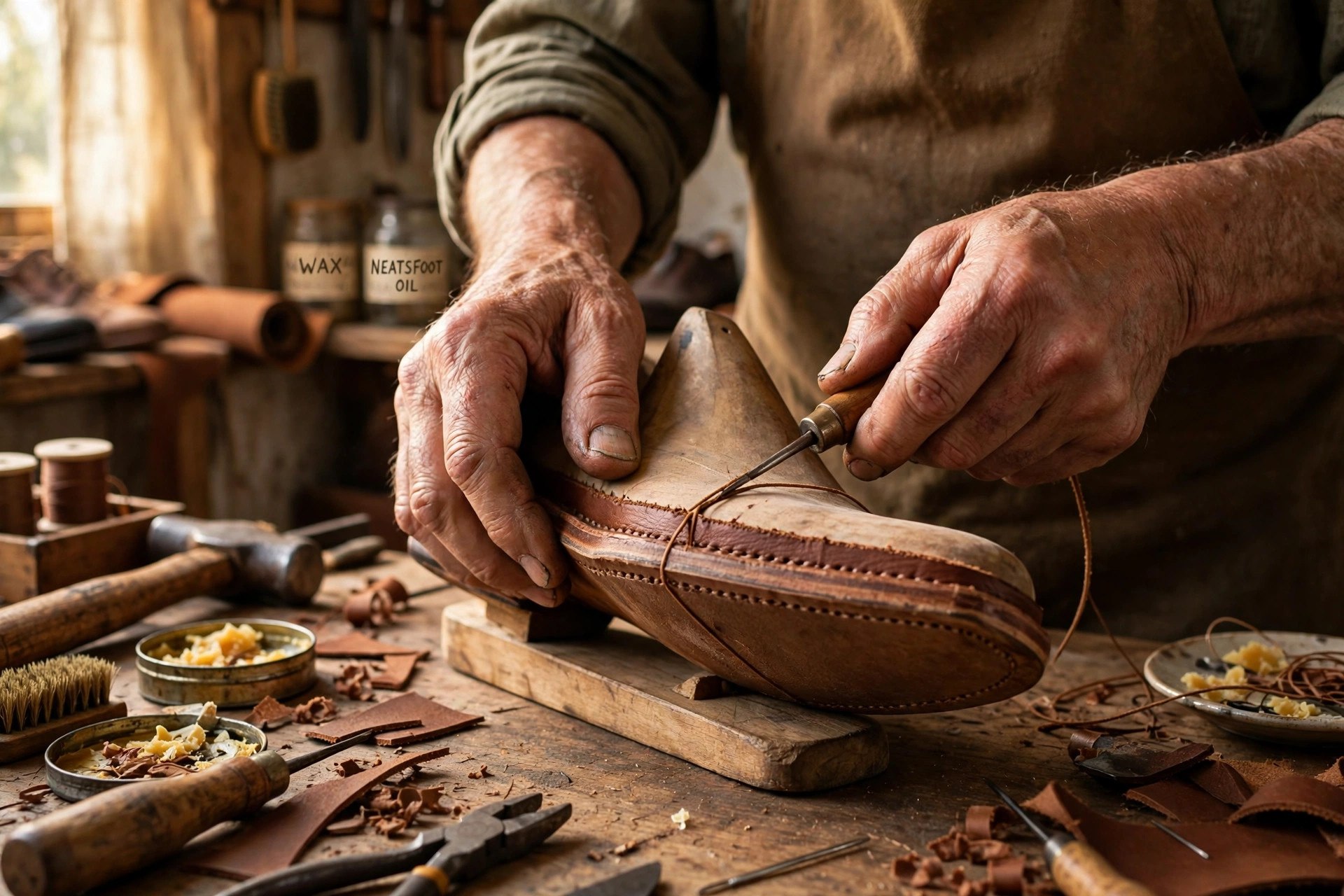
Goodyear welt construction is a two-stage stitched method for attaching a sole. First the upper is stitched to a strip of leather called a welt, along with the insole. Then the outsole is stitched to that welt with a second seam. The sole never has to be stitched directly through the upper, which is the key to everything the method does well.
The name honors Charles Goodyear Jr., whose machinery, patented in 1869, made welted construction practical at scale. Before the machines, welting was slow handwork; after them, stitched, resoleable shoes became the standard for quality dress shoes and boots. The method is still the benchmark against which other constructions, such as Blake stitch construction, are compared.
How a Goodyear Welt Is Built
The build starts inside. A rib on the underside of the insole - traditionally carved from the insole leather, today often a fabric rib called gemming - stands up around the edge. The upper is pulled over the last and held to that rib, and the welt, a narrow leather strip, is stitched through the upper and the rib in one seam. That creates the foundation: upper, welt and insole locked together without any stitch passing into the footbed.
The space inside the welt is then filled with cork, which compresses underfoot and gradually takes the shape of the wearer's foot. Finally the outsole is stitched to the welt with the visible seam around the edge of the shoe. A 360-degree welt runs all the way around the heel, common on boots and casual shoes, while a 270-degree welt stops at the heel, where the sole is nailed or glued - the neater choice on most dress shoes. Quality examples are common among the styles in the men's boots guide.
Why It Matters
Resoling is the headline benefit. When the outsole wears out, a cobbler cuts the outer seam, removes the old sole and stitches a new one to the same welt. The upper and insole are untouched, so a well-kept pair can be resoled again and again and last for many years. That repairability is why welted shoes cost more upfront but can cost less per year of wear.
The welt also helps with water resistance at the seam, because the stitching sits outside the upper rather than passing into the shoe, and the cork layer adds insulation and comfort once it molds to the foot. The trade-offs are real: the process takes more time and material, so prices are higher; the extra layers add weight; and a stiff new pair needs a break-in period before the cork and leather settle. For many buyers of classic shoes from the men's oxford shoes guide, the balance is worth it.
How to Spot One
Look for stitching visible around the top edge of the sole, running through a distinct strip - the welt - between the upper and the outsole. On a genuine welted shoe that seam is functional: the thread locks the sole to the welt, and a cobbler can follow the same line when resoling. The sole edge usually sits slightly proud of the upper, giving welted shoes their recognizable layered profile.
Beware of imitations. Many cemented shoes carry a fake welt strip glued around the edge, sometimes with molded or printed stitch marks that imitate the real seam. Check closely: fake stitching often looks too perfect, does not pass through the strip, or ends abruptly. Price is another clue - true welting is a costly process, so a very cheap shoe claiming a Goodyear welt deserves suspicion. When in doubt, ask whether the shoe can be resoled by a cobbler. A genuine welted shoe, like a stitched Norwegian welt shoe, can be.
Common Questions
- Why is Goodyear welt construction considered better?
- Because it is durable, repairable and more water resistant at the seam. The outsole is stitched to a welt rather than glued to the upper, so it can be replaced repeatedly, and the cork filling molds to the foot for comfort over time.
- Can Goodyear welted shoes be resoled?
- Yes - that is the main reason to buy them. A cobbler cuts the stitching that holds the outsole to the welt, fits a new sole and stitches it to the same welt. The upper is not disturbed, so the process can be repeated many times.
- How can you tell if a shoe is really Goodyear welted?
- Look for real stitching passing through a leather welt strip around the top edge of the sole. Beware of glued-on welt strips with molded or printed stitch marks on cemented shoes - the thread does not pass through, and the shoe cannot be resoled the same way.
- Is Goodyear welt the same as hand-welted?
- No. Hand-welting is the older bench-made method, where a shoemaker stitches the welt by hand. Goodyear welting is its machine version, using the process made practical by Charles Goodyear Jr. Both are welted constructions and both can be resoled.
Footwear Guides: The Full Series
This page is part of the Apparel Search footwear series, which covers the classic shoe styles, boot types and construction methods shoppers ask about. Browse the full series below.