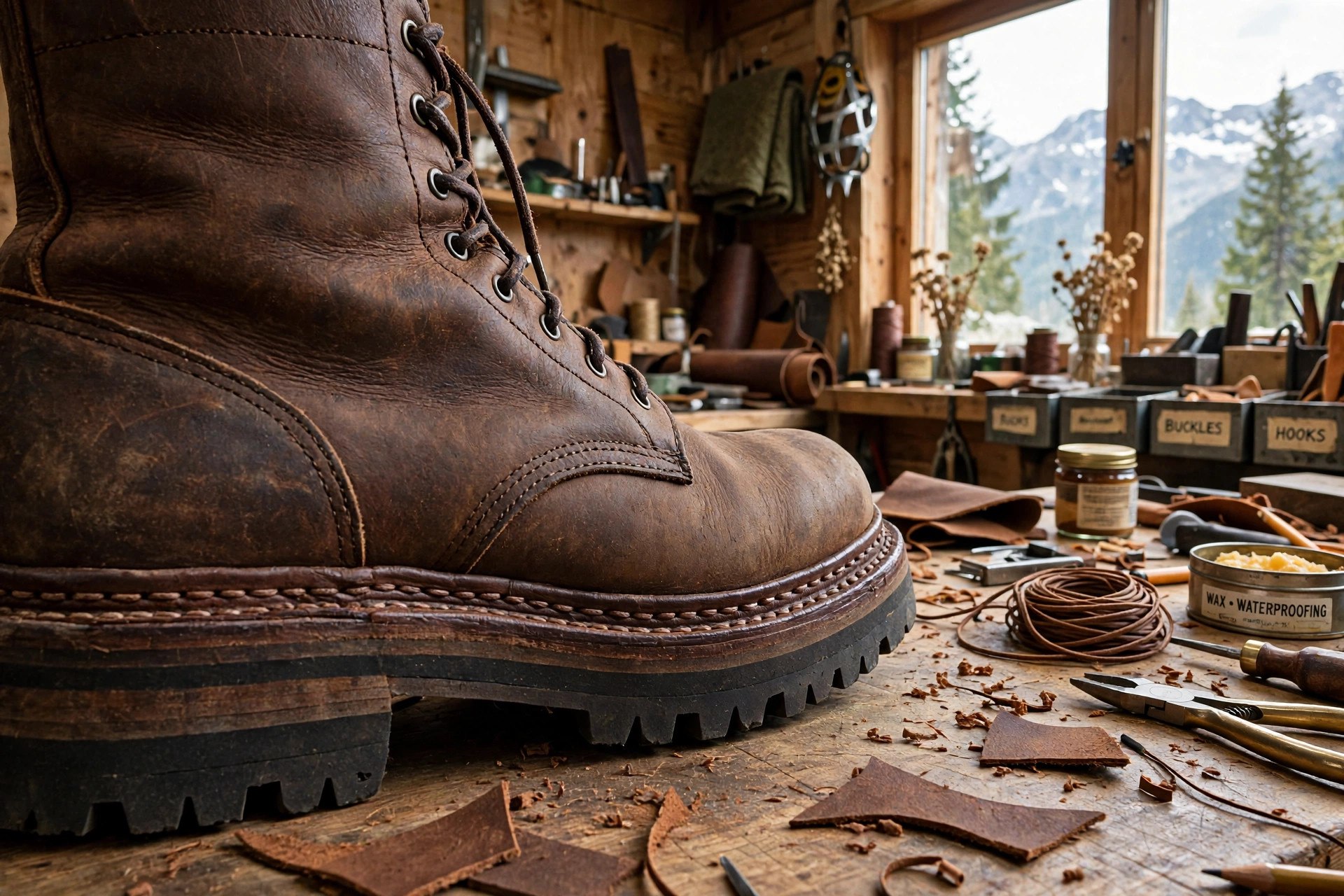
A Norwegian welt is a heavy-duty boot construction in which the bottom edge of the upper is turned outward and stitched through a welt, producing two visible rows of stitching around the base of the boot. One seam joins the turned-out upper to the welt; a second seam joins the welt to the sole. Nothing is hidden - you can read the whole structure of the boot from the stitching on its side.
The method was built for water resistance in serious boots. Because the upper flares outward over the welt instead of tucking under it, water is shed away from the seams rather than drawn into them. Norwegian welted boots are heavy, expensive and slow to make, but they can be resoled, and few stitched constructions keep working in wet country for as long.
How the Norwegian Welt Is Built
Most welting turns the edge of the upper inward, out of sight under the shoe. The Norwegian method does the opposite. The bottom edge of the upper is flared outward, away from the boot, forming a flange of leather that sits on top of the welt. A first seam stitches that flange down through the welt, and a second seam stitches the welt to the midsole and outsole beneath it. The result is the two parallel rows of stitching that circle the base of the boot.
The outward flange is functional, not decorative. Rain and surface water striking the base of the upper meet leather that laps outward like a shingle, shedding water away from the seam line instead of feeding it into the joint. Combined with heavy, well-greased leathers, that is what made the construction the choice for mountain and forestry boots long before waterproof membranes existed.
Norwegian Welt vs Stitchdown
The Norwegian welt is a close cousin of stitchdown construction, and the two are often confused because both turn the upper outward into a visible flange. The difference is what the flange is sewn to. In stitchdown, the flanged upper is stitched directly down through the midsole and outsole, with no separate welt in between. In the Norwegian method, a welt is inserted between upper and sole, and the work is done by two seams instead of one.
That extra component makes the Norwegian boot heavier and more expensive to build, but it also gives a cleaner resole: the sole can be removed at the second seam without disturbing the seam that holds the upper to the welt. Stitchdown is simpler and extremely tough; the Norwegian welt is the more elaborate, more serviceable development of the same idea.
Where You Find It
Look for the Norwegian welt on heavy hiking and mountaineering boots of the kind listed in the men's hiking boots guide, on traditional country boots made for wet ground, and in the work of Italian and Scandinavian bootmakers, who kept the method alive when most factories moved to lighter constructions. It also appears on chunky fashion boots that borrow the double stitching as a style statement - check that both rows are real thread before paying a craftsman price for the look.
Expect a substantial boot. Norwegian welted footwear is heavier and stiffer than cemented or Goodyear welted equivalents, costs more to buy, and asks for a genuine break-in period. In return it is resoleable, exceptionally durable and about as weather resistant as a stitched boot gets, which is why it survives in the serious end of the men's boots guide rather than in everyday fashion ranges.
Common Questions
- What is a Norwegian welt?
- It is a heavy boot construction in which the upper is turned outward at the base and stitched to a welt, and the welt is then stitched to the sole. The two visible rows of stitching around the base of the boot and the outward flange of leather are its signatures.
- Is Norwegian welt construction waterproof?
- No construction is fully waterproof, but the Norwegian welt is among the most water resistant of stitched constructions. The outward-turned upper sheds water away from the seams instead of channeling it inward, which is why it is used on boots made for wet mountains and country ground.
- What is the difference between Norwegian welt and Goodyear welt?
- On a Goodyear welted shoe the upper is turned inward and hidden, and a single seam joins the welt to the sole. On a Norwegian welted boot the upper turns outward in a visible flange, and two rows of stitching show - one joining upper to welt and one joining welt to sole.
- Why does a Norwegian welt have two rows of stitching?
- Because it is really two separate seams doing two jobs. The first seam stitches the turned-out upper to the welt, and the second stitches that welt down to the sole. Each seam can be seen - and, when the time comes, serviced - independently of the other.
Footwear Guides: The Full Series
This page is part of the Apparel Search footwear series, which covers the classic shoe styles, boot types and construction methods shoppers ask about. Browse the full series below.