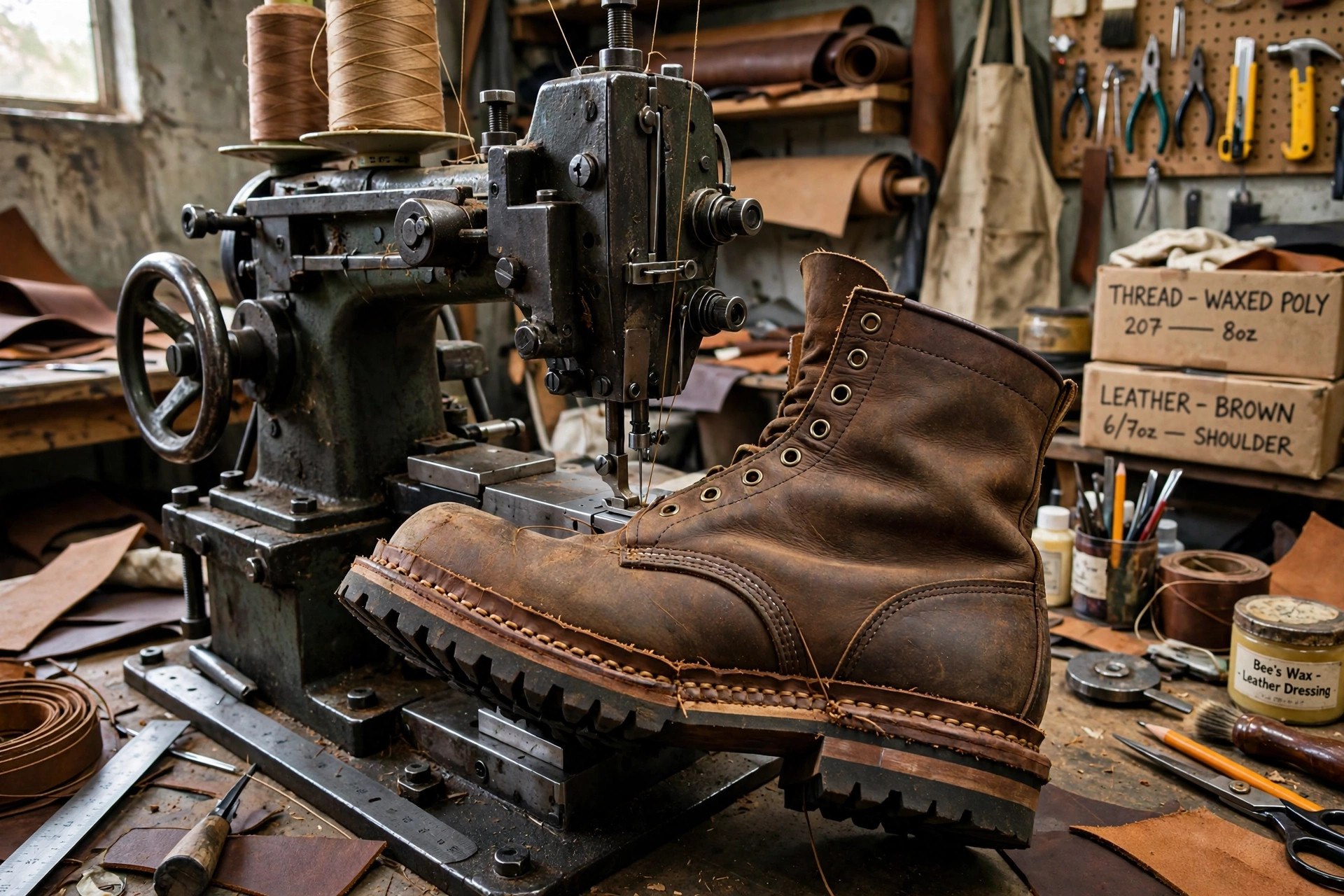
Stitchdown construction flares the upper outward at the base and stitches it directly down through the midsole and outsole - with no separate welt between them. The upper itself becomes part of the joint: its turned-out flange lies flat over the sole layers, and a heavy row of stitching, sometimes two, locks upper, midsole and outsole together.
The visible stitch ring around the base of the upper is the signature of the method, and it is more than a look. The flared flange sheds water, spreads the load over a wide and stable base, and can be unstitched and resoled when the outsole wears through. Stitchdown is old, simple and exceptionally tough - the construction of logger boots, service boots and veld boots rather than dress shoes.
How Stitchdown Works
In stitchdown construction the upper is not tucked under the boot at all. Its lower edge is lasted outward, flaring away from the boot in a flange of leather that lies flat over the midsole. Heavy stitching is then driven down through that flange, through the midsole and into the outsole, locking all three layers together in a single operation. Many boots use two rows of stitching for extra security, and the finished ring of thread around the base of the upper is the unmistakable signature of the method.
The flared base has practical effects. It gives the boot a wide, stable platform underfoot, which is valued in boots worn on uneven ground, ladders and tree work. It also places the seam where it can be inspected and, when the sole wears out, re-stitched - there is no hidden cavity and no welt strip to replace.
Veldtschoen: The Wet-Weather Variant
The best-known stitchdown variant is the veldtschoen, developed in South Africa and adopted by British country bootmakers. In a veldtschoen the upper is made from a single piece of leather turned outward at the base, with very few seams anywhere in the boot - and every seam that remains is positioned and lapped so that water runs off it rather than into it. Stitched down to the midsole, the construction was designed for safari, farm and field use where boots are wet for days at a time.
British makers applied the same idea to country shoes and boots for shooting and walking, usually in waxy, water-resistant leathers with storm welts and heavy soles. A veldtschoen shoe is rarely elegant, but for keeping feet dry without a membrane it remains one of the most effective traditional constructions ever put on a boot.
Where You Find It
Stitchdown is the traditional construction of the Pacific Northwest logger and wildland fire boots in the men's work boots guide - tall, heavy boots that must be resoleable in the field towns where loggers live, and tough enough for a life spent on bark, ash and slope. It is also used for military-style service boots, desert boots and veld boots, all of them designs where durability matters more than refinement.
Compared with the wider range in the men's boots guide, stitchdown boots sit at the rugged end: heavier than cemented boots, plainer than Goodyear welted dress boots, and built to be repaired rather than replaced. If you want one pair of work boots to be resoled for a decade, this is one of the constructions that can honestly promise it.
Common Questions
- What is stitchdown construction in boots?
- It is a method in which the bottom edge of the upper is flared outward and stitched directly down through the midsole and outsole, with no separate welt. The ring of stitching visible around the base of the upper is where the whole boot is held together.
- What is the difference between stitchdown and Goodyear welt?
- A Goodyear welt turns the upper inward and stitches it to a separate welt strip, which is then stitched to the sole, so the upper itself is never pierced by the sole seam. Stitchdown flares the upper outward and stitches it straight through the sole layers, with no welt at all.
- Are stitchdown boots good in wet weather?
- Yes, particularly in the veldtschoen form, where the turned-out upper laps over the joint and sheds water away from the seam. Combined with greasy, water-resistant leathers, stitchdown country and work boots have a long record of service in wet conditions, though no stitched boot is fully waterproof.
- Can stitchdown boots be resoled?
- Yes. A cobbler removes the worn outsole, prepares the midsole and stitches a new sole through the existing flange of the upper. Resoling is routine for the logger and service boots built this way, though the flange can only be re-stitched a limited number of times.
Footwear Guides: The Full Series
This page is part of the Apparel Search footwear series, which covers the classic shoe styles, boot types and construction methods shoppers ask about. Browse the full series below.