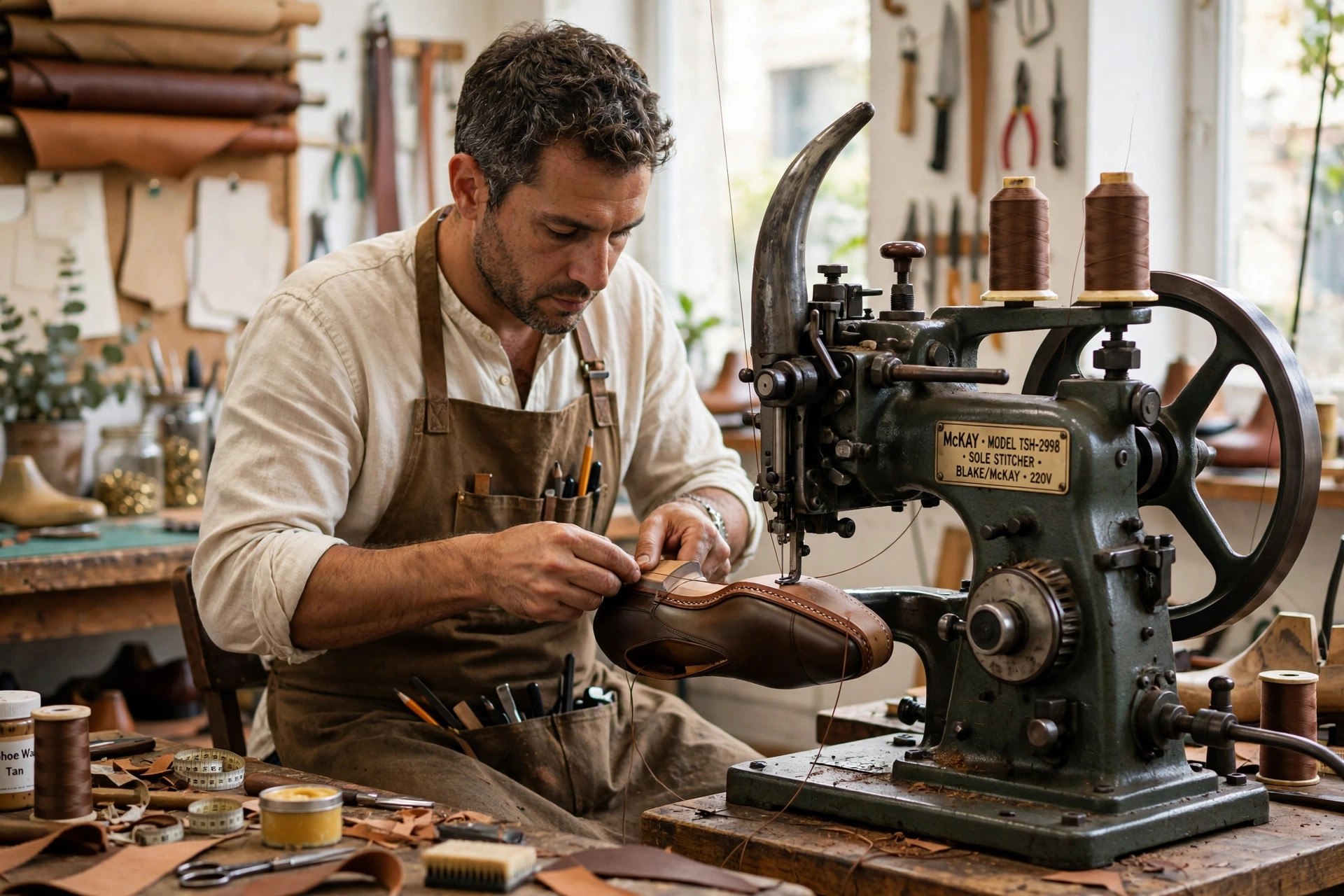
Blake stitch construction joins a shoe with a single row of stitching that passes straight through the insole, the upper and the outsole from inside the shoe. There is no welt and no second seam. The thread line sits in a channel on the sole and is hidden inside the shoe, which is why Blake stitched shoes look so clean and close-cut.
The method is named for Lyman Reed Blake, who patented the sewing machine for the job in 1858; the machine was developed and sold by Gordon McKay, which is why the construction is also called Blake/McKay. It became the signature build of Italian shoemaking, where a light, elegant profile matters more than heavy-duty weatherproofing. Compare it with Goodyear welt construction to see the two philosophies side by side.
How Blake Stitching Works
The shoemaker pulls the upper over the last and tacks it to the insole, then places the outsole against it. A Blake, or McKay, machine reaches inside the shoe with a curved needle and sews one continuous seam through outsole, upper and insole in a single pass. Because the stitching happens from the inside, no machine arm has to work around the outside of the shoe, and no welt strip is needed to carry a seam.
That simplicity decides the shape. With no welt, the sole can be cut close to the upper - trimmed almost flush - so the edge profile is slim and the waist of the shoe can be shaped tightly. The result is the sleek, elongated look associated with Italian dress shoes: little visible sole edge, no stitching showing on top of the sole, and a shoe that feels light from the first wearing. You will see the same close-cut idea carried even further on cemented shoe construction, though there glue replaces the stitch.
Strengths and Trade-offs
The strengths follow from having fewer layers. A Blake stitched shoe is light and flexible, bending easily at the forefoot with almost no break-in, and it sits close to the ground for a dressy, refined feel. With fewer operations and less material than welting, it also costs less to make, which is why good Blake shoes often undercut comparable welted shoes on price while looking more elegant.
The trade-offs are just as direct. The stitch line passes through the insole, so in heavy rain it can wick water into the shoe along the thread - Blake shoes are fair-weather footwear, not storm boots. There is less insulation and cushioning underfoot than a welted shoe with its cork layer, so long days on hard, cold floors are less kind. And because the seam runs through the footbed, you can sometimes feel where the construction sits on very thin-soled models. For dry days and dress wear, including most styles in the men's loafers guide, those compromises are usually worth making.
Resoling and Where You Find It
Blake stitched shoes can be resoled - the stitching is structural, not glue - but with a condition: the cobbler needs a Blake/McKay machine to re-stitch the new sole from inside the shoe. Not every repair shop owns one, so resoling may mean sending a pair to a specialist or back to the maker. Expect fewer resoles over a lifetime than a welted shoe, and protect thin leather soles with a rubber topy if you walk a lot.
You find Blake construction most often on Italian dress shoes and loafers, where makers prize the slim profile, and on other warm-climate footwear built for elegance over weatherproofing. It suits the shoes in the men's oxford shoes guide when they come from Italian workshops, as well as summer loafers and driving styles. Choose Blake for sleek looks, light weight and flexibility; choose a welt when resoling often and walking in wet weather matter more than the profile.
Common Questions
- What is Blake stitch construction?
- It is a construction where a single row of stitching passes straight through the insole, upper and outsole from inside the shoe. Patented by Lyman Reed Blake in 1858 and worked by the McKay machine, it is also called Blake/McKay construction.
- Is Blake stitching durable?
- Yes, for dress wear. The seam is a real structural stitch, not glue, and Blake shoes hold together well in normal dry use. They are less suited to heavy rain and rough wear than welted shoes, and the soles are usually thinner and sleeker.
- Can Blake stitched shoes be resoled?
- Yes, but only by a cobbler with a Blake/McKay machine, which re-stitches the new sole from inside the shoe. Not all repair shops have one, so you may need a specialist or the original maker. A rubber topy can extend the life of the original sole.
- Which is better for wet weather, Blake or Goodyear welt?
- Goodyear welt. Its stitching sits outside the upper, on the welt, so water is not drawn into the shoe, and the cork layer adds insulation. A Blake stitch line passes through the insole and can wick water along the thread in heavy rain.
Footwear Guides: The Full Series
This page is part of the Apparel Search footwear series, which covers the classic shoe styles, boot types and construction methods shoppers ask about. Browse the full series below.