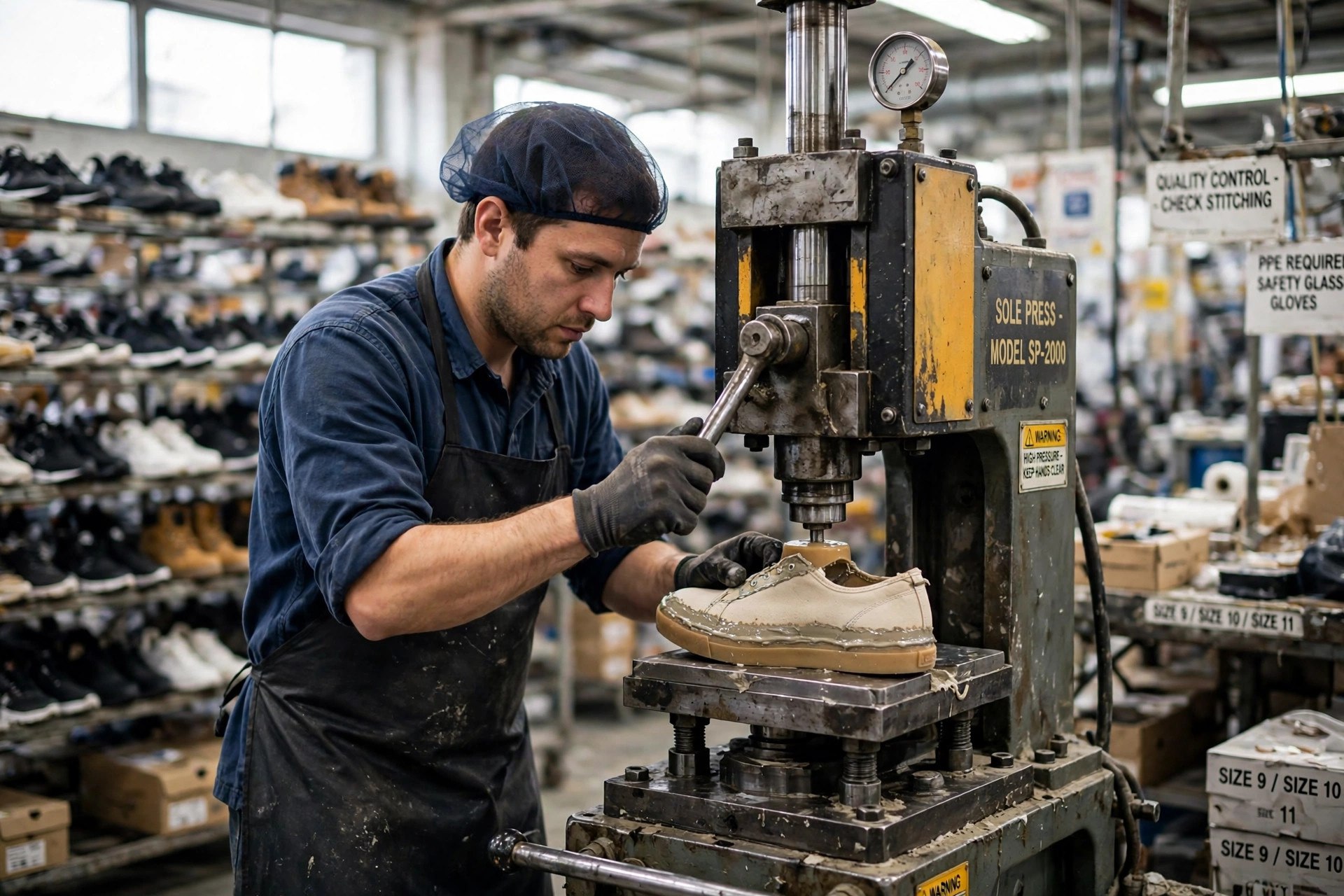
Cemented construction bonds the sole to the upper with adhesive - the "cement" in the name - with no stitching holding the two together. The upper is lasted, its bottom edge is coated with glue, and the sole is pressed on and left to cure. Once the bond sets, that layer of adhesive is the entire connection between the part you wear and the part that meets the ground.
It is how the large majority of modern shoes are made, from running sneakers and court shoes to fashion dress shoes, loafers and most women's styles. Cementing is fast, light and inexpensive, and it allows sole shapes that stitching cannot follow. Its trade-off is permanence: a stitched sole can usually be removed and replaced, while a glued sole generally cannot.
How Cementing Works
Cementing starts with preparation. The bottom edge of the lasted upper and the top face of the sole are roughened - scored or sanded - so the adhesive has a surface it can grip. A heat-activated cement is applied to both surfaces and allowed to dry, then the sole is positioned against the upper and the two are brought together under heat and pressure in a sole press. The pressure forces the parts into full contact while the adhesive bonds, and the shoe is left to cure so the joint reaches full strength.
Because no stitching passes through the parts, there is nothing to see at the joint - which is why some cemented shoes carry a decorative fake welt, a strip glued around the base of the upper that is molded or printed with imitation stitching to suggest a welted shoe. Turn the shoe over and look closely: on a genuinely stitched shoe the thread is real and slightly irregular, while on a cemented shoe the neat row is only decoration.
Strengths of Cemented Shoes
The method has real virtues, which is why it dominates modern footwear. A cemented shoe needs no welt, no heavy midsole and no stitching machinery, so it can be light and flexible from the first wearing, with none of the stiff break-in period of a heavy stitched boot. Production is fast and inexpensive, which keeps prices down across the ranges covered in the men's shoes guide.
Cementing also frees the designer. Soles can be slim, sculpted, cupped around the upper or molded in shapes that stitching could never follow, and uppers in fabric, knit or delicate materials that a needle would damage can be bonded without a mark. For running shoes, court shoes and most fashion footwear, cementing is not a compromise - it is the construction the design actually requires.
Weaknesses and Lifespan
The bond is also the failure point. Adhesives weaken with age, heat and repeated flexing, and when a cemented shoe fails it is usually by sole separation - the sole peeling away at the toe or heel. Leaving shoes in a hot car, storing them for years without wear, or soaking them repeatedly all shorten the life of the glue line, and once the bond lets go across a wide area the shoe is effectively finished.
Resoling is rarely economical, for the reasons given in the questions below, so a cemented shoe should be bought as a shoe with a service life rather than a lifetime purchase - the opposite of the resoleable welted boots in the men's work boots guide. That said, quality varies widely within the method. Good materials, careful roughing, the right adhesive and full curing produce cemented shoes that outlast careless stitched ones, so judge the shoe in hand, not the label for its construction.
Common Questions
- What does cemented construction mean in shoes?
- It means the sole is bonded to the upper with adhesive - the cement - instead of being held on by stitching. The glued joint is the only connection between the two parts, which is why cemented shoes can be light, flexible and inexpensive to make.
- How long do cemented shoes last?
- It depends on the materials, the quality of the bonding and how hard they are worn. A well-made pair worn in rotation can last for years, while a cheap pair worn daily may show sole separation within a year or two as the adhesive ages and flexes.
- Can cemented shoes be resoled or repaired?
- Usually not in an economical way. Removing a glued sole without damaging the upper is difficult, replacement soles for fashion styles are rarely available, and the labor often costs more than the shoes. Small separations can sometimes be re-glued by a cobbler.
- Are cemented shoes bad quality?
- No. Cementing is a method, not a quality grade. Athletic shoes and many well-made fashion shoes are cemented because the method suits their design. Quality depends on the leathers, foams, adhesives and workmanship used, and poor cemented shoes fail for the same reason poor stitched shoes do - cheap materials.
Footwear Guides: The Full Series
This page is part of the Apparel Search footwear series, which covers the classic shoe styles, boot types and construction methods shoppers ask about. Browse the full series below.