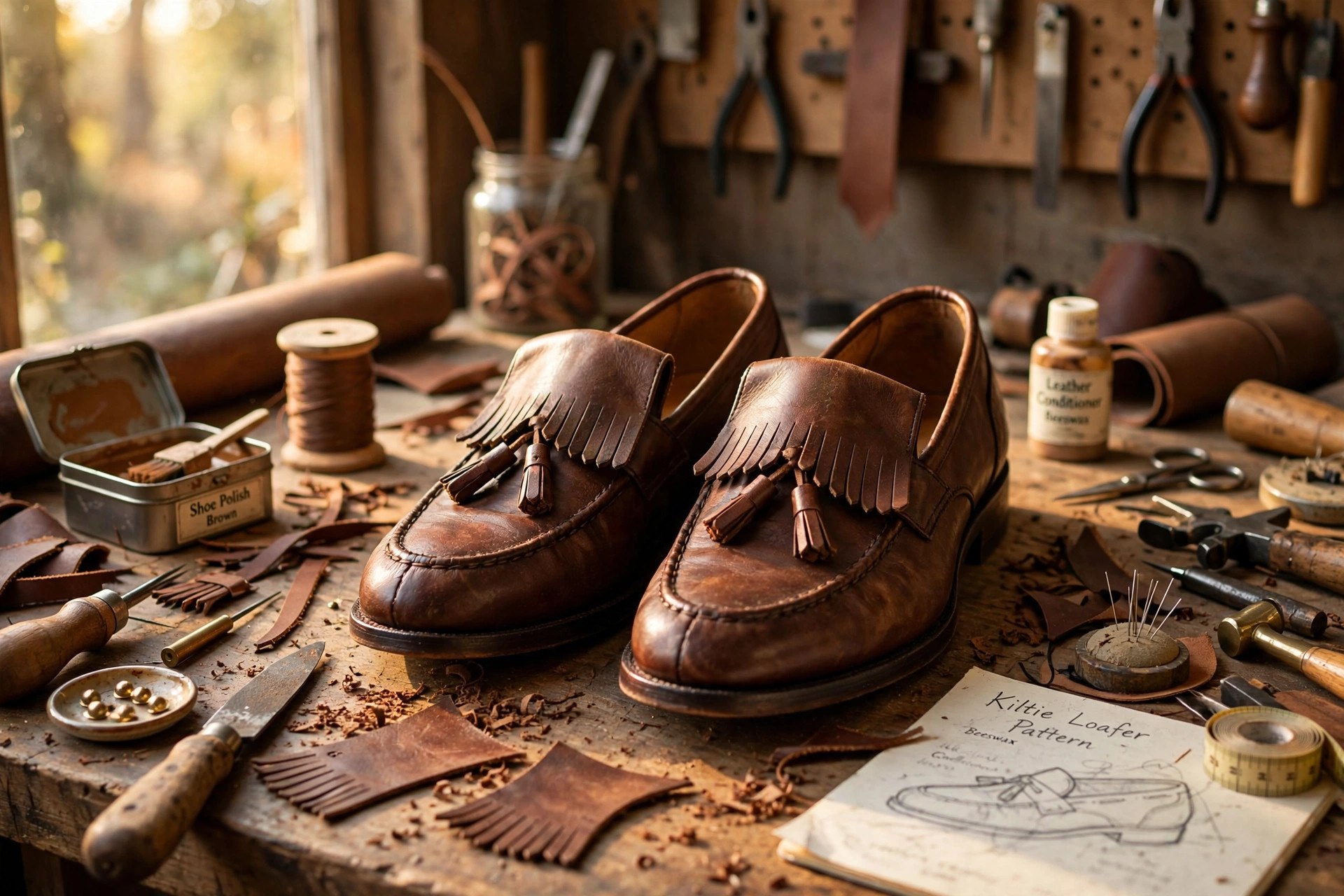
A kiltie is the fringed leather flap that lies over the instep and tongue of a shoe, covering the lower laces or the front of a slip-on. The flap is cut with a fringe along its lower edge, and it is often finished with a tassel. A shoe described as a kiltie is a shoe wearing that flap, whatever its underlying style.
That is the key point: kiltie names a feature, not a whole shoe. The flap appears on loafers, on lace-up dress shoes and brogues, and most famously on golf shoes. Underneath, the shoe keeps its own identity - a kiltie loafer is still a loafer, and a kiltie golf shoe is still a spiked or spikeless golf shoe - with the fringe added as character, tradition and, in some stories, protection.
Where the Kiltie Comes From
The kiltie comes from Scottish footwear tradition. It is kin to the ghillie brogue, the laced shoe worn with Highland dress, whose long laces and fringed tongue belong to the same world of Scottish country and ceremonial clothing. The very name points to the kilt, the garment the full outfit is built around.
Tradition offers an explanation for the fringe: it is said to have shielded the laces, keeping them cleaner and more secure in rough, wet country use, and its shape echoes the fringed details of Highland dress. That account should be presented as tradition rather than certain fact - it is the story the style carries with it, repeated by makers for generations. What is not in doubt is the association: a fringed flap on a shoe reads as Scottish in origin, and that heritage is exactly why the detail survived long after any practical need faded.
Kiltie Loafers
The kiltie's most familiar modern home is the loafer. The classic American kiltie loafer combines the fringed flap with a tassel, producing the tassel kiltie loafer that became a preppy staple - worn with chinos, cords, blazers and sweaters, and associated with campus and country-club dress from the mid-20th century onward.
Versions vary. Some loafers carry the fringe with a tassel through it, some carry the fringe alone, and some replace the tassel with a strap or bit above the flap. Without a tassel the shoe looks quieter; with one, busier and more traditional. Either way, the flap adds texture to a plain slip-on. The base style is covered in the men's loafers guide and in loafers vs moccasins.
Kilties on Golf Shoes
For much of the 20th century, the kiltie was standard equipment on golf shoes. The traditional golf shoe carried a large fringed flap over the laces, and it came with its own practical origin story: the fringe kept the laces out of wet grass and morning dew, and shielded them from mud on the course. As with the Scottish story, treat that as the traditional explanation - plausible, long repeated, and impossible to prove for every pair.
Modern golf shoes have mostly dropped the flap in favor of athletic, sneaker-like designs, so today the golf kiltie is largely decorative. It survives on classic leather golf shoes, where it signals heritage rather than function. Related decorated styles appear in the brogues product guide.
Styling Kiltie Shoes
Kilties invite a formality debate, and the honest answer is that the fringe moves a shoe one step casual. A smooth tassel loafer is already on the relaxed side of dress shoes; adding a fringed flap makes it more textured and more country in feel, not more formal. Wear kiltie loafers with casual tailoring, cords, chinos and knitwear rather than with sharp business suits.
Because the flap is a busy detail, keep the rest of the outfit simple. Plain trousers, an unpatterned sweater or a quiet blazer let the shoes carry the interest. Fit is unaffected by the flap, so choose the size you would choose for the same shoe without it.
Common Questions
- What is a kiltie on a shoe?
- A kiltie is a fringed leather flap that lies over the instep and tongue of a shoe, covering the lower laces or the front of a slip-on. It is a feature added to a shoe - such as a loafer or a golf shoe - not a shoe type of its own.
- What is the difference between a kiltie and a tassel?
- A kiltie is the wide fringed flap across the front of the shoe. A tassel is a small hanging ornament of bundled leather strands, usually attached at the front. Many loafers carry both together, but a shoe can have a kiltie with no tassel, or a tassel with no kiltie.
- Why do golf shoes have a fringe?
- Tradition says the fringed kiltie flap shielded the laces from wet grass, dew and mud on the course. That is the long-repeated explanation rather than a proven fact, and on modern golf shoes the fringe is mostly decorative - a nod to the game's classic dress.
- Are kiltie loafers formal?
- No. Kiltie loafers are smart-casual shoes. The fringe and tassel add texture that moves the loafer a step down in formality, so they suit chinos, cords, casual tailoring and knitwear, but they are not formal enough for business suits or dress occasions.
Footwear Guides: The Full Series
This page is part of the Apparel Search footwear series, which covers the classic shoe styles, boot types and construction methods shoppers ask about. Browse the full series below.