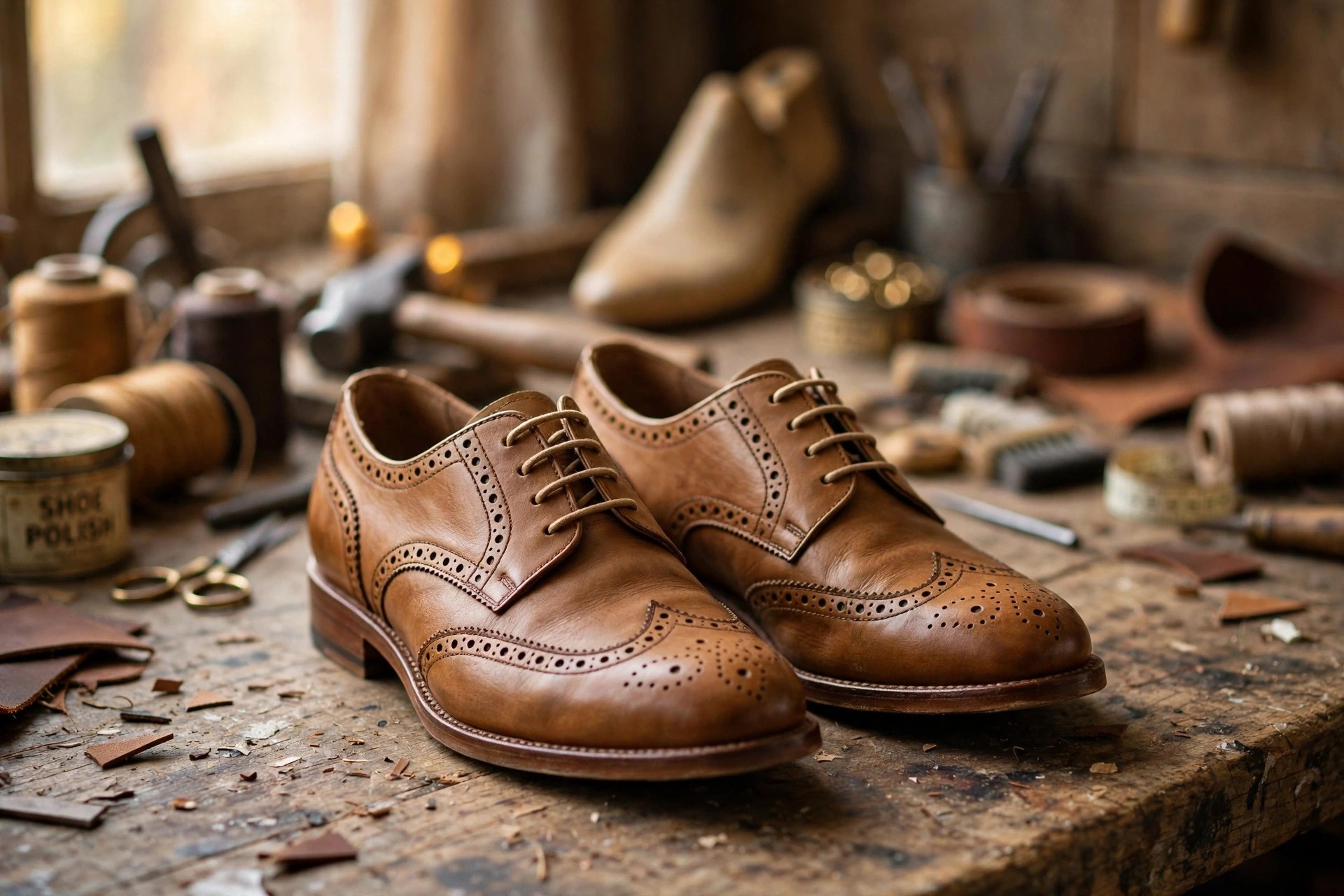
Brogues are shoes defined by brogueing - decorative perforations punched in patterns along the seams and toe, not by their shape, lacing or construction. A punched hole pattern is the whole definition. That is why almost any classic shoe can become a brogue: an oxford can carry it, a derby can carry it, and so can a boot or a monk shoe.
The decoration changes how formal the shoe looks, not how it is built or how it fits. A plain shoe and a brogued version of the same shoe fit the same foot, but send different signals. The more brogueing a shoe carries, the more relaxed and country in character it reads.
Where Brogues Come From
Brogues began as practical country shoes in Ireland and Scotland, made for walking wet, uneven ground in rough weather. The traditional explanation for the perforations is that the holes let water drain out after crossing bogs, streams and soaked fields. That story is widely repeated and fits the landscape, but it should be treated as tradition - possibly partly legendary - rather than a proven record of how every early pair was used.
What is certain is the direction of travel. A sturdy working shoe became, in the early 20th century, a fashionable town shoe. As country cloths such as tweed entered city wardrobes, brogues came with them, settling into their modern role: dress shoes with a relaxed, textured, outdoor heritage.
The Four Levels of Brogueing
Brogues are sorted by how much decoration they carry. More holes mean a more casual shoe, and learning the levels is the quickest way to judge whether a pair belongs with a suit, with sports jackets, or only with casual clothes.
| Level | Features | Formality |
|---|---|---|
| Full brogue (wingtip) | Wing-shaped toe cap, perforated medallion on the toe, brogued seams throughout | Least formal brogue - smart casual to casual tailoring |
| Semi brogue (half brogue) | Straight cap toe with a brogued cap seam; medallion on the toe is optional | Middle ground - business suits and smart outfits |
| Quarter brogue | Perforations along the cap seam only, with no medallion | Most formal brogue - suitable for business suits |
| Longwing | Wing seam runs around the whole shoe to the back seam | Casual and sturdy, usually on a derby base |
| Austerity brogue | Wing-shaped seams with no perforations at all | Sleek and dressy - decoration suggested, not punched |
The semi brogue is the versatile middle: the straight cap keeps it tidy and the punched seam softens it. The quarter brogue leaves a single line of holes where the cap meets the vamp. The austerity brogue, born when leather was rationed, keeps the wingtip outline but skips the punching.
How to Wear Brogues
Match the shoe to the texture of the outfit. Brogues are happiest with tweeds, flannels, corduroy, country suits and casual tailoring - cloths with visible texture that echo the shoe's punched detail. Smooth, fine worsted suits ask for plainer shoes, which is why a heavily brogued pair can look busy under a formal city suit. Brown and tan brogues underline the country character; black brogues read dressier than the same shoe in brown.
There is one clear exception. A black quarter brogue, with its single restrained line of perforations, can work well with business suits, because the decoration is quiet enough not to fight the tailoring. If you are choosing a first pair, a dark brown semi brogue covers the widest range, from flannels and sports jackets to softer suits. For the base styles underneath the decoration, see the men's oxford shoes guide and the comparison of oxford vs derby shoes, and browse examples in the brogues product guide.
Buying and Care Notes
Buy brogues for the outfits you actually wear. Heavy brogueing on a thick sole is a casual shoe however expensive it is, while a quarter brogue on a neat last can serve as a business shoe for years. Check that perforations are cleanly punched and evenly spaced. Care is the same as for any leather shoe: rotate pairs, use trees, condition the uppers, and keep polish from clogging the holes.
Common Questions
- Are brogues formal shoes?
- It depends on the level. Quarter brogues are the most formal and work with business suits, semi brogues suit most smart outfits, and full brogues are the least formal. As a rule, the more perforations a brogue has, the more casual it is.
- Can you wear brogues with a suit?
- Yes, if you match the level to the suit. Black quarter brogues and dark semi brogues work well with business suits, while heavily decorated full brogues are better with casual tailoring, tweeds and flannels than with a formal city suit.
- What is the difference between full, semi and quarter brogues?
- A full brogue has a wing-shaped toe cap and a perforated medallion. A semi brogue has a straight cap toe with a brogued seam and an optional medallion. A quarter brogue has perforations along the cap seam only and no medallion, which makes it the most formal of the three.
- Why do brogues have holes in them?
- Tradition says the holes were punched in Irish and Scottish country shoes so water could drain out after crossing wet ground. That explanation may be partly legendary, but the perforations remained as decoration when brogues became town shoes, and they are now purely ornamental.
Footwear Guides: The Full Series
This page is part of the Apparel Search footwear series, which covers the classic shoe styles, boot types and construction methods shoppers ask about. Browse the full series below.