01Fit First
Cropped, Classic or Longline: Pick the Length First
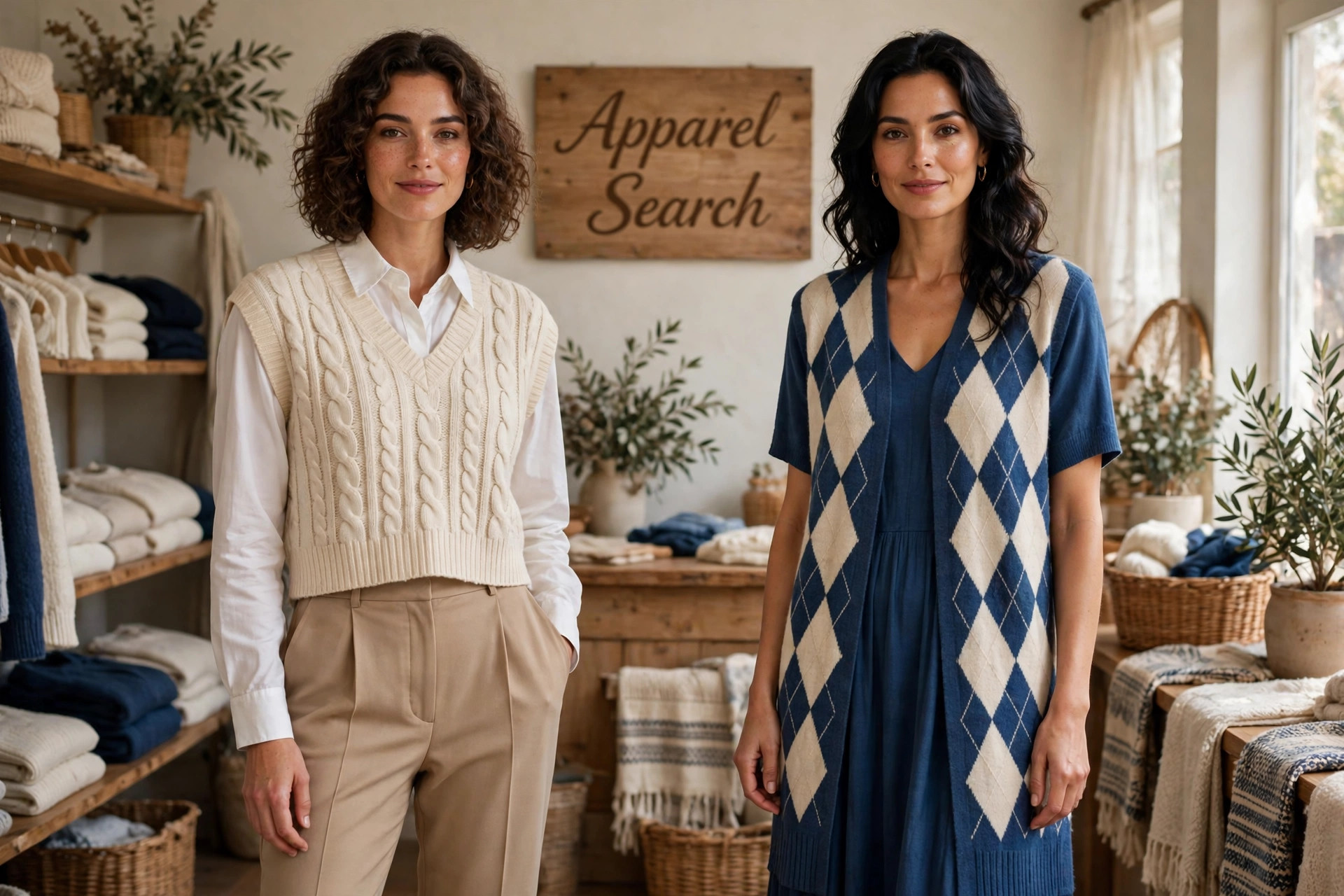
A sweater vest is a sweater with the sleeves removed and the styling decisions doubled: it can be the layer on top of an outfit or, cut close enough, the top itself. Everything it does well starts with choosing the right length and fit.
Cropped vests end at or just above the waistband. They are built for high-waisted trousers, skirts and jeans: the hem meets the rise, the waist stays defined, and the layer underneath shows at the collar and cuffs rather than hanging below. Classic vests end at the hip bone and are the true layering length, worn over shirts and under jackets. Longline vests fall past the hip, sometimes to mid-thigh, and behave like a knitted tunic — they need slim shapes beneath them, which the finishing section covers. Neckline matters alongside length: a V-neck frames a collar or a crew underneath, while a crewneck vest reads sportier and more modern. The garment’s types, yarns and patterns are catalogued in the women’s sweater vest guide; this page is about wearing them.
02Layered
Over Shirts, Blouses and Dresses
The vest’s home ground is the layered outfit, and the classic partner is a collared shirt. White is the default because it makes any knit color look deliberate, but the formula survives every variation: a striped shirt under a plain vest, a chambray shirt under a cream cable knit, a dark shirt under a fair isle. Keep the shirt’s collar out and its cuffs showing past the vest’s armhole line — those two flashes of shirting make the layering look finished rather than bundled. A blouse softens the same idea: a soft bow or a fluid sleeve under a structured vest gives contrast in both texture and mood, and it is the version that moves most easily into work and evening settings.
Over dresses, the vest works as a waistcoat. A cropped or classic vest over a shirt dress or a plain midi dress adds warmth and a waistline at once; belt the vest itself if the dress is straight. Fine layers go under, too — a thin turtleneck beneath a V-neck vest is the cold-weather standard, built on the same principles as how to style a turtleneck. One rule governs every layered version: the piece underneath should be smoother and thinner than the vest. A chunky shirt under a fine vest, or two heavy knits stacked, bunches at the armhole and adds bulk exactly where the vest is supposed to look clean — the layer order in how to style layers applies directly.
03Solo and Men’s
Worn Solo — and the Men’s Takes
Worn solo, the sweater vest becomes a knitted top, and the fit rules tighten. The armhole must sit high and close to the body: deep armholes are cut to fit a shirt underneath and will gap and show a bra or chest worn alone. Choose a fitted or cropped cut with a finished neckline, and pair it with high-waisted bottoms. A fine-gauge solo vest with tailored trousers is a warm-weather work option in relaxed offices; a ribbed one with a midi skirt carries into evening. If the vest is loose, skip the solo wear and give it a layer — that is what it was cut for.
Men’s sweater vests run on the same logic with a narrower menu. The standard is the V-neck vest over an Oxford or dress shirt, with or without a tie — the vest frames the tie knot, which is why the combination has survived a century of office dressing. For casual wear, a crewneck or quarter-zip vest over a plain tee or henley with chinos keeps the layering benefit without the formality. Pattern discipline matters most for men: argyle and fair isle are the vest’s statement, so keep the shirt plain and the trousers quieter still. Fit should skim, never squeeze — a vest that pulls across the chest reads a size too small, and one that billows reads borrowed.
04Finishing Rules
Proportions, Patterns and Seasons
Three finishing rules settle most sweater vest outfits. First, one pattern at a time: an argyle, fair isle or striped vest is the outfit’s print, so the layer under it and the bottom below it stay plain — the one exception is a fine shirt stripe under a plain vest, where the stripe behaves like a texture. Second, mind the hem conversation: the vest’s hem and the bottom’s waistband should either meet cleanly (cropped vest, high rise) or clearly overlap (longline vest over slim trousers); a classic vest ending exactly at a low waistband is the awkward middle. Third, match shoe weight to knit weight: loafers and ballet flats suit fine and cropped vests, ankle boots ground classic lengths, and longline vests take a boot or a substantial shoe to balance the column — the open-knit cousin of these rules appears in how to style a cardigan.
Seasonally, the vest is a three-season piece. In spring it replaces the jacket over shirts and dresses; in autumn it stretches summer dresses and light blouses into cooler weeks; in winter it goes under coats, adding core warmth without sleeve bulk. Cotton blends cover the warm end of that range, lambswool and chunkier knits the cold end.
Questions
Common Questions
What do you wear under a sweater vest?
A collared shirt or blouse is the classic layer — the collar and cuffs frame the vest and the shirt’s body keeps the knit smooth. A fine turtleneck or a plain long-sleeve tee works in colder weather, and a slip dress or shirt dress underneath turns the vest into the outfit’s top layer.
Can you wear a sweater vest on its own?
Yes, in warm weather or as an evening look, provided the armholes are cut high and close — a deep, loose armhole is cut for layering and gaps when worn solo. A fitted or cropped vest with a finished neckline reads as a knitted top; pair it with high-waisted trousers or a skirt so the proportions stay deliberate.
Should a sweater vest be cropped or long?
Match the length to what sits below it. Cropped vests end at the waistband and suit high-waisted trousers, skirts and dresses because the hem meets the rise. Longline vests fall past the hip and work as a tunic layer over slim trousers, leggings or a straight dress — avoid them over wide or flared bottoms, where the two volumes compete.
More to Explore
Search Apparel Search