Apparel Search Consumer Guides
How to Authenticate a Designer Handbag
The checks in the order an experienced buyer runs them — from the seller and the silhouette to stitching, hardware, stamps and date codes — with what genuine construction usually shows, and what should make you pause.
A designer handbag is the most counterfeited object in fashion, and also the most checkable. It is a piece of engineering: made to tolerances, from specified materials, in a set sequence — and every one of those decisions leaves evidence. This page runs the examination in order, as part of our designer authentication guide. Run it before you pay, in person where you can and from photographs where you must. One ground rule governs everything below: no single check decides. Genuine bags fail an individual test now and then — a replaced zipper, a lost dust bag — and good fakes pass individual tests routinely. You are looking for a pattern: check after check quietly agreeing.
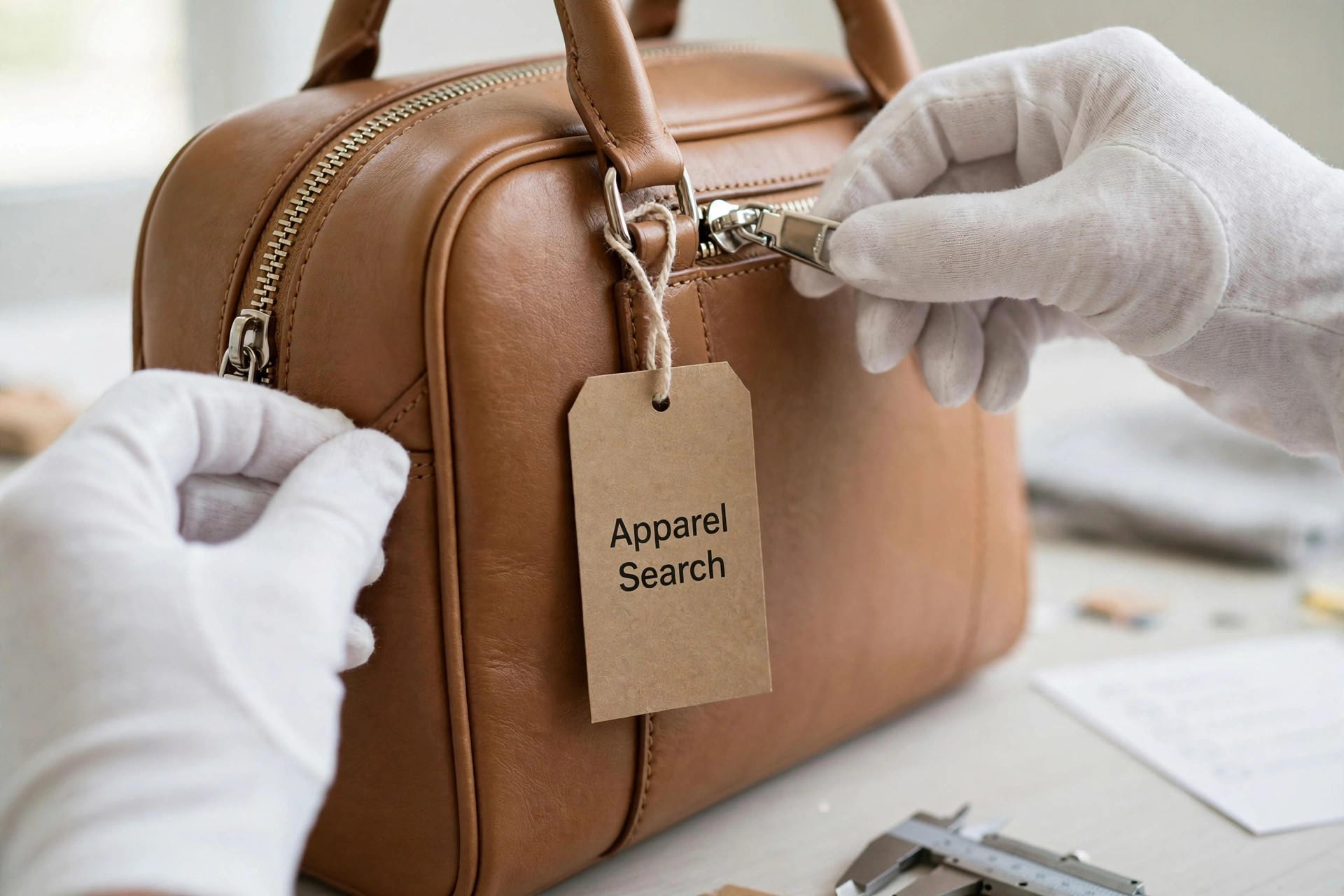
The Examination, in Order
- The seller and the price, once more. However you found the bag, price it against the same model in the same condition across reputable resale channels. A rare bargain from a seller offering a written authenticity guarantee and returns is a find; the same price from a seller with neither is a warning. If you are buying from photographs, insist on the photographs this checklist needs — front and back straight on, the base, the corners, hardware close-ups, the interior, stamps and any code. A seller who cannot or will not show the details has answered the question.
- Overall shape and proportions. Stand back first. Each model has a silhouette — how it stands, how a flap falls, where the handles attach, the ratio of height to width — and genuine production holds it tightly. A bag that reads as almost right but slightly soft, slightly tall, slightly off in its hang is showing you the most honest evidence there is: copies are usually modeled from photographs or from a single sample, and proportions are where that origin shows. Compare against photographs of the same model from the brand or a major retailer, angle for angle.
- Leather and materials. Genuine bags use the material the model specifies, and it behaves accordingly: real leather shows irregular natural pores, flexes and creases naturally, and smells of leather rather than chemicals — our guide to telling real leather from fake covers the tests in full. Canvas should carry its print crisply and feel substantial; monogram patterns should align where the design aligns them, particularly across pockets and seams, because alignment is expensive and cheap production skips it. Synthetic-feeling coatings, a plasticky shine and patterns drifting off-register are all reasons to stop.
- Stitching. Count, and look. Genuine stitching is even and straight, consistent in stitches per inch along a seam, in thread of the right weight and color, with clean finishing where seams end. Houses have their own habits — characteristic stitch styles, thread choices, ways of attaching handles — and while per-brand stitch charts change and age badly, the principle never does: irregular spacing, wandering lines, loose ends and stitching that changes character mid-seam are carelessness that genuine production rarely ships.
- Hardware: weight, finish and engraving. Judge the metal by hand. Zippers, clasps, rings and feet on genuine pieces are substantial — real weight, even plating or finishing, smooth movement. Zipper pulls should run without grit or catch. Engraved logos and lettering are cut crisply, with clean edges and correct spelling; stamped lettering on fakes often looks soft, shallow or slightly uneven, and plating on fakes flakes at the edges early. Visible screws, where a design uses them, are proper screws, neatly seated. Lightweight, sharp-edged or tinny hardware on a bag at this price level is a contradiction.
- Lining and interior stamps. Open it. The lining should be the material the model specifies — houses are particular about linings — and finished as carefully inside as out, because genuine production does not relax where cameras rarely go. Interior stamps and logos should be crisp and correctly spelled (check character by character; a subtly wrong letterform is a classic tell) and placed where the model places them. A puckered lining, raw edges and glue at the seams argue against authenticity more eloquently than any logo argues for it.
- Date codes and serial marks. Many houses mark bags with a date code, serial number or similar identifier, stamped on a tag, a patch or the lining itself. You are checking consistency, not existence: codes are copied onto fakes in huge numbers, so a present code proves nothing — while a code whose format belongs to a different era than the bag's hardware, lining and styling is a genuine red flag. Formats have changed repeatedly over the decades, and some houses have moved newer pieces toward embedded digital identification instead of printed codes, so a missing code is not proof either. Era-consistency is the check; any single-format rule circulating online is a trap.
- Dust bag, box and paperwork. The supporting cast should agree with the lead. Dust bags and boxes use specified materials, print and typography; care booklets and cards match the model and its period. Counterfeiters reproduce these too, sometimes well, so treat mismatches as evidence — a dust bag in a fabric the house never used, a booklet describing a different model — and matches as merely neutral. A full set is pleasant for resale value. It is not authentication.
- Smell, feel, and the whole-bag verdict. Finish with the senses photographs cannot carry. A strong chemical or solvent smell belongs to cheap materials and adhesives, not to a luxury bag; genuine leather goods smell of leather and workshop. The bag should feel balanced and solid, and its closures should engage with a deliberate, finished action. Then weigh everything together: one anomaly on an otherwise consistent bag is a question to resolve, while anomalies accumulating across shape, materials, hardware and codes are the answer. Walk away, or make the purchase conditional on a professional authentication opinion, settled before the money becomes final.
When the Price Justifies a Professional
Your own examination is the right tool for most purchases. It stops being the right tool when the price of a mistake is high: into four figures, most buyers should treat a professional authentication opinion — or a platform whose own authentication step and buyer protection stand behind the sale — as part of the purchase price rather than an optional extra. Photo-based services work from exactly the views listed at step one, which is another reason to demand them from any seller. An opinion backed by a money-back guarantee is not certainty, but it is accountability, and on an expensive bag accountability is what you are actually buying.
Photographs Hide Two of the Best Checks
Weight and smell cannot travel through a listing, and they are among the hardest qualities for a counterfeiter to match at a price. When you buy a valuable bag remotely, the return policy is part of the authentication: it is what lets you run the in-hand checks before the purchase becomes final. A seller who offers no route back is asking you to authenticate with half the evidence missing.
Common Questions
What is the first thing to check on a designer handbag?
Before the bag, the seller and the price: a written authenticity guarantee, a real return policy, and a price that makes sense against the same model in similar condition on reputable resale channels. On the bag itself, start with overall shape and proportions, because copies are modeled second-hand and proportions are where that shows. Then work through leather, stitching, hardware, lining, stamps and codes in the order this page sets out.
Do all genuine designer bags have date codes or serial numbers?
No. Marking practices vary widely by house and by era: many houses stamp a date code or serial somewhere on a tag, patch or lining, others have used different systems at different times, and some newer pieces rely on embedded digital identification rather than a printed code. A missing code is a question, not a verdict — and a present code is not proof either, since codes are copied. What matters is whether the code's format fits the bag's apparent era and agrees with everything else about it.
Can a fake bag carry a correct-looking date code?
Yes, easily. Date codes, serial numbers, receipts and authenticity cards are among the most-copied elements of a designer bag, because they are cheap to print. That is why the code check in this guide is about consistency — format against era, paperwork against model — and why it sits near the end of the examination, after construction, materials and hardware have already had their say.
A bag passed every check but one. Should I buy it?
It depends which check, and how the rest line up. A single soft anomaly on an otherwise fully consistent bag — a replaced zipper pull, a missing dust bag — can have an innocent explanation, and wear explains more on a pre-owned piece. Anomalies in the fundamentals — proportions, materials, hardware quality, a code from the wrong era — are different: they argue the bag is not what it claims to be. If the price is significant and any doubt remains, make the purchase conditional on a professional authentication opinion, or buy only where a return is genuinely possible.
Back to the Designer Authentication Guide
The verification mindset: seller and provenance first, what authentication can and cannot prove, and when a professional opinion earns its fee.