Leather Guide · Authenticity
How to Tell Real Leather from Fake
Six tests you can run in a store with nothing but your hands and eyes, the label terms that actually carry legal weight, and the FTC rules behind them.
Faux leather has become good enough that a photograph — and sometimes a price tag — will not settle the question. Hands will. Real leather is a natural fiber structure with an irregular surface, a distinctive smell and an unfinished back; synthetic leather is a coating on cloth, regular in every detail. This page of the Leather Guide collects the tests that exploit those differences, then decodes the labels and the labeling law. For the side-by-side buying comparison, see Leather vs Faux Leather; for what the synthetics are, see the alternatives guide.
Six Tests That Work in the Store
Read the Pores
Look closely — a phone flashlight helps. Real leather's pore pattern is irregular: pores vary in size and spacing because they follow the animal's hair follicles. Faux leather's grain is embossed from a plate, so its pattern repeats with machine regularity across the surface. A repeating pattern is the single fastest tell.
The Press Test
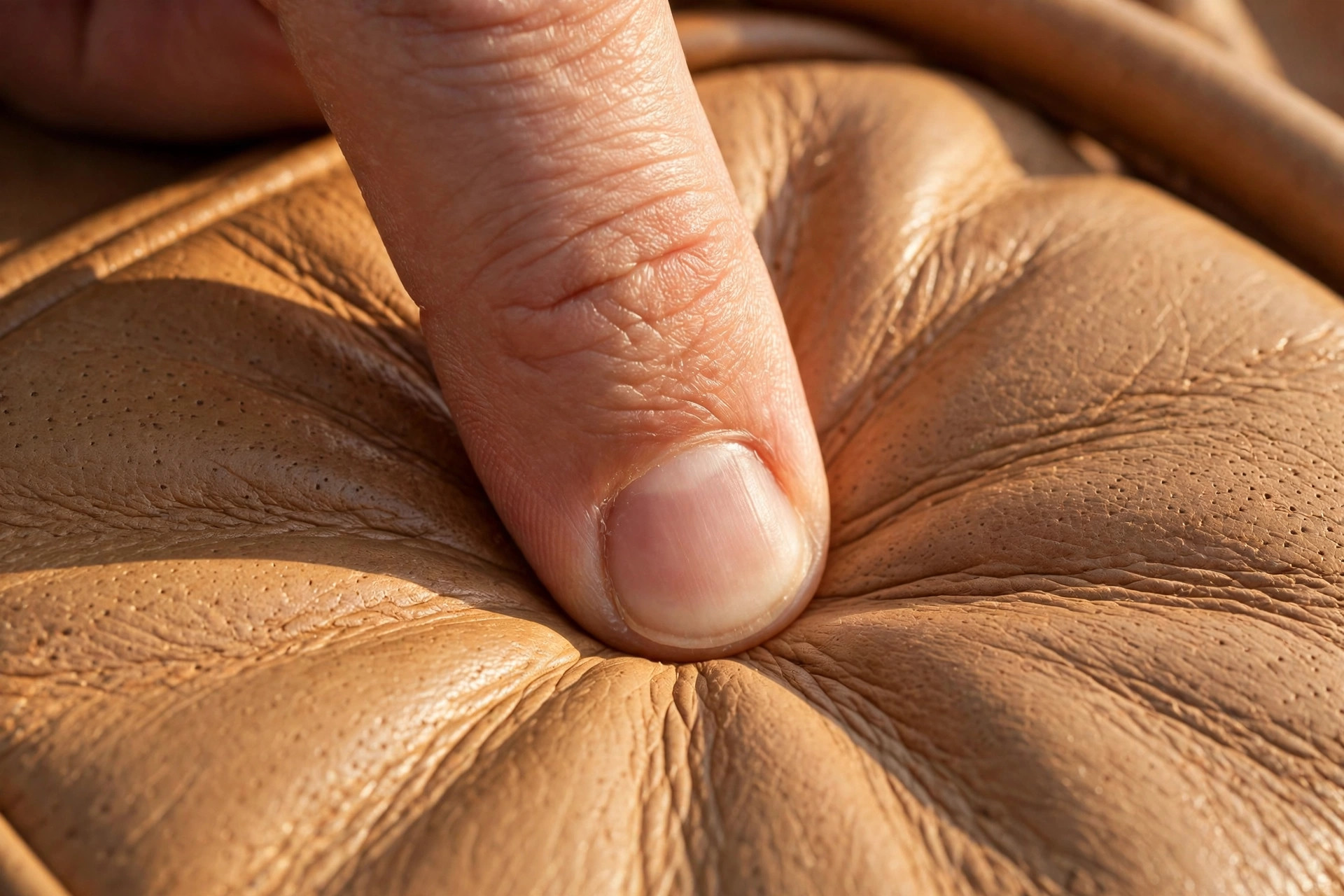
Press a fingertip firmly into the surface. Real leather wrinkles like skin — fine creases radiate around your fingertip and recover when you release. Synthetic coatings resist or crease in broad, uniform folds, and cheap PU may stay dented. The photograph at the top of this page shows the real-leather response.
The Smell Test
Real leather has a rich, earthy, slightly sweet hide smell that no one has successfully bottled — though some synthetics are now scented to imitate it, which is why smell supports but never decides. A distinct chemical or plastic odor, on the other hand, points firmly toward a synthetic, especially on a new item.
Check the Edges and the Back
Find a cut edge — at a seam, a strap end or an unlined panel. Real leather's edge is a single fibrous material, rough and suede-like through its thickness. Faux leather shows its sandwich: a smooth coating on top, fabric or foam beneath. An exposed back is just as revealing: the back of real leather is suede-textured fiber; the back of faux is woven or knitted cloth.
The Water Drop Test
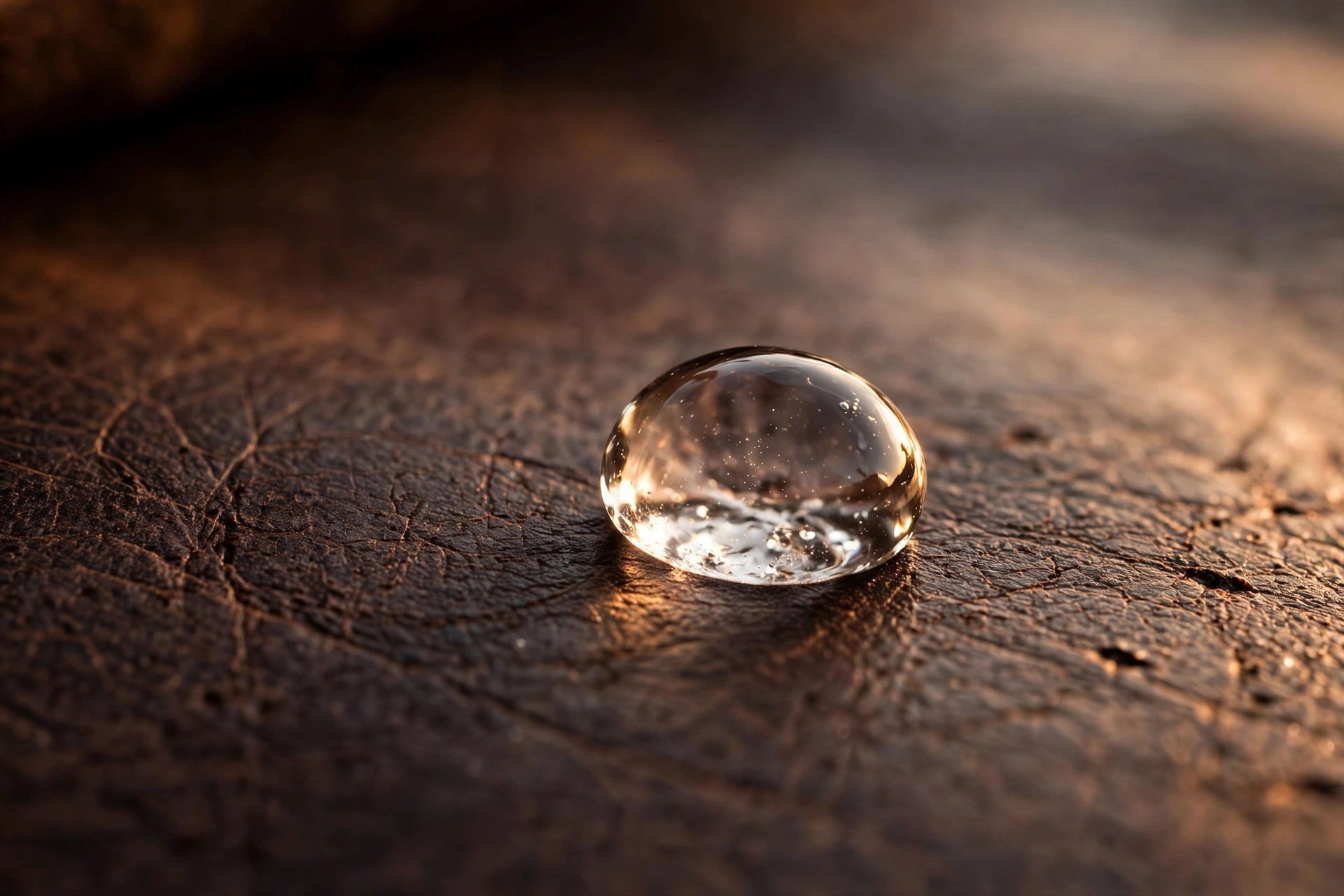
Place a tiny drop of water on an inconspicuous spot. On unfinished and aniline real leather, the drop darkens the surface and slowly absorbs. On most synthetics (and heavily pigmented leather) it beads and sits. Use judgment: this test cannot separate pigmented real leather from faux, and you should skip it on pale aniline goods in a store you plan to buy from.
Bend and Flex It
Bend the material and watch the surface. Real leather flexes like skin, changing tone slightly in the crease (the “pull-up” effect on waxy finishes) and recovering smoothly. Coatings tend to crease uniformly, and a stiff, boardy flex with a plasticky spring-back suggests PVC or a heavily coated split masquerading as top-grain — the grades guide explains that middle territory.
Label Terms: What They Mean and What They Don't
Sellers choose words carefully, so read them literally. “Full-grain,” “top-grain” and the hide names (calfskin, lambskin) are specific claims a seller must be able to back up. “Genuine leather” is a weak claim — as the grades guide details, it traditionally marks the lower grades, not quality. “Leather-look,” “leather-touch,” “man-made leather” and brand-coined words signal synthetics. And “bonded leather” or “reconstituted leather” means ground leather fiber in a binder — a real disclosure, and one to price accordingly. Apparel Search also maintains a page on leather labels and the markings used in the trade.
The FTC Rules in Plain Language
In the United States, the Federal Trade Commission's Guides for Select Leather and Imitation Leather Products (16 CFR Part 24) set the labeling ground rules. In substance:
- It is deceptive to misrepresent what a product is made of — including using the word “leather” for material that is not tanned animal hide.
- Products made from ground, shredded or bonded leather must disclose that fact; they may not be sold under the unqualified name “leather,” because the material does not have the durability and appearance of hide leather.
- Imitation leather may not be described with unqualified leather terms or embossed and labeled in ways that imply it is hide; terms like “leather-look” exist precisely to keep that line clear.
- Embossed grain, leather-scented finishes and pictures of hides in advertising do not change what the material is — composition claims must match the actual product.
The guides are enforcement guidance rather than a labeling statute, but reputable sellers follow them, and they give buyers a clear standard to hold a listing against.
Putting It Together
No single test is proof — scented synthetics, pigmented finishes and high-grade microfiber each defeat one check or another. Two or three tests in agreement, plus a label read literally, plus a price that makes sense for the claimed grade, will settle nearly every case you will meet. When a seller resists all inspection, that is information too. Once you know a piece is real, the Leather Care Guide keeps it that way for the long term.
More in the Leather Guide
Common Questions
Does real leather peel?
The hide itself does not peel — peeling in sheets is the signature failure of coated materials: PU faux leather, and bonded leather whose surface film separates from its fiber backing. A heavily pigmented or corrected real leather can eventually crack or wear through its finish, but it does not delaminate the way coatings do. If a 'leather' product is peeling, its working surface was a coating, not grain.
Is the burn test a reliable way to identify leather?
It is informative but destructive, so it belongs on swatches and samples, never on a product you might buy or keep. Real leather chars slowly, does not melt or shrink away from flame, and smells like burnt hair; synthetics melt, bead and give off a chemical or plastic smell. The non-destructive tests — pores, press, edges, water — settle most cases without a match.
Can faux leather smell like real leather?
Yes — some synthetic products are treated with leather-scented finishes, which is why smell is a supporting test, not a decisive one. New PU usually has a faint chemical or plasticky odor, while real leather has a rich, earthy hide smell; but scenting and age blur the line. Combine smell with the pore pattern and the press test before concluding.
Why did my leather sofa or jacket start cracking after a few years?
The most common cause is that the item is bonded leather or a coated split: the thin surface film flexes until it cracks and flakes, and because the 'leather' is mostly ground fiber and binder beneath, there is nothing sound to repair. Genuine top-grain and full-grain leather can dry and crack if never conditioned, but that cracking is in the surface fibers and responds to cleaning and conditioning, as the Leather Care Guide describes.
Back to the Leather Guide
The Leather Guide hub covers the whole material — grades, hides, tanning, alternatives, care and authenticity — with a map of every guide in this cluster.