A-Line Skirts
Fashion Influence — how style shapes, and is shaped by, the people who wear it
The A-line skirt is the silhouette named after a letter: narrow at the waist, widening in one clean slope to the hem. This guide covers the shape's naming in Christian Dior's 1950s collections, how it is cut — fitted waist, no gathers, the fullness built into the panels — and why it remains the default skirt shape that other styles are compared against.
A-Line Skirts
An A-line skirt is a skirt that fits at the natural waist and gradually widens toward the hem, so its outline resembles the capital letter A. Unlike a circle skirt, its fullness is modest and controlled; unlike a gathered or pleated skirt, the waist is smooth — the flare comes from the shape of the panels themselves, cut wider at the bottom than at the top, with darts at the waist doing the fitting. The result is a skirt that skims the hips and swings slightly as the wearer moves, and that covers the a-line skirt definition in garment form.
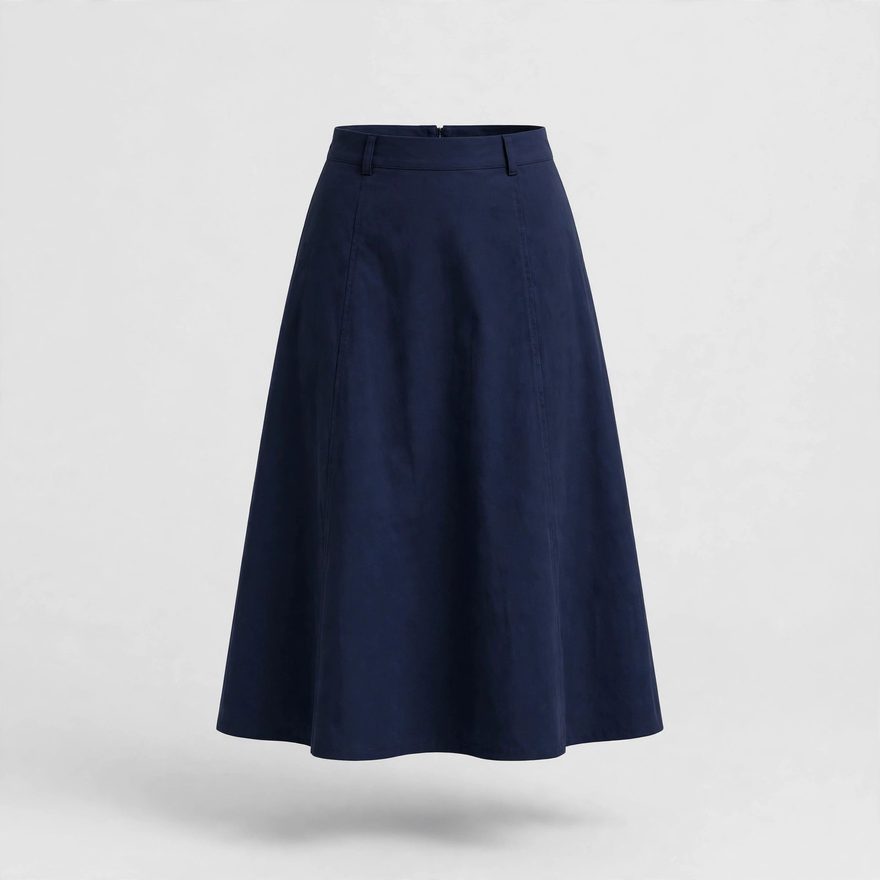
The term entered fashion with Christian Dior. His spring 1955 collection was built on the A-line — dresses and skirts widening from a fitted waist — following his H-line of 1954, in a sequence the fashion press covered as alphabet fashion. The shape itself was far older than the name; flared skirts are centuries old. But the A-line label fixed the silhouette in the modern vocabulary, and in 1958 Yves Saint Laurent, succeeding Dior, loosened the idea into the trapeze line. Through the 1960s the A-line became a standard skirt and dress shape, familiar from the a-line dress, and it has never really left the rails since.
An A-line skirt needs a fabric with some body. Cotton twill, denim, corduroy, wool blends, ponte and scuba hold the clean slope from waist to hem; very soft fabrics let it collapse, and very stiff ones turn it into a bell. Lengths run from mini to maxi, with knee and midi lengths the most common. Because the waist is fitted and the hem is free, the shape suits most figures — it defines the smallest point of the torso and passes over the hips without clinging — which is also why the A-line is the standard skirt shape for school and work uniforms.
Fashion Products Fashion Products A-F Fashion Products A
Return to the Influence Fashion home page.
A-Line, Circle and Pencil: The Shape Family
The A-line sits between its two neighbours. A circle skirt is cut from a ring of fabric and flares far more dramatically; a pencil skirt does not flare at all. The A-line's moderate flare is the compromise — movement without volume — and it is measured by eye rather than by pattern: if the hem is clearly wider than the hips but the skirt still hangs in a clean slope, it is an A-line. The skirts guide sets the shape among the other skirt types sold alongside it.
Styling the A-Line Skirt
The A-line's waist is its focal point, so tops are usually tucked in or cropped to meet it; a long untucked top erases the very line the cut creates. Fitted knits, shirts and short jackets keep the proportions the designer intended, while a fuller top turns the outfit into a contrast of volumes. Shoes follow length: flats and loafers for knee-length day versions, boots under midi A-lines in winter, heels when the same skirt is dressed up. Because the silhouette is simple, pattern and texture do the decorating — plaid, corduroy and denim A-lines are perennial versions.
Common Questions
What is an A-line skirt?
A skirt fitted at the waist that gradually widens toward the hem, forming the outline of the letter A. Its flare is cut into the panels, so the waist stays smooth with no gathers or pleats.
Where does the A-line name come from?
From Christian Dior's spring 1955 collection, which was built on silhouettes widening from a fitted waist and was reported as the A-line, following his H-line of the previous year.
What is the difference between an A-line skirt and a circle skirt?
Fullness and construction. A circle skirt is cut from a full or part circle of fabric and flares dramatically; an A-line is cut from shaped panels with a moderate flare, so it hangs closer and uses far less fabric.