Circle Skirt
Clothing Definitions — definitions of garments and clothing terms from Apparel Search
Search Apparel Search
At a Glance
Definition: A circle skirt is a skirt cut from a full or partial ring of fabric with the waist at the centre hole, so it hangs in deep, even folds and flares dramatically in motion, with no gathers, pleats or darts at the waist.
Category: Clothing Definitions
The circle skirt is the rare garment whose name is literally its pattern. Cut a ring of fabric, put the waist through the hole in the middle, sew on a waistband — and the ring does the rest, falling into deep, even folds that stand away from the legs and flare wide when the wearer turns. No gathers, no pleats, no darts: the shape is pure geometry. This page defines the full, half and quarter-circle family, and recalls the skirt's famous 1950s moment — the felt poodle skirt.
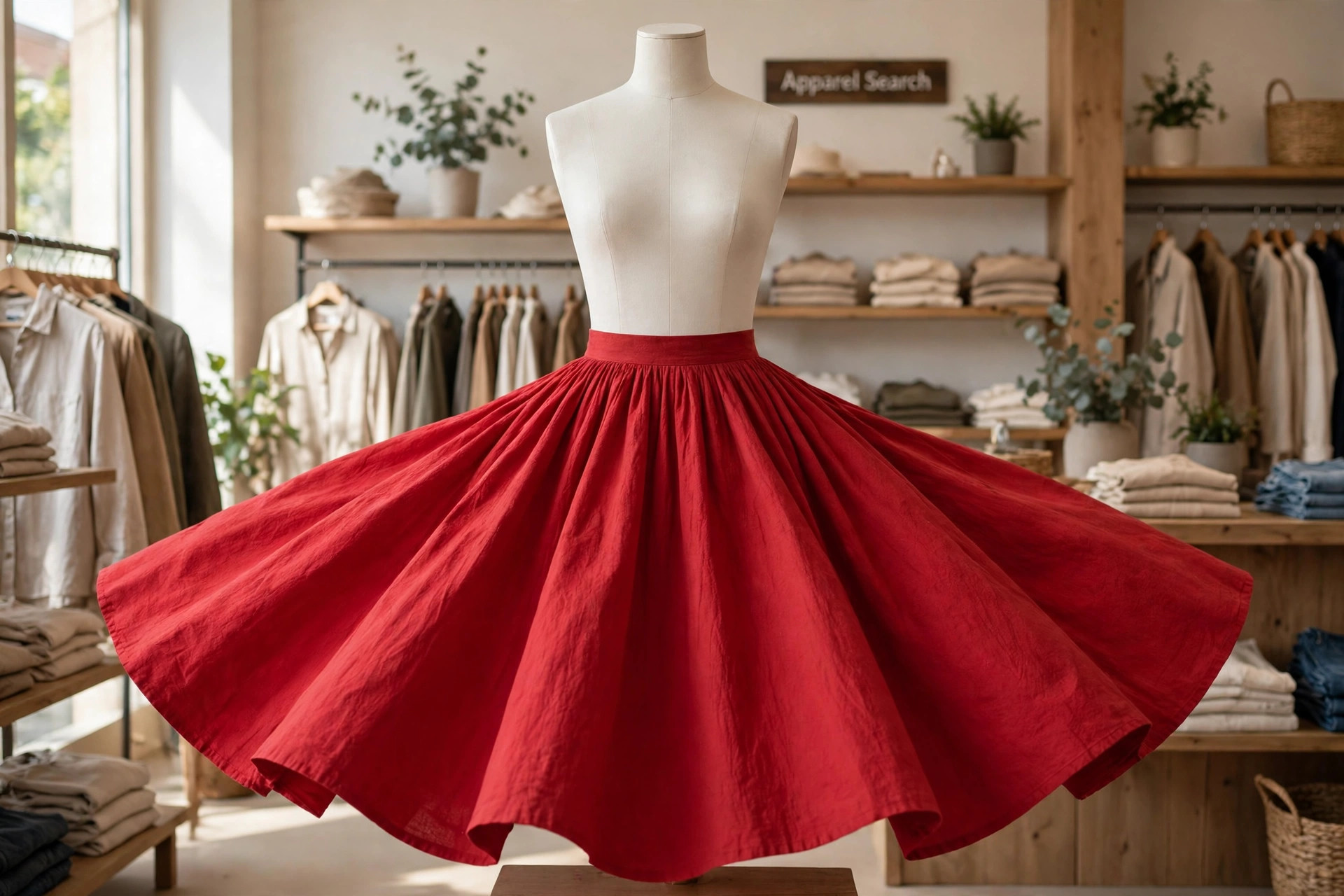
Cut from a Ring
A circle skirt is cut from a circle of fabric: the pattern is an annulus — a disc with a smaller circle removed at the centre for the waist — assembled from panels when the cloth is not wide enough to yield the whole ring in one piece. Because the waist edge and the hem are both curves of the same ring, the fabric falls in regular flutes all the way round, and the skirt flares dramatically when the wearer turns or dances.
Fitting is correspondingly simple. No darts, gathers or pleats are needed to take in the waist, because the waist is a cut edge, not a shaped one; a waistband and a side or back zip do the whole job. That simplicity is why the circle skirt is a classic first project in home sewing — and why it behaves so differently from a gathered skirt, whose fullness is bunched at the waist rather than distributed by the cut.
Full, Three-Quarter, Half and Quarter Circles
Circle skirts are graded by how much of the ring they use. A full circle skirt uses the complete ring and gives the maximum flare and the deepest folds — the skirt of dance, skating and 1950s photographs. A three-quarter circle and a half circle reduce the sweep in proportion, hanging closer to the body while keeping the even, seam-radiating folds; a quarter circle approaches an A-line in behaviour, though it is still cut on the curve.
One construction consequence follows from the geometry. Much of the hem is cut on the bias, and bias fabric stretches under its own weight — unevenly, since the bias direction rotates around the ring. A circle skirt is therefore left hanging for a day or more before its hem is levelled and finished, or the hem that was even on the table will not stay even on the body.
Felt, Poodles and the 1950s
The circle skirt's famous moment came just after the Second World War. In 1947, Juli Lynne Charlot, asked for a Christmas party skirt and no confident seamstress, cut one from a single piece of felt — felt needs no hemming — and appliquéd festive motifs onto it. Her themed felt skirts, the poodle skirt most famously, became an emblem of 1950s teenage dress.
The full effect depended on what went underneath. The circle was worn over stiff petticoats of the kind described in the crinoline entry, which held the ring out to its full width exactly as the hoop skirt had done a century earlier. Post-war fashion's return to full skirts after wartime fabric rationing made the extravagant sweep of the full circle — several yards of cloth in a single skirt — part of its appeal.
Wearing the Circle Skirt Today
The modern circle skirt is usually a half or three-quarter circle in cotton, jersey or printed synthetics, at knee or midi length, and it keeps the family behaviour: a smooth fitted waist, an even flare, and a hem that moves. Full circles survive in dance, skating and costume wear, and in formal skirts where the sweep is the point. Our clothes guide covers choosing and wearing them in its circle skirt guide.
Within the skirt family, the circle skirt is the fullness extreme: the pleated skirt achieves its flare with folded cloth released below the hip, the pencil skirt gives up flare altogether for a narrow line, and the wrap skirt closes by overlap rather than a zip. Choosing among them is choosing how the cloth is organised around the body — by ring, by fold, by cut, or by wrap.
Fabric choice decides how a given circle behaves. Stiff cottons and taffetas hold the ring out in sculptural folds; jerseys and fluid rayons collapse it into a swaying column that only flares in motion; felt, the original 1950s material, needs no hem at all. The waistband is the one engineered part — a straight band, sometimes elasticated at the back, carrying the whole weight of the sweep, which in a full circle of heavy fabric is considerable.
Not to Be Confused With
A circle skirt is often grouped with the A-line skirt, since both flare from the waist — but they are cut differently. An A-line is built from straight panels shaped by seams and darts, and its flare is moderate and fixed. A circle skirt is cut from a ring, has no waist shaping at all, and its flare increases with the fraction of the circle used, up to the full circle's dramatic sweep.
Common Questions
What is a circle skirt?
A skirt cut from a full or part circle of fabric with the waist at the centre hole, so it falls in even folds and flares wide in motion, with no gathers or pleats at the waist.
What is the difference between a full circle and a half circle skirt?
The amount of fabric in the ring. A full circle skirt uses a complete ring and flares most; a half circle uses half as much fabric in the sweep and hangs closer, though it still has the circle's even folds.
Why are circle skirts left hanging before they are hemmed?
Parts of the circular hem are cut on the bias, which stretches under the fabric's weight. Hanging the skirt for a day or more lets the bias drop so the final hem can be levelled evenly.