Culottes
Clothing Definitions — definitions of garments and clothing terms from Apparel Search
Search Apparel Search
At a Glance
Definition: Culottes are a divided skirt: a garment with two separate legs cut so full that it hangs and looks like a skirt while allowing the freedom of trousers.
Also known as: Split skirt; divided skirt
Pronunciation: koo-LOTS
Category: Clothing Definitions
Word Origin
Culottes is the plural of French culotte, the knee-breeches worn by men of the eighteenth century, from cul, the seat. The breeches gave revolutionary history its most famous clothing label — the sans-culottes, “those without knee-breeches,” of 1789 — before the word passed to the divided skirt that borrowed the breeches’ two-legged construction.
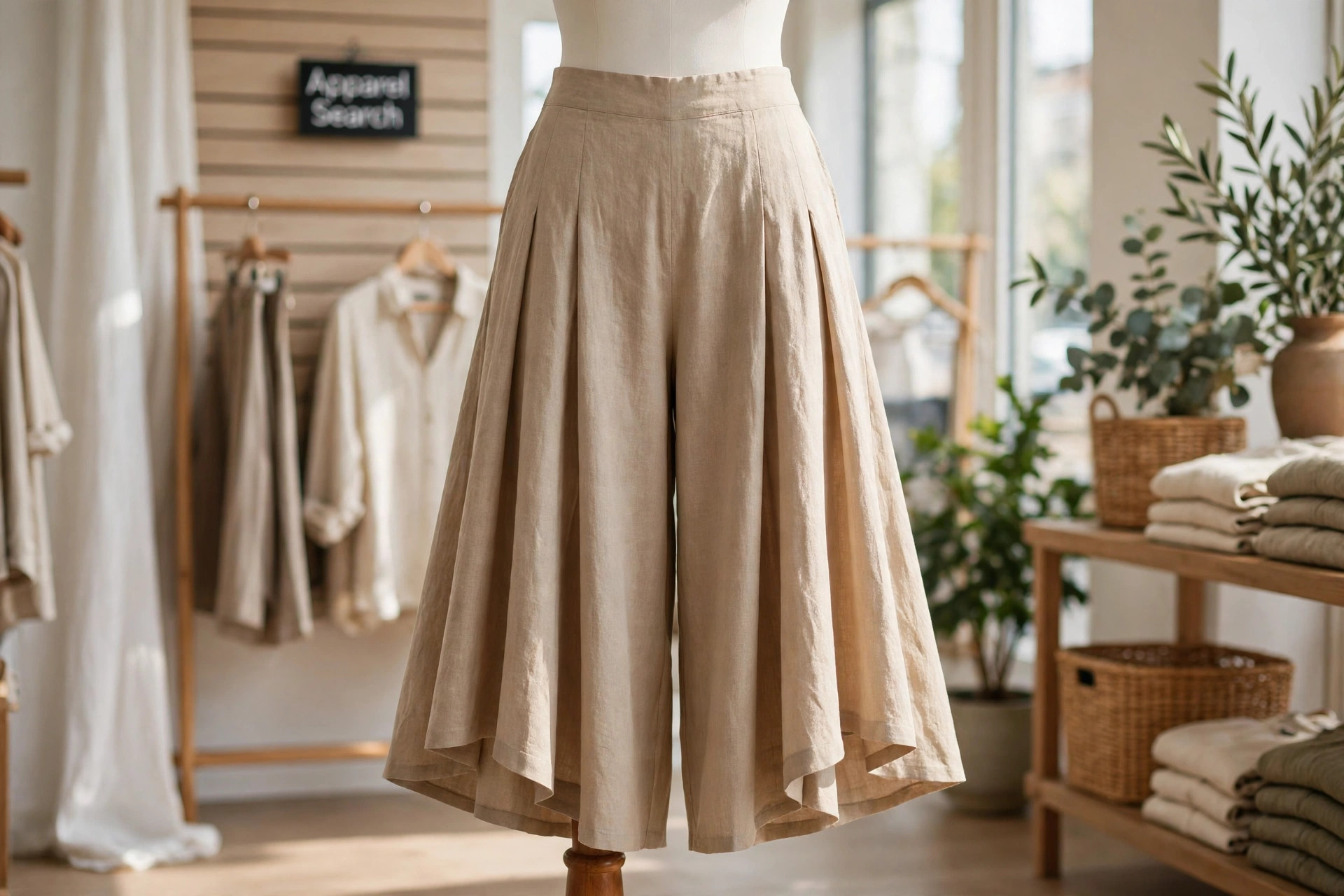
Culottes are a divided skirt — a garment built like trousers, with a separate leg for each of the wearer’s legs, but cut so much fuller at the hem than at the waist that, worn, it reads as a skirt. That double nature is the whole point of the garment: it was developed so the wearer could garden, clean, ride a bicycle and move freely while still presenting the accepted silhouette of a skirt. This page explains the divided construction, the lengths and fabrics culottes are made in, their history from men’s knee-breeches through dress reform to the modern cropped wide leg, and how they differ from the skort they are so often confused with. A fuller terminology treatment, covering all three senses of the word, is in our Fashion Terms section: Culottes — Fashion Terms.
The Divided Construction
Everything about culottes follows from one cutting decision: the legs are made wide enough that their inner seams disappear into folds. At the waist and hip a pair of culottes is fitted like trousers, with a waistband, closure and often pleats or darts; below the hip each leg flares — through pleats released at the front, through sheer width of cloth, or both — until the hem circumference of each leg rivals a skirt’s. Standing still, the two legs hang together and the eye reads one continuous A-line or full skirt shape; walking, climbing or cycling, the legs separate and do the work of trousers. Garments sold as culottes that are merely short, slightly wide trousers fail the test the definition sets: to truly be culottes, the garment must look like a skirt.
Lengths have settled into a modern range. Classic culottes ended below the knee; today’s standard is a cropped wide leg ending anywhere from below the knee to the ankle, with shorter, shorts-length versions at the casual end. Fabrics need drape enough to fall in skirt-like folds — crepe, viscose, linen and soft denim are common — though tailored wool and cotton culottes work as office dress precisely because the divided construction passes, at a glance, for a skirt. The width is both the point and the fitting challenge: the leg should fall straight from the hip without clinging, so fullness comes from the cut, not from stretch.

From Knee-Breeches to Dress Reform
The word arrived in women’s fashion with a long history already attached. The original culotte was the knee-breech of eighteenth-century men’s dress, and the garment carries one of history’s most famous fashion-political labels: the Parisian working men of 1789 who rejected the aristocrat’s silk knee-breeches for long trousers were dubbed the sans-culottes, “without culottes.” The divided skirt took the name in the nineteenth century, when rational-dress campaigners promoted bifurcated garments for women who rode, cycled, gardened and worked. The divided skirt let its wearer do all of those things while keeping the outward form the period demanded — a compromise garment, engineered as much socially as sartorially, and an ancestor of every later argument that women’s clothing should permit an active life.
Wearing Culottes
Styling follows the volume. A fitted or tucked-in top balances the wide leg and keeps the waist — the garment’s one fitted point — visible; a loose top over loose culottes loses the shape entirely. Footwear is chosen against the hem length: a heel lengthens the leg under a mid-calf hem, a clean flat keeps the look relaxed, and a heavy shoe can shorten the leg visually. Because the legs divide only in movement, culottes behave like a skirt in wind and on stairs and like trousers on a bicycle or a ladder, which remains their practical charm more than a century after the reformers. Care follows the fabric, with one note: press the pleats or front creases as cut, since the skirt illusion depends on the folds falling where the pattern put them.
The style has revived in waves — as a 1970s wardrobe staple, and again in the 2010s when the cropped wide leg became a standard trouser alternative — because it solves a recurring problem: the polish of a skirt with the ease of trousers, in a single garment that needs no layering or adjustment through the day. Each revival keeps the same test the reformers set: standing still, it must read as a skirt.
Not to Be Confused With
The words overlap in shops, but the construction differs. A skort is a skirt — or shorts with a skirt panel — with a separate pair of shorts built in or visible beneath, and it is usually short. Culottes are a single divided garment: there is no skirt and no separate shorts, only two very wide legs whose fullness creates the skirt-like effect, and they are often knee-length or longer. Our product guide to skorts shows the skort side of the line.
Common Questions
What are culottes?
Culottes are a divided skirt: a garment with separate legs like trousers, but cut much fuller at the bottom hem than at the waist so that it looks like a skirt when worn. They are also known as a split skirt or divided skirt.
Why were culottes developed?
Culottes were developed to provide more freedom to do activities such as gardening, cleaning and bike riding, while still looking like the wearer is wearing a skirt. The divided leg gives the movement of trousers under the appearance of a skirt.
How do culottes differ from a skort?
The words overlap, and culottes have also been called skorts. In stricter use, a skort is a skirt with a pair of shorts visible or built in beneath it, usually short, while culottes are a single divided garment, fuller and often longer, whose own wide legs create the skirt-like effect.