Wrap Skirt
Clothing Definitions — definitions of garments and clothing terms from Apparel Search
Search Apparel Search
At a Glance
Definition: A wrap skirt is a skirt constructed from a single shaped panel that wraps around the waist, the front edge overlapping the back, and is secured by ties, buttons or a buckle rather than a fixed waistband and zip.
Category: Clothing Definitions
A wrap skirt is a skirt made by wrapping: a flat, shaped piece of fabric passes around the body, overlaps at the front or side, and fastens at the waist with ties, buttons or a buckle rather than a fixed waistband and zip. Because the closure is the overlap itself, the skirt opens out flat when untied, and its fit is adjustable across a range of waist sizes. This page defines the wrap skirt, distinguishes the true wrap from the sewn faux wrap, and places it in the world family of wrapped waist garments that includes the sarong.
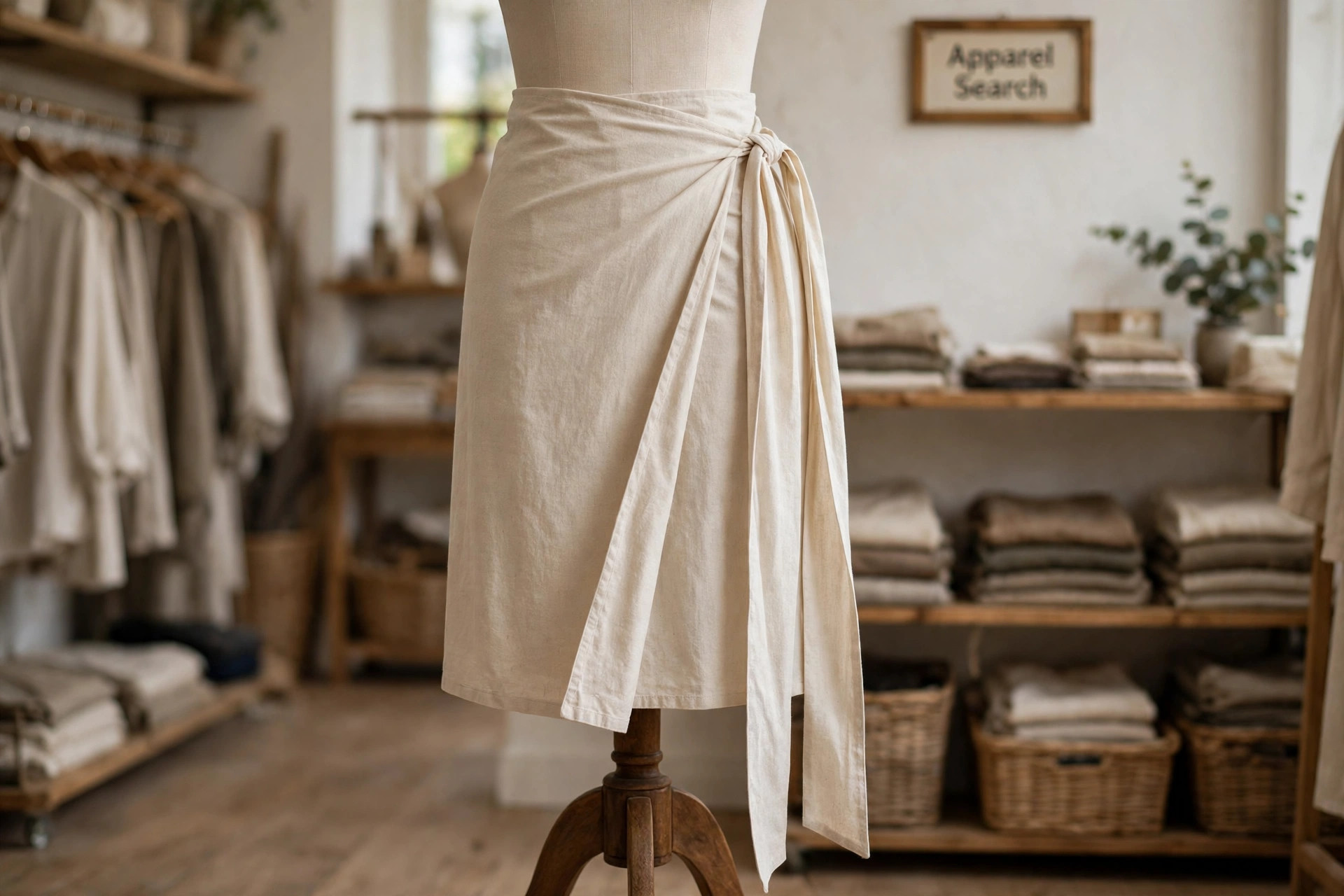
True Wrap and Faux Wrap
A true wrap skirt depends entirely on its fastening. Ties are the commonest, sometimes with an inside button or hook to anchor the under-layer before the outer panel is tied over it. The wrap construction is applied across skirt shapes — straight pencil wraps, pleated wraps and full circle wraps all exist — because the closure is independent of the silhouette: the panel is cut to the shape wanted, and the wrapping does the rest.
A faux wrap skirt imitates the diagonal wrapped front but is sewn shut and closes with a zip, hook or elastic like an ordinary skirt. The two are easy to tell apart: check whether the front panel can actually be unwrapped. True wraps are standard for beach cover-ups, dance skirts — the rehearsal wrap worn over a ballerina skirt outfit is the familiar example — and casual summer wear; faux wraps are used where the wrap look is wanted with the security of a fixed garment, such as office clothing. The related wrap dress applies the same closure to a whole dress.
Lengths and fabrics follow the use. Short, light cotton wraps serve as beach cover-ups over swimwear; longer, lined wraps in wool or crepe serve as ordinary day skirts; and the dance wrap — a brief crossover skirt tied over practice clothes — is cut for movement and removed in seconds. In every case the pattern is one panel and the sizing is a range rather than a number, which is why wrap skirts are also a staple of one-size and adjustable-fit ranges.
The Wrapped-Garment Family
The wrap skirt belongs to the oldest and most widespread family of garments: wrapped cloth held at the waist. Its relatives include the sarong of Southeast Asia, the Pacific pareo, and the overlapping front aprons of the kilt. What distinguishes the wrap skirt from the sarong is finish: the wrap skirt is cut to a skirt's shape — narrower at the waist, wider at the hem, with the curve built into the panel — and is hemmed, faced and sometimes lined, where the sarong is an unshaped rectangle tied as it is.
The family resemblance is construction, not geography. A wrapped garment needs no pattern pieces, no darts and no sized waistband, which is why wrapped waist garments arose independently wherever cloth was woven in lengths. The wrap skirt is the tailored member of that family — the point where the ancient wrapped rectangle acquires a cut, a hem and a place in a modern wardrobe, alongside divided wrapped relatives such as culottes.
Overlap and Security
The working measure of a wrap skirt is its overlap: the distance the outer panel crosses past the body's centre front. An overlap of a third of the waist measurement or more keeps the skirt closed while walking and sitting; less than that gapes. Makers manage this with a small button or slot at the side seam through which one tie passes, fixing the under-layer independently.
In wind, a wrap skirt worn with the overlap against the prevailing side is the traditional answer — the construction that makes the skirt adjustable is the same one that makes its security the wearer's business. That trade is the garment's character: one panel, no fixed sizing, complete adjustability, in exchange for a closure the wearer checks rather than forgets. The product treatment is in the Fashion Influence guide to wrap skirts.
Makers therefore grade a wrap skirt by its overlap before anything else, and experienced wearers check it the same way: sit, stride and bend in the tied skirt before trusting it. A generous overlap, an anchored under-layer and ties long enough to knot securely are the whole technology — simple parts, honestly arranged, which is exactly what a garment descended from the world's oldest way of wearing cloth ought to offer.
Not to Be Confused With
Relatives, not synonyms. The wrap skirt is a cut garment: a shaped panel — narrower at the waist, wider at the hem — hemmed, faced and sometimes lined, which wraps and ties at the waist. The sarong is the unshaped original: a plain rectangle of cloth, wrapped and tied as it comes off the loom, with no cutting to a skirt's shape. Every wrap skirt is wrapped cloth, but only the cut, finished version is a wrap skirt; the rectangle stays a sarong.
Common Questions
What is a wrap skirt?
A wrap skirt is a skirt made from a shaped panel of fabric that wraps around the body and fastens at the waist, usually with ties, so the garment opens flat and adjusts to fit.
What is a faux wrap skirt?
A faux wrap skirt is a skirt sewn closed with a conventional fastening that imitates the diagonal front of a wrap skirt without actually unwrapping.
How is a wrap skirt related to a sarong?
Both are cloth wrapped and tied at the waist. The sarong is an unshaped rectangle; the wrap skirt is cut to shape, hemmed and finished as a garment.