Pleated Skirt
Clothing Definitions — definitions of garments and clothing terms from Apparel Search
Search Apparel Search
At a Glance
Definition: A pleated skirt is a skirt whose fabric is folded into regular pleats that lie flat at the waist or hip and release their fullness toward the hem.
Category: Clothing Definitions
Word Origin
Pleat is a variant of plait, from Old French plait, a fold, ultimately from Latin plicare, to fold — a pleat is a fold that has been given a permanent place in the garment.
A pleated skirt is a skirt built from folds. The fabric is arranged in pleats — regular folds that are pressed flat, held by stitching for part of their length, or left free to open — so that the skirt sits smooth at the waist and swings wide at the hem. This page defines the pleated skirt and its main pleat types, knife, box, accordion and sunburst, and traces the style from Mariano Fortuny's permanently pleated silk to the school uniform and the tennis court.
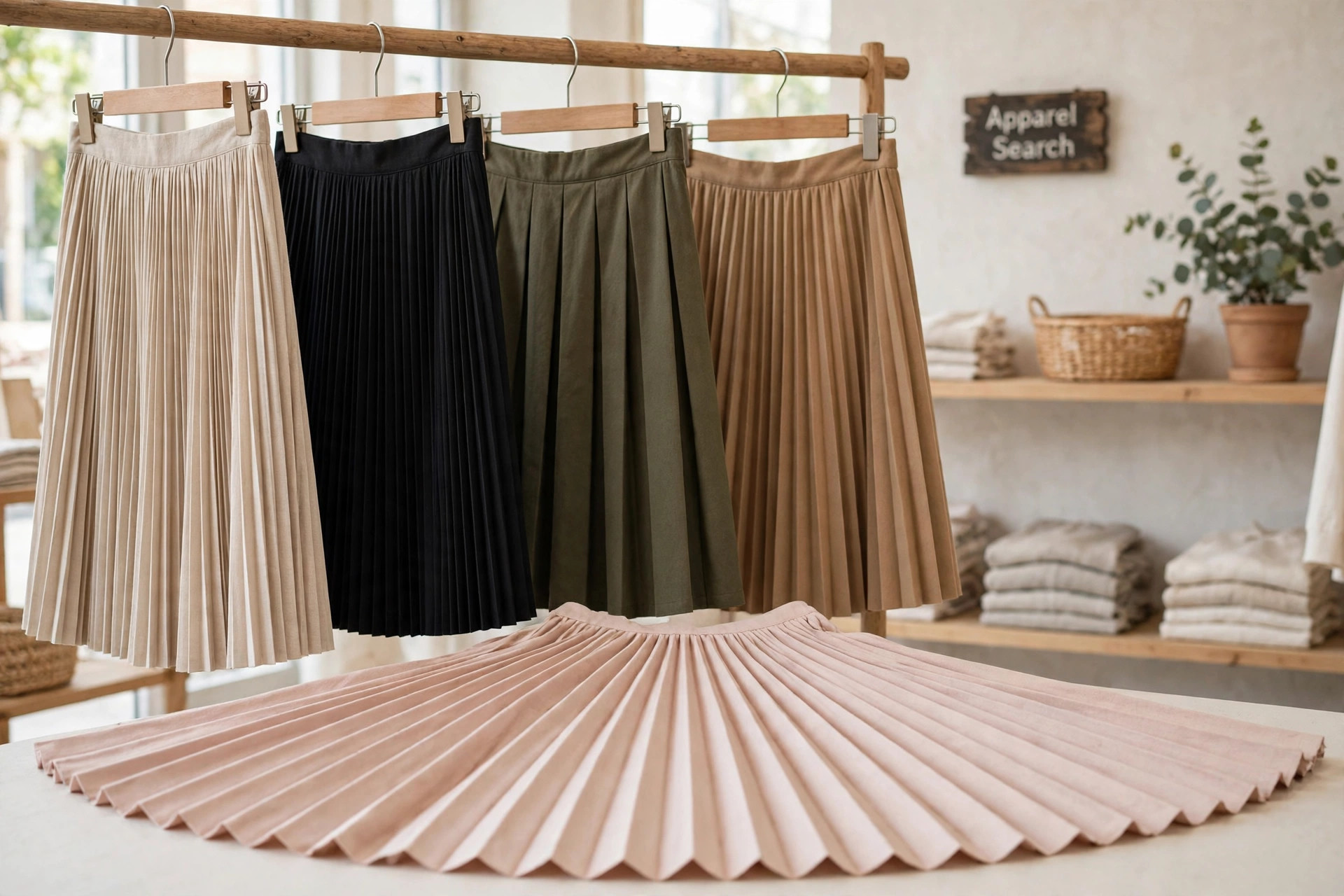
How Pleats Control Fullness
Pleating solves the skirt-maker's basic problem: a wide hem needs more fabric than a narrow waist can take. The extra cloth is folded away at the top, where the pleats lie flat against the body, and let out lower down, where the folds open as the skirt moves. The result is a garment that is neat standing still and generous in motion, and the folds give it a characteristic striped play of light and shade — the same fluted effect seen at large scale in the fluted skirts of the hoop skirt era.
How much of each fold is controlled decides the skirt's behaviour. Pleats may be stitched down through the hip and released below, which keeps the top of the skirt smooth on the body while the lower half moves freely — the standard construction of school and uniform skirts. Or they may be left unstitched from the waist, for a softer, more fluid fall. At rest the folds lie closed and the skirt reads as a neat column of stripes; walking, the pleats open like a fan and the hem swings wide.
The Main Pleat Types
The pleat types have standard names. In a knife-pleated skirt every fold faces the same direction, one overlapping the next like the blades of a closing fan. Box pleats are formed in pairs that fold away from each other, making a flat, raised ridge on the surface. Inverted pleats do the opposite, folding toward each other so the fold is hidden inside. Accordion pleats are narrow, sharp and evenly spaced for the skirt's full length. Sunburst pleats radiate from the waist — narrow at the top, widening toward the hem — following the flare of the circle skirt they are usually cut into.
Whether the folds last is a question of fibre and heat. Pleats in heat-set synthetic fabrics are set during manufacture and hold permanently through washing. Pleats in wool and silk are pressed in, and they soften gradually with wear; keeping them sharp means re-pressing along the original folds.
Fortuny, Uniforms and Fashion Waves
Fine permanent pleating in silk was made famous by Mariano Fortuny, whose Delphos gown of 1909 used a pleating process that has never been fully replicated — the folds were set so finely, and held so well, that the gowns could be stored twisted in small boxes and worn without pressing. In the twentieth century the pleated skirt also became institutional dress: it is the pleated back of the kilt, the standard school uniform skirt, and the short pleated skirt of cheerleading and tennis, where the folds give the freedom of movement those activities need.
Fashion itself revives the pleated skirt in waves, from the pleated day dresses of the 1940s through successive revivals to the metallic pleated midi skirts of the 2010s. Each return changes the length, the fabric and the pleat, but not the mechanism: folds that behave at the waist and perform at the hem. The miniskirt era took the school and tennis pleats short; longer revivals have taken them to midi and ankle length in satin, lamé and printed cloth.
Pleats in Wear and Care
Care decides how long the effect lasts. A heat-set polyester pleated skirt can generally be washed and hung dry without pressing. Wool and silk pleats need their folds respected: gentle washing or dry cleaning as the label directs, and re-pressing fold by fold when the creases soften. A pleated skirt is stored hanging by its waistband, never folded in a drawer, since a cross-fold pressed into the pleats by storage is the hardest mark to remove. Worn with those small attentions, a pleated skirt keeps the double character that defines it — a column at rest, a fan in motion. That double character is also why the style suits so many lengths: the same folds that give a tennis skirt its flare give a midi skirt its swing, and the construction changes far less between the two than the hemlines suggest.
Common Questions
What is a pleated skirt?
A pleated skirt is a skirt whose fabric is folded into regular pleats. The folds lie flat at the waist or hip and release fullness toward the hem, giving the skirt movement and a striped play of light across the folds.
What are the main types of pleats used in skirts?
Knife pleats, with all folds facing one way; box pleats, folding away from each other in pairs; inverted pleats, folding toward each other; accordion pleats, narrow and sharp throughout; and sunburst pleats, radiating from the waist and widening toward the hem.
Do pleats stay in permanently?
In heat-set synthetic fabrics, yes — the folds are set during manufacture and survive washing. In natural fibres such as wool and silk the pleats are pressed in and gradually soften with wear and washing unless they are re-pressed along the original folds.