Pencil Skirt
Clothing Definitions — definitions of garments and clothing terms from Apparel Search
Search Apparel Search
At a Glance
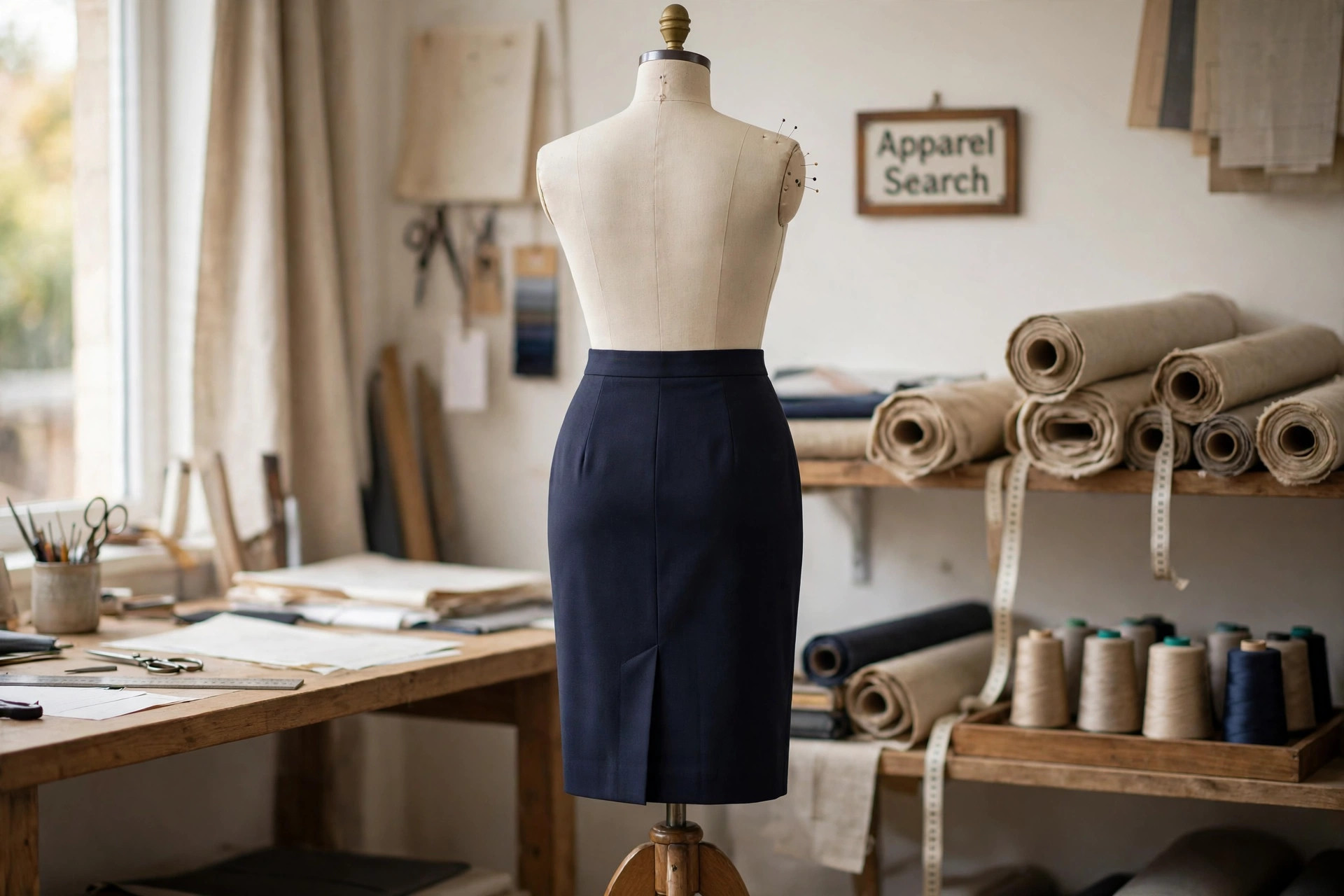
Definition: A pencil skirt is a straight, narrow skirt that follows the contours of the waist, hips and thighs without flare and usually ends at or just below the knee, shaped with darts and finished with a back vent or kick pleat for walking.
Category: Clothing Definitions
A pencil skirt is the tailored skirt reduced to a single line: straight and narrow from waist to hem, following the body through the waist, hips and thighs with no flare, gathers or pleats anywhere. The name compares the silhouette — long and slim — to a pencil. Most pencil skirts end at or just below the knee, and the style has been the standard skirt of the tailored suit since the 1950s. This page explains the construction that makes so narrow a skirt wearable, the restrictive ancestor it descends from, and the knit and denim versions that loosened the original.
Construction: Darts, and the Walking Problem
The close fit is made with darts, not with flare. Darts at the back waist, and often at the front, take in the difference between hip and waist measure so the fabric follows the body in one smooth line, and a centre-back seam carries the closure, usually a zip. There is no spare cloth anywhere in the pattern: the hem is no wider than the hips.
That creates the pencil skirt's defining construction problem — walking. A hem as narrow as the hips leaves no room for a stride, so the standard solution is an opening at the back: a vent, an overlapped slit in the centre-back seam typically 15 to 25 centimetres long, or a kick pleat, an inverted pleat let into the back seam. Both open as the leg moves and lie flat when the wearer stands. A woven pencil skirt with neither feature is either cut with stretch in the fabric or is not meant for walking far.
From Hobble Skirt to the 1950s Suit
The pencil skirt descends from the hobble skirt of around 1910, which narrowed toward the ankle and genuinely restricted its wearers' movement. The modern, practical form arrived after the Second World War: Christian Dior's New Look of 1947 matched fitted jackets with slim, below-knee skirts, and the pencil skirt became the standard skirt of the 1950s suit — the skirt counterpart of the suit itself. It has remained the default tailored skirt ever since, its exact tightness adjusted by each decade's taste, and it stands at the opposite pole of skirt design from full, flared shapes such as the circle skirt: where those add cloth for movement and swing, the pencil skirt removes it and solves movement with a vent instead.
Fabrics, Lining and Lengths
The tailored original is a lined garment. Suiting wools, wool blends and firm cotton weaves hold the straight line; a lining lets the skirt slide over the hips and keeps the outer cloth from seating or bagging at the back, and the vent is cut through both layers so it opens cleanly. Unlined summer versions in linen or cotton exist, but they crease where the lined wool version does not, which is why the lined construction remains the standard the definition assumes.
Length is the style's main variable. The classic pencil skirt ends at or just below the knee; shorter versions keep the same darts-and-vent construction at mid-thigh lengths, in the territory of the miniskirt, and longer midi versions extend the line to mid-calf, where the vent becomes more necessary, not less. What does not vary is the rule of the cut: no flare, no gathers, no pleats at the waist — the moment flare is added the skirt has become a different style, however slim it looks. Worn with its matching jacket it completes the suit; worn separately it is the standard tailored skirt of office and formal day dress, paired with blouses, knitwear and shirts on the same terms as tailored trousers.
Knit and Denim Variants
Two modern variants loosen the tailored original while keeping its line. Knit pencil skirts in ponte, scuba or heavy jersey rely on elastane rather than darts for their fit, drop the lining and usually the vent, and are worn as casual clothing. Denim pencil skirts are built like jeans — fly front, five pockets, topstitching — in the same denim used for jeans; the short denim skirts of the early 1980s were typically pencil-shaped. Both variants keep the definition's essentials: a straight, close line from waist to hem, and no flare. The product side of the style is covered in the Fashion Influence guide to pencil skirts, and its closest length relative is the miniskirt, which keeps a similarly straight cut at a much shorter length.
Not to Be Confused With
Ancestor and descendant, often mixed up in costume writing. The hobble skirt (around 1910) narrowed all the way to the ankle and genuinely hobbled its wearer — there was no construction answer to walking in it. The pencil skirt stops at or below the knee and solves the same problem properly, with a back vent or kick pleat that opens with each stride. Same straight line, opposite practicality.
Common Questions
What is a pencil skirt?
A pencil skirt is a straight, narrow skirt, usually knee-length, that follows the line of the waist, hips and thighs without flare, gathers or pleats. It is named for its long, slim silhouette, and is shaped with darts at the waist.
Why does a pencil skirt have a vent?
The hem is as narrow as the hips, so a vent, slit or kick pleat at the back is needed to allow a normal walking stride. The opening spreads as the leg moves and lies flat when the wearer stands.
How does a pencil skirt differ from a hobble skirt?
The hobble skirt of around 1910 narrowed to the ankle and genuinely restricted movement. The pencil skirt stops at the knee and adds a back vent or kick pleat, which makes the close fit practical to walk in.