Women's Circle Skirt Guide
Cut from a literal circle of cloth with the waist at its centre — the circle skirt falls in perfect ripples and spins into a full disc.
Shop Women's Circle Skirts Now
Shop Women's Circle Skirts on Amazon Shop Women's Circle Skirts on eBayThe Amazon and eBay links on this page are affiliate links. If you make a purchase through them, Apparel Search may earn a commission.
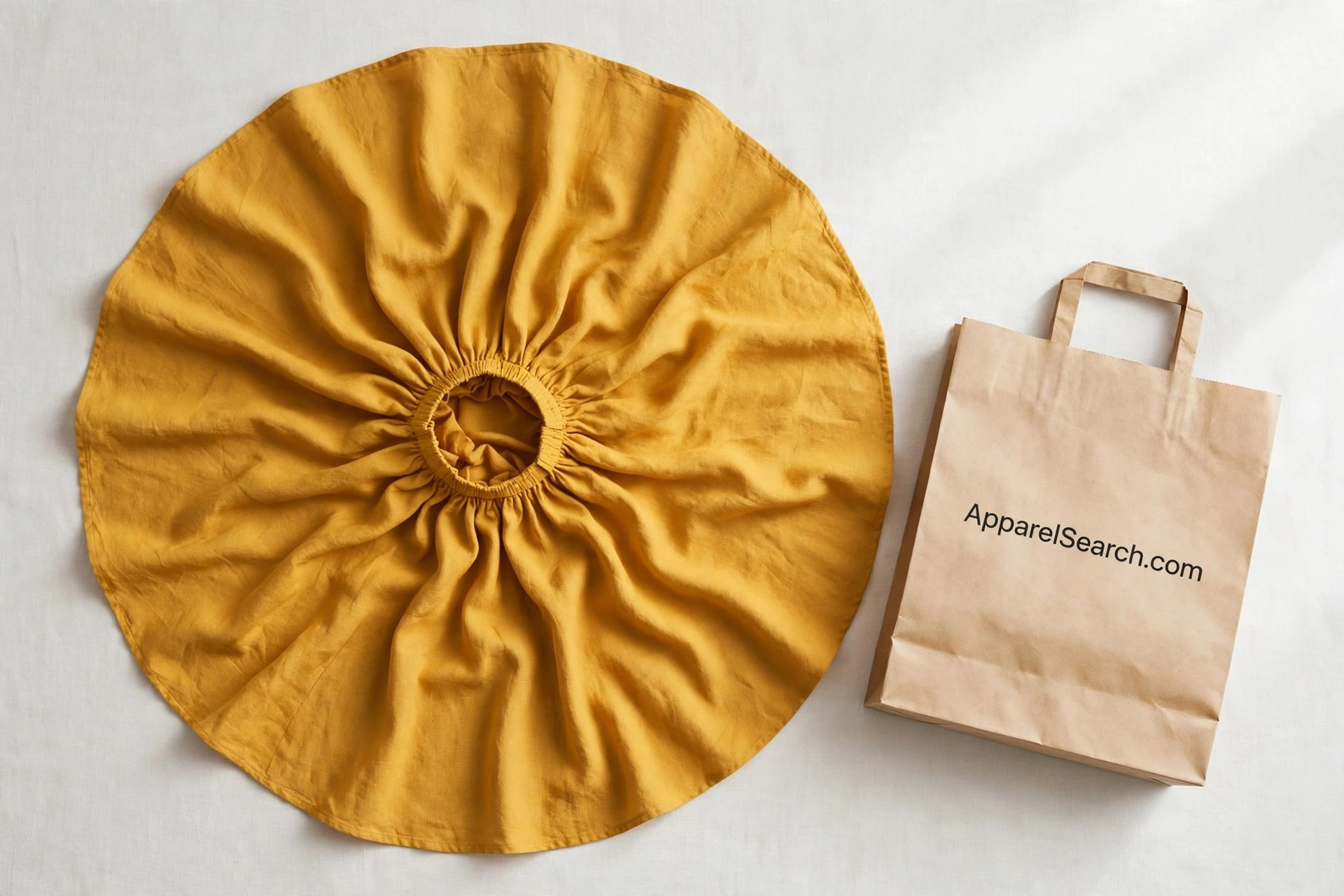
A circle skirt is geometry you can wear: a ring of fabric cut as a true circle — full, half or quarter — with a small circular opening at the centre for the waist. Because the fabric's grain runs in every direction around the ring, the skirt falls in deep, even ripples, clings nowhere, and when you spin, lifts into the flat disc that made it the defining skirt of the 1950s. It is the skirt half of the skater dress and the swing dress, sold on its own.
Its famous decade gave it the poodle skirt — a felt circle appliquéd with a poodle, a novelty that started as a 1947 Juli Lynne Charlot design and became the teenage uniform of the rock-and-roll years. Felt was the practical choice: it needed no hemming and held the circle's flare stiffly. Modern circle skirts return in every fabric from scuba to chiffon, at every fullness, but the cut — and the twirl — are unchanged.
Full, Half and Quarter: Reading the Circle
Fullness is a fraction of the circle. A full circle uses the complete ring: maximum ripple, maximum twirl, several metres of fabric, and a hem that can measure over five metres around. A half circle keeps the even fall with half the drama and half the fabric — the everyday favourite. A quarter circle (sometimes called a flare or A-line circle) ripples gently and reads close to an A-line skirt. Lay any candidate flat and fan it: the angle the skirt spreads from the waistband tells you its fraction instantly.
Because the grain spirals, a circle skirt is cut with few or no side seams and its hem hangs unevenly until the fabric relaxes — the bias sections stretch. Quality makers let circle skirts hang for a day or two before levelling the hem; a skirt whose hem waves up and down unevenly after wear was probably hemmed too soon. Check the hem level in a mirror after the first wears, and expect a tailor's levelling to be a normal, cheap fix rather than a defect.
Who It Flatters, and the Waistband Rule
The circle skirt's contract is a marked waist and a free hip. It suits an hourglass shape by underlining exactly that contract, creates a waist-and-hip contrast on a rectangle shape, and passes over pear hips without measuring them — the flare starts at the waist, above the hip entirely. Our body-shape guide treats it as the benchmark flared skirt against which others are compared.
The waistband carries the whole garment, so it carries rules: it should sit at the natural waist, close flat without a belt doing structural work, and be firm enough not to rotate as the skirt's weight swings — a circle skirt is heavy, and a weak waistband will slowly turn the skirt on the body through the day. Interfaced or elastic-backed waistbands, or a wide belt worn as reinforcement, are the honest solutions. If the waistband turns, the skirt is asking for one.
Lengths, Petticoats and Styling
Length rewrites the skirt's character. Above the knee it is the skater's skirt — young, sporty, worn with trainers and tees. At the knee and below it becomes the 1950s classic, and at midi and tea lengths, in lace, tulle or satin, it is a genuine occasion garment and a popular bridesmaid formula with a fitted separate top. Long circle skirts need their fabric light; a full-circle maxi in heavy cloth is a workout to wear.
A petticoat underneath is the vintage option — it domes the skirt and displays the flare standing still — while modern styling lets the ripples speak alone with a tucked fitted top: a slim knit, a bodysuit, a cropped cardigan. The top must tuck or end at the waist; anything hanging over the waistband hides the skirt's one fitted point. Shoes follow length: flats and trainers short, heels long. Store circle skirts folded or hung by waistband loops, never crushed — the ripples steam back, but the waistband should not have to be rescued.
Common Questions
What is a circle skirt?
A skirt cut as a ring of fabric — a full, half or quarter circle — with the waist as a small circular opening at the centre. The all-direction grain makes it fall in even ripples and flare into a disc when you spin. It defined 1950s dressing (including the felt poodle skirt) and survives today at every length and fullness.
What is the difference between a full circle and a half circle skirt?
How much of the ring the skirt uses. A full circle skirt is the complete ring: the most ripples, flare and fabric, and a hem that can exceed five metres. A half circle uses half the ring — the same even fall with less volume and weight, making it the practical everyday version. A quarter circle ripples gently, close to an A-line.
Do circle skirts need a petticoat?
No — a petticoat is a styling choice, not a requirement. It domes the skirt into the full 1950s silhouette and shows the flare even standing still, which vintage and dance wearers love. Worn without one, a circle skirt still ripples and moves beautifully; most modern versions are designed to be worn petticoat-free.
Dress & Skirt Silhouette Guides
Every dress and skirt silhouette guide in this cluster — the new guides plus the classic silhouettes already on Apparel Search — in alphabetical order:
- Women's Asymmetric Skirt
- Women's Bubble Dress
- Women's Cold Shoulder Dress
- Women's Column Dress
- Women's Empire Dress
- Women's Fit and Flare Dress
- Women's Prairie Dress
- Women's Prairie Skirt
- Women's Sheath Dress
- Women's Shift Dress
- Women's Skater Dress
- Women's Slip Dress
- Women's Surplice Dress
- Women's Swing Dress
- Women's Tea Length Dress
- Women's Tent Dress
- Women's Tiered Dress
- Women's Tiered Skirt
- Women's Tulip Skirt
- Women's Wrap Dress
- Women's Wrap Skirt
More to Explore on Apparel Search
Looking for Women's Clothing Stores?
This guide helps you choose women's circle skirts. To browse where to buy, visit our womens clothing store directory, where you can find retailers that carry them.