Women's Shift Dress Guide
A shift dress hangs straight from the shoulders with no waist definition — the simplest dress silhouette, and the opposite engineering of a sheath.
Shop Women's Shift Dresses Now
Shop Women's Shift Dresses on Amazon Shop Women's Shift Dresses on eBayThe Amazon and eBay links on this page are affiliate links. If you make a purchase through them, Apparel Search may earn a commission.
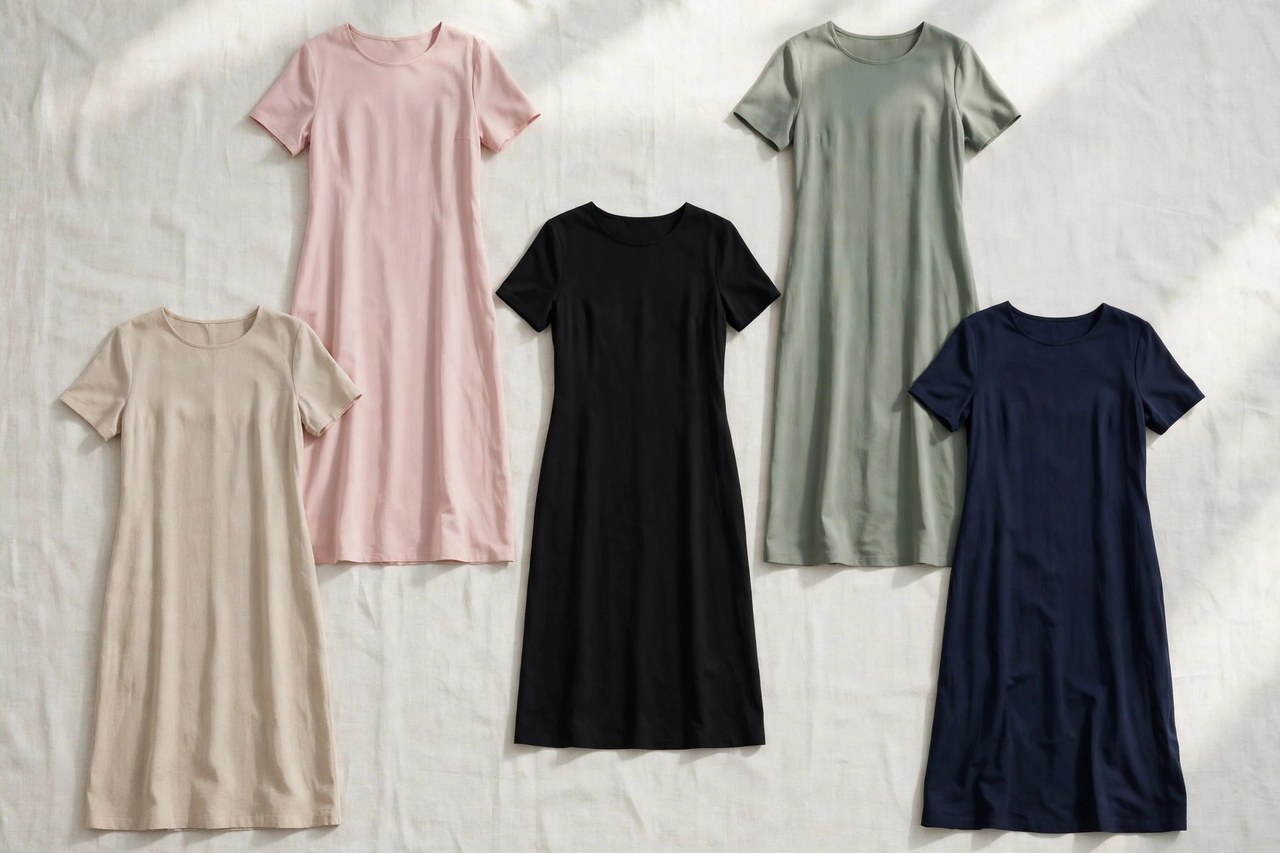
A shift dress is a short to knee-length dress that hangs straight from the shoulders, with clean lines and no defined waist, shaped, if at all, only by bust darts. The shift is best understood against its near neighbor: a sheath follows the waist, a shift deliberately ignores it, falling in one unbroken column that moves independently of the body inside it.
That single decision — no waist — drives everything else about the garment: which fabrics it needs, which bodies it flatters, how it is styled, and why it returns to fashion whenever ease becomes the priority. This guide covers those consequences in order, including fit, fabric and styling.
Shift vs Sheath: Reading the Silhouette
Place the two silhouettes side by side. The sheath is fitted, darted through the waist and cut to skim bust, waist and hip in sequence. The shift is cut straight or with a gentle A-line widening, fitted only at the shoulders and bust, then released. A shift may have bust darts, a back zipper or a simple pull-over construction, and short, three-quarter or sleeveless arms; what it never has is a waist seam, waist darts or a belt as part of its original design, though wearers sometimes add one.
The practical difference is comfort and tolerance. A shift accommodates a day of sitting, eating and moving without any adjustment at the waist, and its fit changes little with small changes in the wearer's measurements, which makes it an unusually forgiving online purchase. Its risk is the opposite of the sheath's: instead of looking too tight, a badly chosen shift can look shapeless, which is a fabric and proportion problem — the column must be clean, the length deliberate, and the fabric firm enough to hold the line away from the body.
Fabrics and Lengths
The shift needs fabric with body: cotton sateen, linen, ponte, wool crepe, brocade, scuba-style knits and structured blends hold the straight fall and swing cleanly from the shoulder. Soft, fluid fabrics collapse the silhouette into a loose sack and belong to other dress styles; very stiff fabrics stand away like a tent. The test in hand is simple — hold the dress by its shoulders and watch it fall. A good shift fabric falls in one smooth column and recovers that column when you shake it gently.
Length is proportion, because a waist-free dress offers no horizontal break to adjust the eye. The classic shift ends above the knee, which balances its volume with leg; knee-length and longer shifts need the narrower, straighter cut and firmer fabric to avoid excess width. Sleeve choices tune formality: sleeveless for summer and layering, cap and short sleeves for day, three-quarter sleeves for the most covered, work-suitable version. Neckline — boat, jewel or V — provides the only ornament the original design allows itself, apart from print and color.
Fit Without a Waist
Fit a shift at the shoulders and bust, the only places it is meant to fit. The shoulder line should sit at your shoulder, the bust should have ease without pulling at the armholes, and below the bust the dress should clear your waist and hips without touching down its whole length. If it clings at the hip, size up: a shift that fits the hip like a sheath delivers neither silhouette and usually rides up when you walk, because the straight cut has no waist to anchor it.
Move in it before deciding. A correct shift swings slightly when you turn and stays in place when you sit, its hem roughly level front and back. Check the back zipper or closure lies flat and that any lining moves with the shell rather than catching. Because there is no waist shaping to tailor, alterations are mostly hem and shoulder work — another reason to choose the size by shoulder and bust and let the rest of the column do what the design intends it to do: fall straight, and leave the waist alone.
Styling and Care
Styling a shift is an exercise in contrast: the dress provides a plain, modern ground, and shoes, bag, jewelry or a jacket provide the punctuation. Flat shoes and loafers keep its 1960s directness; a heel lengthens the column; a long pendant supplies the vertical line the dress itself withholds. Bold prints and color blocking suit the shift particularly well, because its uninterrupted surface shows them like a canvas — one reason printed shifts remain a recurring summer staple across price levels.
Care follows fabric and construction: wash or dry-clean as the label directs, press the column smooth, and hang the dress by its shoulders on a suitable hanger, since its shape lives entirely in that shoulder line. Store it with room to hang straight rather than crushed among fitted garments. Bought in the right fabric and the right shoulder fit, a shift is among the lowest-maintenance dresses to own — no waist to adjust, no belt to lose.
Related Women's Guides
More to Explore on Apparel Search
Women’s Clothes Guide by Letter: A · B · C · D · E · F · G · H · I · J · K · L · M · N · O · P · Q · R · T · U · V · W · X · Y · Z
Looking for Women's Clothing Stores?
This guide helps you choose women's shift dresses. To browse where to buy, visit our women's clothing store directory, where you can find retailers that carry them.