Women's Shirt Dress Guide
A shirt dress borrows a shirt's collar, button front and cuffed sleeves and extends them to dress length — usually without a waist seam, relying on a belt for definition.
Shop Women's Shirt Dresses Now
Shop Women's Shirt Dresses on Amazon Shop Women's Shirt Dresses on eBayThe Amazon and eBay links on this page are affiliate links. If you make a purchase through them, Apparel Search may earn a commission.
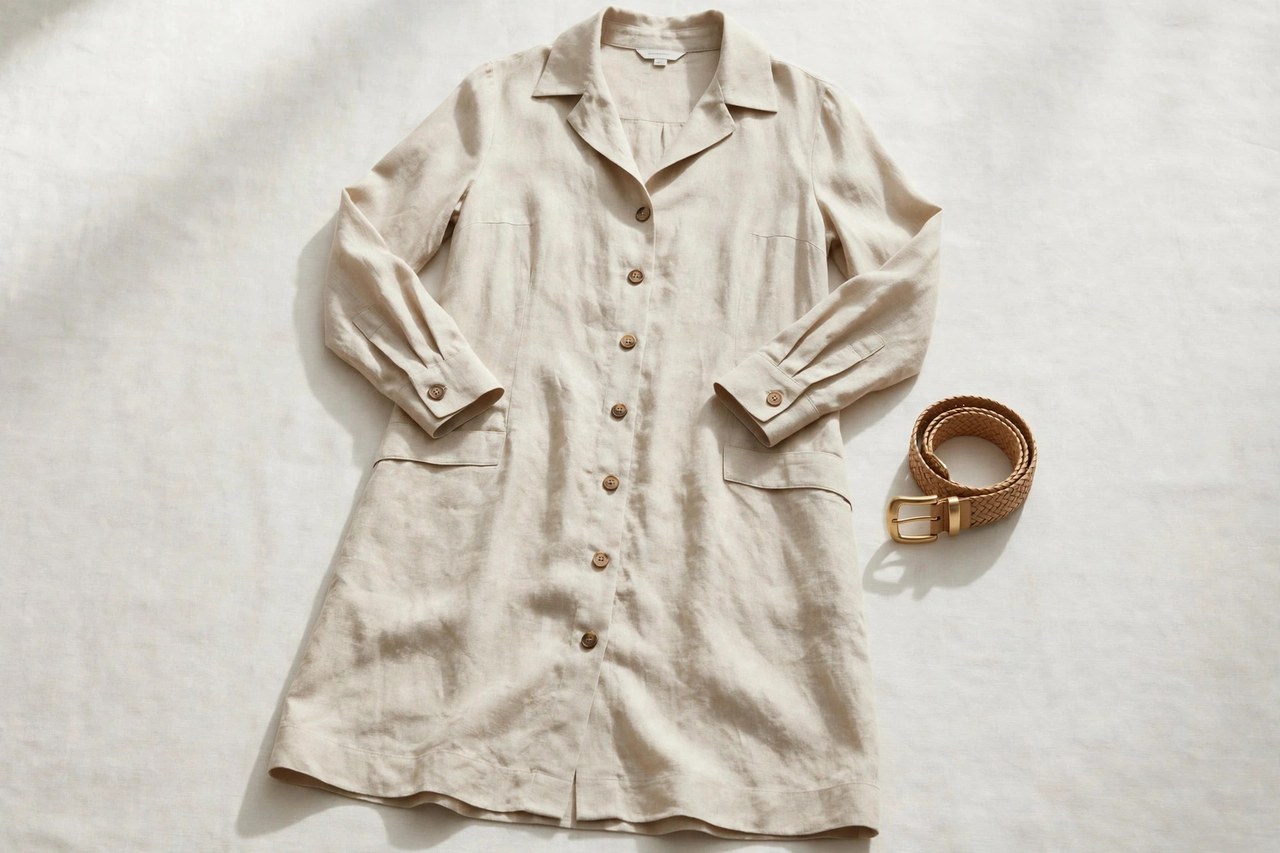
A shirt dress is a dress that typically has a similar silhouette to a man's dress shirt or a women's dress shirt. A shirtdress is a style of women's dress that borrows details from a man's shirt — these can include a collar, a button front, or cuffed sleeves. This type of dress is often made in crisp fabrics including cotton or silk, much like a typical men's dress shirt, and its appeal is exactly that borrowed tailoring: a familiar, structured top half extended into a complete, one-piece outfit.
This guide covers the classic shirtdress first — its construction, its waist, its fabrics — and then its two famous variations, the T-shirt dress and the polo dress, which borrow from casual shirts instead of dress shirts. Button fronts and a forgiving fit make this a flattering look for most body types, and understanding where the fit comes from — belt, buttons and cut — tells you how to adjust it to yours.
Construction: Collar, Placket and the Missing Waist Seam
Because this style of women's dress is often cut without a seam at the waist, these dresses usually have a looser fit, relying on a belt to define the waist. The belt may be self-fabric, leather, woven or a drawstring; unbelted, the dress falls straight, like a long shirt. The button front may run the full length — making the dress step-in easy and nursing- and layering-friendly — or stop at the waist over a sewn skirt.
Details decide quality here, because they are borrowed from shirting, where standards are visible. Collars should roll cleanly and lie flat, buttonholes should be dense and even, buttons should be securely stitched with spares provided, and cuffs should close without gaping. A placket that ripples or pulls between buttons signals a cut too tight across the bust, not a style feature. Side pockets, where present, should sit at the seam without flaring it open — a small construction detail that separates a considered shirtdress from a lengthened shirt.
History and the Shirtwaist Name
Shirtdresses were sometimes called 'shirtwaist dresses' when they were fashionable during the 1950s, when the fitted shirtwaist top over a fuller skirt became a defining silhouette of the decade. The name preserves the garment's two-part logic: a shirt above, a dress below, joined at a waist that the 1950s version emphasized with tailoring and belts, where many modern versions leave the join unseamed and let the belt alone do the work. Both approaches remain in production, and listings use 'shirt dress' and 'shirtdress' for either.
That history explains the style's durability. The shirtdress sits at a useful midpoint: more structured than a knit dress, less formal than tailoring, appropriate across work, travel and social daytime wear with only accessory changes. Crisp cotton poplin gives the classic, almost uniform clarity; silk gives an evening-leaning fluidity; denim, linen and flannel versions translate the same construction across seasons. Few dress styles cover as many settings with one pattern.
Variations: T-Shirt Dress and Polo Dress
A variation of the original shirtdress is the T-shirt dress. T-shirt dresses began being produced in the 1960s and are simply an elongated version of a women's T-shirt — knit, pull-over, with the tee's neckline and sleeves extended to dress length. Dresses are also made in a tennis shirt or polo shirt style, with the polo's knitted collar, short placket and ribbed cuffs; the women's polo dress applies that sport construction to a dress silhouette, usually in cotton pique or a pique-style knit.
Judge the variations by their parent garments' rules. A T-shirt dress lives or dies by its knit: too thin and it clings and shows every line, in a fabric with recovery it drapes and keeps its length through the day. A polo dress should keep the polo's structure at collar and placket even in longer lengths. Both variations are more casual than the woven shirtdress and rarely belted, though a belt converts either into a closer relative of the classic. Knowing which shirt a dress borrowed from tells you how it should fit, stretch and be washed.
Fit, Styling and Care
Fit the shirtdress at shoulder and bust first, confirm the placket lies closed without strain while seated, and then set the waist with the belt at your natural waistline, not where the dress happens to gather. Lengths run from above the knee to midi and maxi; fuller skirts want the belt, straighter cuts tolerate either styling. Worn open over trousers or a slip dress, a long shirtdress doubles as a light duster layer — one of the few dresses that can also be outerwear, thanks to that full button front.
Care is shirting care: wash woven cotton and linen versions as you would a good shirt, unbuttoned and inside out, iron or steam the collar and placket properly, and hang on a shaped hanger. Silk versions follow silk rules; knit T-shirt and polo variations wash gently and dry flat or on low to protect length and collar shape. Keep spare buttons with the dress. Maintained as the shirt it descends from, a shirt dress stays crisp for years — its whole character is crispness, borrowed from the best-made garment in the wardrobe.
Related Women's Guides
Photos


More to Explore on Apparel Search
Women’s Clothes Guide by Letter: Women's Fashion Directory R · Women's Clothes Directory T
Looking for Women's Clothing Stores?
This guide helps you choose women's shirt dresses. To browse where to buy, visit our women's clothing store directory, where you can find retailers that carry them.