Women's Wrap Skirt Guide
One panel crossing over the other and tying at the waist — the wrap skirt adjusts to the body wearing it, which is why every culture invented it.
Shop Women's Wrap Skirts Now
Shop Women's Wrap Skirts on Amazon Shop Women's Wrap Skirts on eBayThe Amazon and eBay links on this page are affiliate links. If you make a purchase through them, Apparel Search may earn a commission.
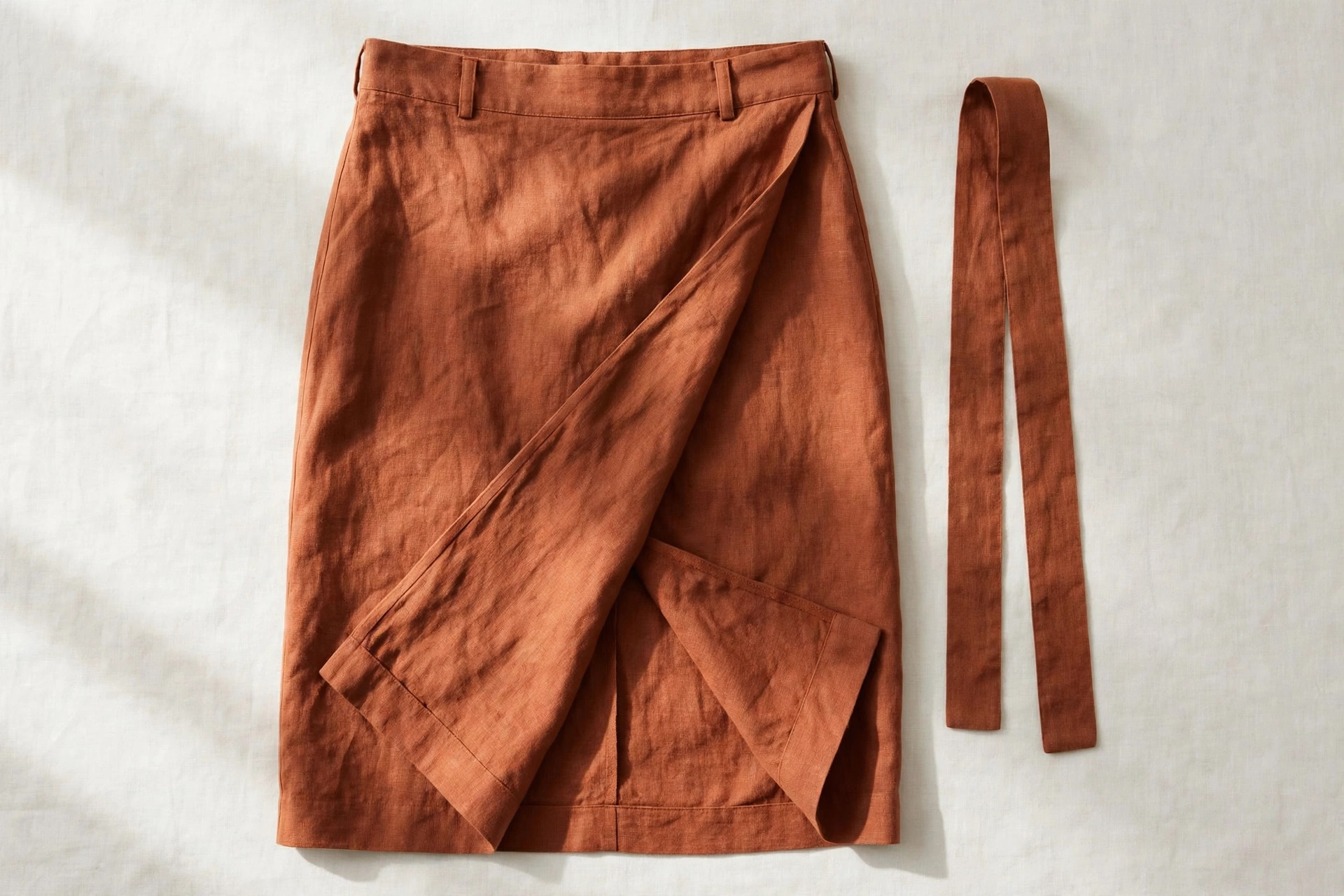
A wrap skirt is a panel of fabric that wraps around the body, overlaps at the front and fastens at the waist with ties, buttons or both. There is no fixed circumference to fit into: the skirt's size is set each time it is tied, which makes it the most forgiving and longest-lived skirt in this cluster — the one that fits before and after lunch, before and after holidays, across the fluctuations every body has. Its dress counterpart, the wrap dress, applies the same principle to a whole outfit.
Wrapped lower garments are among the oldest clothing on earth — the sarong, the pareo, the lava-lava and the wrapped skirts of a dozen textile cultures all solve dressing with one rectangle and a knot. The Western fashion wrap skirt, popularised in the 1970s alongside the wrap dress and revived in every decade since, tidies the idea with a shaped waistband and a secure closure, but the principle — and the diagonal line of the overlap — is unchanged.
True Wrap, Faux Wrap, and the Wind Test
A true wrap opens completely flat and ties on; a faux wrap is a sewn skirt whose front panel merely crosses and is stitched in place, with a conventional zip closure. The faux version keeps the diagonal line and the flattery while surrendering the adjustability — and gaining total security. The true version adjusts endlessly but carries the wrap skirt's one famous risk: the overlap is held by friction and the tie, and a gust of wind at the wrong moment tests both. Generous overlap — the panel should cross by at least a third of the front — is the real protection, and an interior button or snap at the overlap's edge marks a well-designed wrap.
Fit checks follow from the construction. Tie the skirt at your natural waist and walk briskly, sit, and climb a step: the overlap should stay closed through all three without your hand supervising it. The under-panel's edge should not peek below the hem — asymmetric hems where the inner panel is shorter are a design choice on some, a flaw on others, so decide which you are looking at. Long ties finish best as a bow at the side front, which also keeps the knot off your spine when seated.
Who It Flatters, at What Length
The wrap's diagonal and adjustable waist repeat the wrap dress's kindnesses in skirt form. The angled overlap lengthens the leg line and breaks up the front view flatteringly on an apple shape; the self-set waist suits an hourglass shape precisely because it is tied to measure; and skirt length can be chosen freely since the construction works at every one. Midi wraps are the modern default, mini wraps the summer classic, and long sarong-style wraps double as beach cover-ups and evening skirts alike.
Fabric steers the length choice. Crisp cotton and linen hold a structured A-line wrap at knee and midi lengths; rayon and silk let a long wrap fall in the fluid column the sarong suggests; denim and corduroy wraps carry the 1970s note into autumn with boots. Very slippery fabrics — satin, pure silk charmeuse — make true wraps that untie themselves; in those cloths, choose the faux construction or a design with a buttoned waistband plus ties, so the knot is decoration rather than sole security.
Styling the Diagonal
The wrap skirt's front diagonal is a design element: keep tops tucked or cropped so the tie and the angle stay visible, and let the bow be the accessory at the waist. Fitted knits, bodysuits and tucked tees are the natural partners; a slim turtleneck with a midi wrap and boots is a complete cold-weather formula. The skirt's own print tradition is bold — batik, block print, stripes that meet at the overlap in a chevron — and plain tops let those patterns work.
Compare its neighbours in this cluster to place it: the circle skirt flares further and fits fixed; the surplice dress borrows the same crossing line for a bodice. The wrap skirt remains the practical traveller of the family — it packs flat (it is flat), irons in minutes, fits on any day of a trip, and in a pinch has served as a shawl or beach mat across five thousand years of precedent.
Common Questions
What is a wrap skirt?
A skirt made of a fabric panel that wraps around the body, overlaps at the front and ties or buttons at the waist. Because it fastens by tying, it adjusts to the wearer rather than coming in a fixed circumference. Faux wrap skirts copy the crossed front but are sewn shut. The design descends from wrapped garments like the sarong.
How do you keep a wrap skirt from opening?
Overlap and closure design. The panel should overlap by at least a third of the front, ties should be secured at the natural waist, and good designs add an interior button or snap at the overlap edge. In slippery fabrics like satin, choose a faux wrap or a button-waistband style. Test any wrap by walking briskly and climbing a step before wearing it out.
Are wrap skirts flattering on apple shapes?
Yes — the diagonal overlap draws a lengthening angle across the front, and the tie-it-yourself waist sits exactly where you place it rather than at a manufacturer's guess. Midi lengths in fluid fabric are the most elegant version; avoid tying so tightly that the overlap pulls, which undoes the smooth diagonal.
Dress & Skirt Silhouette Guides
Every dress and skirt silhouette guide in this cluster — the new guides plus the classic silhouettes already on Apparel Search — in alphabetical order:
- Women's Asymmetric Skirt
- Women's Bubble Dress
- Women's Circle Skirt
- Women's Cold Shoulder Dress
- Women's Column Dress
- Women's Empire Dress
- Women's Fit and Flare Dress
- Women's Prairie Dress
- Women's Prairie Skirt
- Women's Sheath Dress
- Women's Shift Dress
- Women's Skater Dress
- Women's Slip Dress
- Women's Surplice Dress
- Women's Swing Dress
- Women's Tea Length Dress
- Women's Tent Dress
- Women's Tiered Dress
- Women's Tiered Skirt
- Women's Tulip Skirt
- Women's Wrap Dress
More to Explore on Apparel Search
Looking for Women's Clothing Stores?
This guide helps you choose women's wrap skirts. To browse where to buy, visit our womens clothing store directory, where you can find retailers that carry them.