Women's Bubble Dress Guide
Volume gathered back in at the hem — the bubble dress, also sold as the balloon dress, is fashion's most playful silhouette, built entirely around one curved seam.
Shop Women's Bubble Dresses Now
Shop Women's Bubble Dresses on Amazon Shop Women's Bubble Dresses on eBayThe Amazon and eBay links on this page are affiliate links. If you make a purchase through them, Apparel Search may earn a commission.
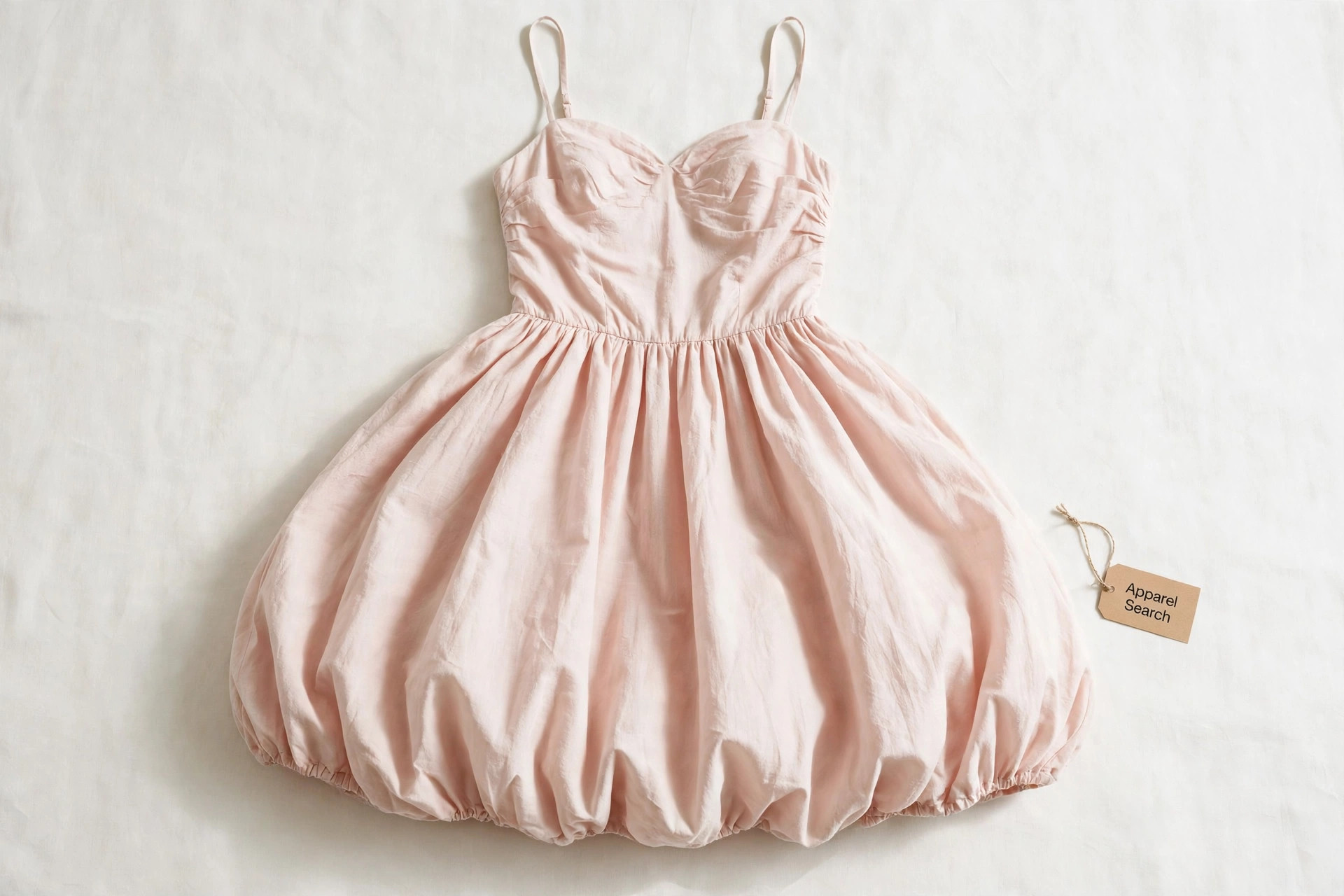
A bubble dress is cut wide through the body, then gathered, tucked under and attached to a narrower lining or band at the hem, so the fabric pouches out into a rounded bubble — which is why the same garment is just as often sold as a balloon dress. The two names describe one construction: volume on the outside, a controlled hem underneath it. There is no close fit anywhere except sometimes at the bust; the silhouette is the curve itself.
The shape has serious fashion ancestry. Cristóbal Balenciaga showed balloon dresses in the late 1950s, Hubert de Givenchy's sack and bubble shapes freed the waist at the same moment, and the silhouette returned at full volume in the 1980s before its current revival as a short, sculptural party dress. Each return keeps the same trick: the hem comes back under, so the dress reads round from every angle.
How a Bubble Hem Is Built
The outer skirt is cut significantly wider and longer than the lining. At the hem, the outer fabric is gathered or pleated and sewn to the lining's edge several inches higher, forcing the surplus cloth to billow outward and under. Better versions distribute the gathers evenly so the bubble is smooth; cheaper versions bunch unevenly, which is the first quality check — turn the dress and look at the underside seam. Some modern versions use elastic in a hem channel instead of a sewn lining, which makes the bubble adjustable but less sculptural.
Because the volume sits low, the top of the dress decides its mood. A fitted or strapless bodice makes the bubble a deliberate contrast and keeps the overall shape readable. A loose bodice flowing straight into the bubble creates the softer, trapeze-like version — charming, but the one most likely to overwhelm a small frame, and the one where length matters most: above the knee almost always works better than at it.
The hem itself has its own guide: our bubble hem page explains how the gathered-into-lining construction works, which fabrics hold the pouf, and how to style and store bubble-hem skirts and dresses without crushing the shape.
Who It Flatters, and the Honest Limits
The bubble adds its volume at the hip and thigh, which makes it a genuine tool for an inverted triangle body shape: the rounded skirt answers broad shoulders and balances the frame. On a rectangle body shape, a bubble with a defined or belted top half manufactures an hourglass suggestion — curve below, waist marked above. Straighter, boyish frames wear the fully loose version best of all, since the dress supplies all the shape itself.
The honest limits: the silhouette adds width exactly where a pear shape already carries it, so pear figures usually do better with the volume placed higher, in an empire or fit-and-flare cut from this cluster. And the bubble is a statement — it photographs boldly and moves conspicuously. That is the point of it, but it is why the dress lives in party, event and fashion-forward wardrobes rather than everyday rotation.
Fabrics and Styling
Fabric must hold air. Taffeta, faille, mikado, stiff cotton and scuba keep the bubble round all evening; soft jersey and thin crepe collapse the shape into a gathered sack, which is a different and usually unintended look. Read the fabric content before buying online: the more body and synthetic crispness, the rounder the bubble. Lined versions in structured fabrics are also the most comfortable, because the smooth lining — not the gathered outer — is what touches the legs.
Style it as the single loud element: clean heels or pointed flats, a small bag, hair and jewellery kept simple so the silhouette stays the subject. A short, fitted jacket works over a strapless bubble; long layers that cover the hem undo the construction entirely, so coats should be worn open. Store the dress hung by its lining loops or folded with the bubble uncrushed — a flattened bubble can be steamed back, but repeated crushing tires the gathers.
Common Questions
Is a bubble dress the same as a balloon dress?
Yes. Bubble dress and balloon dress are two retail names for the same construction: a wide outer layer gathered back under at the hem to a narrower lining or band, creating a rounded, pouched silhouette. Some retailers use one term, some the other, and many listings use both — shop by the hem construction, not the name.
Are bubble dresses flattering?
They are flattering where added volume at the hip helps: on inverted triangle shapes they balance broad shoulders, and on rectangle shapes they create lower-body curve. They are less kind to pear shapes, which already carry volume at the hip. Fitted-bodice versions suit more bodies than fully loose ones, because the defined top keeps the silhouette in proportion.
What fabric makes the best bubble hem?
A fabric with body: taffeta, faille, mikado, scuba or crisp cotton holds the rounded pouch shape all day. Soft, fluid fabrics like thin jersey collapse the bubble into ordinary gathers. Cheaper constructions sometimes substitute an elastic hem channel, which is adjustable but produces a softer, less sculptural curve.
Dress & Skirt Silhouette Guides
Every dress and skirt silhouette guide in this cluster — the new guides plus the classic silhouettes already on Apparel Search — in alphabetical order:
- Women's Asymmetric Skirt
- Women's Circle Skirt
- Women's Cold Shoulder Dress
- Women's Column Dress
- Women's Empire Dress
- Women's Fit and Flare Dress
- Women's Prairie Dress
- Women's Prairie Skirt
- Women's Sheath Dress
- Women's Shift Dress
- Women's Skater Dress
- Women's Slip Dress
- Women's Surplice Dress
- Women's Swing Dress
- Women's Tea Length Dress
- Women's Tent Dress
- Women's Tiered Dress
- Women's Tiered Skirt
- Women's Tulip Skirt
- Women's Wrap Dress
- Women's Wrap Skirt
More to Explore on Apparel Search
Looking for Women's Clothing Stores?
This guide helps you choose women's bubble dresses. To browse where to buy, visit our womens clothing store directory, where you can find retailers that carry them.