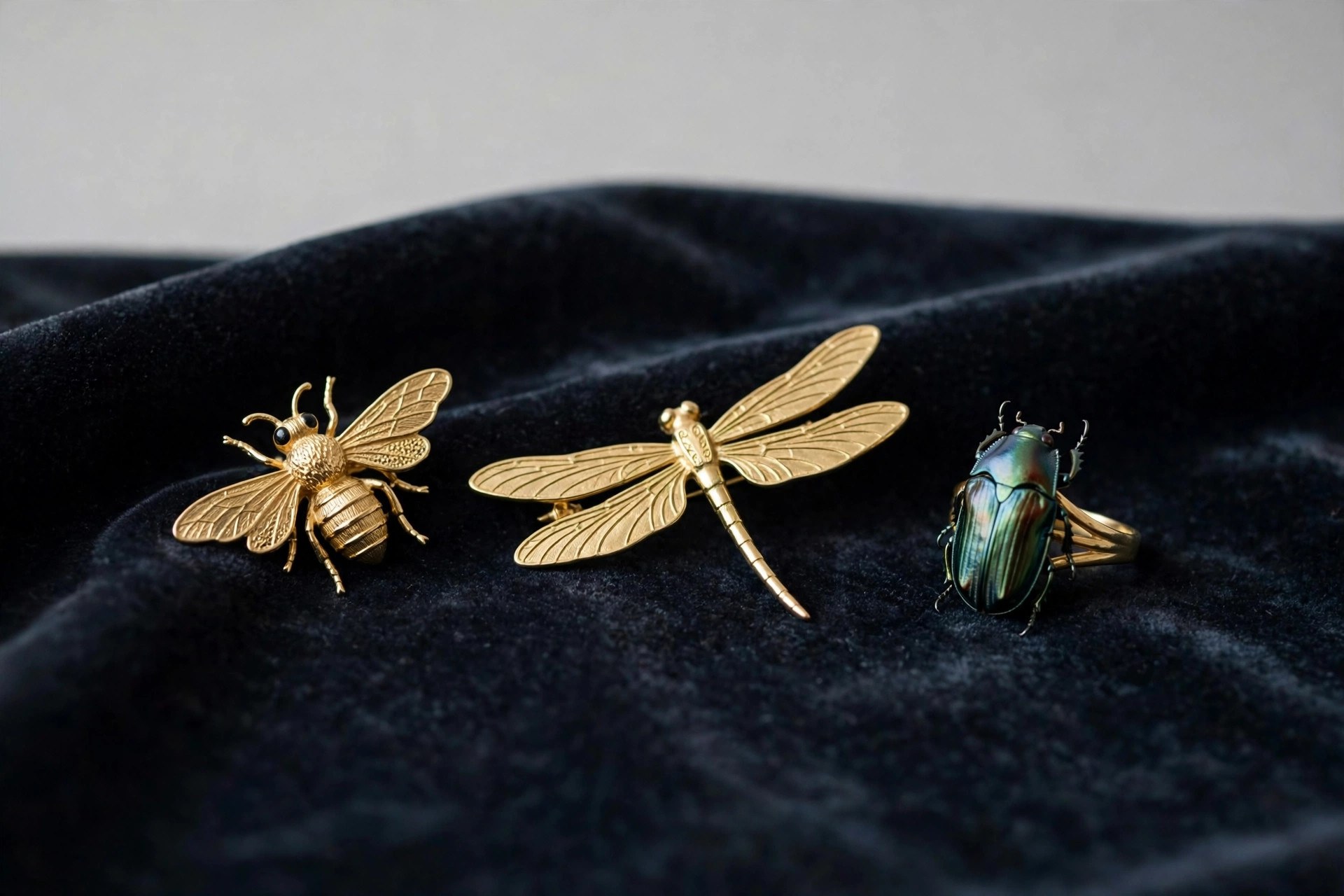
Insect jewelry is jewelry modeled on bugs and other small creatures: scarab beetles, bees, dragonflies, ladybirds, spiders, and ants, rendered as brooches, pendants, studs, and rings. Butterflies are so popular they have their own page, linked below. The scarab carries the oldest symbolism, revered in ancient Egypt as an emblem of renewal. Other insects bring their own associations: the bee with industry and sweetness, the dragonfly with lightness and change, the ladybird with luck. In skilled hands the results are miniature sculpture, all legs, wings, and antennae in metal, enamel, and stones.
Victorian Fashion and the Art Nouveau Tradition
Insect jewels became a genuine fashion in the Victorian era, when natural history was a popular passion and collectors filled cabinets with specimens. Jewelers answered with lifelike brooches and pins, sometimes unsettlingly lifelike, set with gems for eyes and wings. Taste ranged from charming ladybirds to spiders worn, against superstition, as tokens of good fortune. The era established the ground rule that still applies: an insect jewel is a conversation piece, made to be noticed and asked about.
Art Nouveau jewelers then turned insects into art. Dragonflies above all became vehicles for enamel work, with translucent plique-a-jour wings that glow like real insect wings when held to the light, and bodies set with opals and colored stones. Beetles, grasshoppers, and bees appeared in the same flowing, nature-obsessed style. Antique pieces from both eras remain collectible, and modern makers still borrow their techniques: colored enamel wings, pavé bodies, and delicate wire legs that give a jewel its lifelike tension.
Modern Forms, Styling, and Care
Today the motif spans every scale. Tiny bee or ladybird studs and ant pendants work as everyday pieces; larger dragonfly brooches, beetle cocktail rings, and jeweled spider pins are occasion statements. Styling advice is simple: wear one conversation piece at a time and let it own the attention. A single brooch on a coat lapel, blazer, or knit, or one bold ring, reads as wit and confidence; a full swarm competes with itself and tips into costume.
Nature themes help the piece settle into an outfit: floral prints, garden-party dresses, and earthy colors all give an insect jewel context. Care needs a little respect for the construction. Enamel chips if knocked against hard surfaces, and legs, wings, and antennae are the first parts to bend or catch on knitwear. Store pieces separately in soft pouches, put brooches on after dressing, and clean gently with a soft, dry cloth rather than soaking, especially where enamel or glued stones are involved.
Scale is worth a thought before buying. A jewel that looks delicate in a display case can read larger on a lapel or hand, and insect pieces have presence out of proportion to their size because the shapes are so recognizable. If you are new to the motif, start with a small bee pin or ladybird studs and live with them for a while. Enthusiasts often find one beloved piece becomes a signature, collected in a few forms rather than worn all at once.
Common Questions
- What does scarab jewelry symbolize?
- The scarab beetle was a powerful symbol in ancient Egypt, associated with the sun, rebirth, and renewal, because the beetle was linked in Egyptian belief to the daily return of the sun. Scarab amulets and seals were worn for protection and good fortune. Modern scarab jewelry borrows that heritage, and the beetle's neat, oval shape also makes it a naturally satisfying form for rings, pendants, and brooches.
- Are insect jewels appropriate for formal wear?
- Yes, chosen with the same judgment as any statement jewel. A refined dragonfly brooch, bee pin, or beetle ring in precious metal and stones sits comfortably with evening and formal dress, and antique insect jewels were made for exactly that world. Keep it to one piece, match the metal to your other jewelry, and let the craftsmanship show; novelty plastic bugs are the only version that reads as costume.
- How do I stop a brooch damaging knitwear?
- Insect brooches have fine legs and antennae that can snag, and a heavy pin can pull soft knits out of shape. Pin through a doubled layer or a seam where possible, support a heavy brooch by pinning it where the fabric is backed by a collar or lapel, and always open and close the pin away from the fabric. Removing the brooch before storing the garment prevents both snags and distortion.
- How should enamel insect jewelry be cleaned?
- Gently, and mostly dry. Wipe with a soft cloth to remove dust and fingerprints, and avoid soaking, ultrasonic cleaners, and harsh chemicals, which can damage enamel and loosen stones. Enamel can chip if the piece is dropped or knocked, so store it separately from harder jewelry. If a leg or antenna bends, a jeweler can usually straighten it safely; forcing it at home risks a break.
Finishing Touches
The small, personal details that complete an outfit, from a jewel brooch to a signature scent.