Choosing Gemstones by Color and Wear
Start with the color, then match the stone to the jewelry
Most gemstone jewelry is chosen color first: a buyer wants a red stone, a blue stone or a green stone, and only then decides which gemstone should supply that color. Every color offers several candidates at very different prices and durability. Red can be ruby, garnet, spinel or tourmaline. Blue can be sapphire, blue topaz, aquamarine, tanzanite or turquoise if an opaque stone suits the design. Green can be emerald, peridot, jade, green tourmaline or tsavorite garnet. Working color first, then checking hardness against the jewelry type, is the practical way to shop: a ring needs a harder stone than a pendant in the same color, because rings are knocked and scraped in daily wear. This page approaches gemstones from that buying angle, setting out the main color families and their candidate stones, the hardness each form of jewelry demands, and the three material categories every listing should state plainly: natural stones formed in the earth, lab-created stones with the same chemistry grown by people, and imitation stones that merely copy a color in glass or another material. With those three checks, color, hardness and category, a buyer can compare two stones of the same color on equal terms.
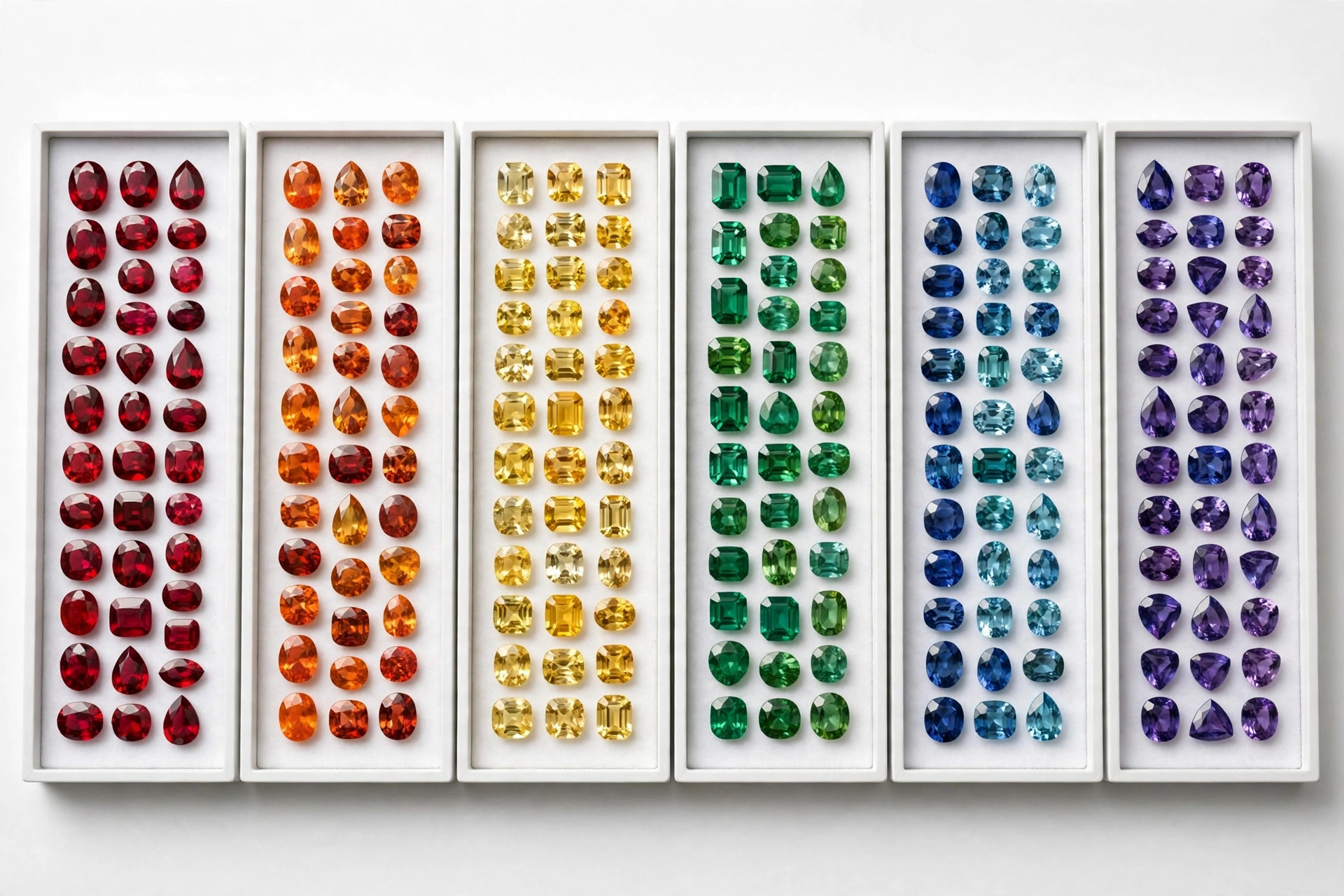
Color Quality: Hue, Tone and Saturation
Gem dealers describe color in three parts. Hue is the basic color and any modifier, such as a slightly greenish blue. Tone is how light or dark the stone is, from pale to nearly black. Saturation is the strength or purity of the color, from dull and greyish to vivid. The most valued stones of a species usually sit in a medium to medium-dark tone with strong saturation, while very pale or very dark stones cost less even at the same size and clarity. Judging color in person, in daylight-equivalent light rather than under warm shop lighting alone, shows how the stone will look in daily wear.
Color also explains price jumps within one species. Sapphire is corundum, and only the red form is called ruby: the same mineral in blue, pink, yellow or green is sold as sapphire in that color, each with its own market. Garnet is a family, not a single stone, spanning red almandine and pyrope, green tsavorite and demantoid, and orange spessartite. Knowing the family behind a color helps a buyer find the same hue in a less famous, better-value stone.
Common Questions
If I want a particular color, how do I choose between the stones that offer it?
Compare the candidates on hardness, price at the size you need, and the exact shade. In blue, for example, sapphire is the hardest and most valuable, blue topaz gives a bright color for much less, aquamarine is paler and harder-wearing than tanzanite, and tanzanite's violet-blue is beautiful but softer. Ask for the stone's Mohs hardness, whether it is natural or lab created, and any treatments, then pick the combination that fits the piece and the budget rather than paying for a famous name in a small size.
What is the difference between natural, lab-created and imitation gemstones?
A natural gemstone formed in the earth and was mined. A lab-created gemstone has the same chemical composition, crystal structure and hardness as its natural counterpart but was grown in a laboratory, so it is a real gemstone of human-made origin, usually cleaner and less expensive. An imitation is a look-alike in a different material, such as colored glass or cubic zirconia, which copies the color without the properties. Sellers should state which category a stone belongs to, and the price differences between the three are large.
Which gemstone colors hold up best in an everyday ring?
The color matters less than the stone supplying it. Diamond, ruby and sapphire at Mohs 9 to 10 are the most durable ring stones in any color they offer, followed by spinel, topaz and the quartz family at 7 to 8 for careful daily wear. In softer stones, a deep color such as turquoise blue, opal's play of color or pearl white is better enjoyed in earrings and pendants, where knocks are rare, or in a bezel-set ring worn on dress occasions rather than daily.