What Locknit Is
Locknit — also sold for decades under the name charmeuse — is the standard two-bar warp knit: the fabric that turned the tricot machine from a maker of plain net-like cloth into the workhorse of the lingerie, lining and dress trades. It is knitted on a tricot warp knitting machine from two full sets of warp yarns, one set carried by the front guide bar and one by the back guide bar, and every needle receives a yarn from each bar in every course. The result is a fine, smooth, closely covered fabric with a soft technical face, a slightly more open technical back, and a combination of drape, opacity and run-resistance that no single-bar fabric can match at the same weight.
Warp knitting builds fabric from many parallel yarns at once, each yarn forming loops up its own column (a wale) and zigzagging sideways to bind the wales together — the opposite approach to weft knitting, where one yarn travels across the fabric course by course. The companion page Weft vs Warp Knitting sets out that difference in full. In a warp knit, the sideways zigzag is called the underlap, and its length is the single most important design variable in the fabric. Locknit is what happens when the two bars are given underlaps of different lengths and set to work against each other.
Locknit in one line: a two-bar tricot-machine fabric in which the front guide bar works an extended two-needle lap (2-3 / 1-0) over a back guide bar working the plain one-needle tricot lap (1-0 / 1-2), the two bars lapping in opposite directions so their underlaps cross, balance and lock together.
The name is a fair description of the mechanism. In a plain single-bar tricot, a broken yarn can ladder: loop after loop pulls out up the wale, because nothing crosses the wale to hold the neighbouring loops. In locknit the front bar’s longer underlaps cross behind the back bar’s loops at an angle, and the back bar’s underlaps cross back the other way. Each bar’s yarn is trapped by the other bar’s yarn at every course, so a break is contained instead of running freely — hence “lock” knit. For a fabric this fine and light, the improvement in run-resistance is dramatic.
How Locknit Is Knitted
How to read the notation. Chain notation is written in needle spaces: each pair of numbers, such as 2-3, gives the guide positions either side of a needle before and after that course’s overlap (the swing of the yarn around the needle, drawn here as the short horizontal stroke). A slash marks the underlap — the diagonal run of yarn across the back of the fabric to the starting position of the next course — and the double slash closes the two-course repeat. In the diagram each coloured dot sits on the needle that the course’s overlap wraps, at the higher-numbered side of its pair, so the length of every diagonal line is exactly the underlap length the notation describes: count the needle spaces it crosses. Course 1 is at the bottom and the fabric builds upward, as it is knitted. The front guide bar (GB1) is drawn in wine and the back guide bar (GB2) in teal throughout this series.
Course 1. The front bar starts at space 2 and overlaps to space 3, wrapping the needle that stands between them — the wine dot at needle 3. The back bar overlaps 1-0 around its needle, the teal dot at needle 1. Every needle across the machine does the same, so course 1 is a full row of double loops, one yarn from each bar in every loop.
The first underlap. Behind the needles, the front bar now shogs two needle spaces, from space 3 to space 1: the long wine diagonal. The back bar shogs one space in the opposite direction, from space 0 to space 1 — in dot terms its next loop sits one needle over, at needle 2. The two underlaps cross each other on the technical back of the fabric, and that crossing, repeated millions of times, is the lock in locknit.
Course 2. The front bar overlaps 1-0 (wine dot at needle 1) and the back bar overlaps 1-2 (teal dot at needle 2). Then the front bar underlaps back from space 0 to space 2 — two spaces again, closing the repeat — while the back bar underlaps back by one space. Courses 3 and 4 simply repeat courses 1 and 2, and so on for the whole piece: a two-course repeat, knitted at hundreds of courses per minute.
Note the run-in consequence. The front bar travels more yarn than the back bar in the same two courses (the standard run-in ratio for locknit is about 3:4, front to back, once loop lengths are counted), so the two bars are fed from separate warp beams at different rates. Getting that ratio right keeps the face smooth: too much front-bar yarn and the fabric puckers; too little and the long underlaps pull tight and the cover opens up.
Properties: What the Geometry Buys
Cover and opacity. The front bar’s two-needle underlaps lie across the back of the fabric at a shallow angle, filling the gaps that a one-needle underlap leaves open. Turn a piece of locknit to the light and the difference from plain tricot is immediate: where tricot can look almost net-like in fine deniers, locknit is a closed, even cloth. That cover is bought with yarn — locknit is heavier than two-bar tricot at the same gauge — but it is cover without stiffness, because the extra yarn lies flat rather than standing up in the loop.
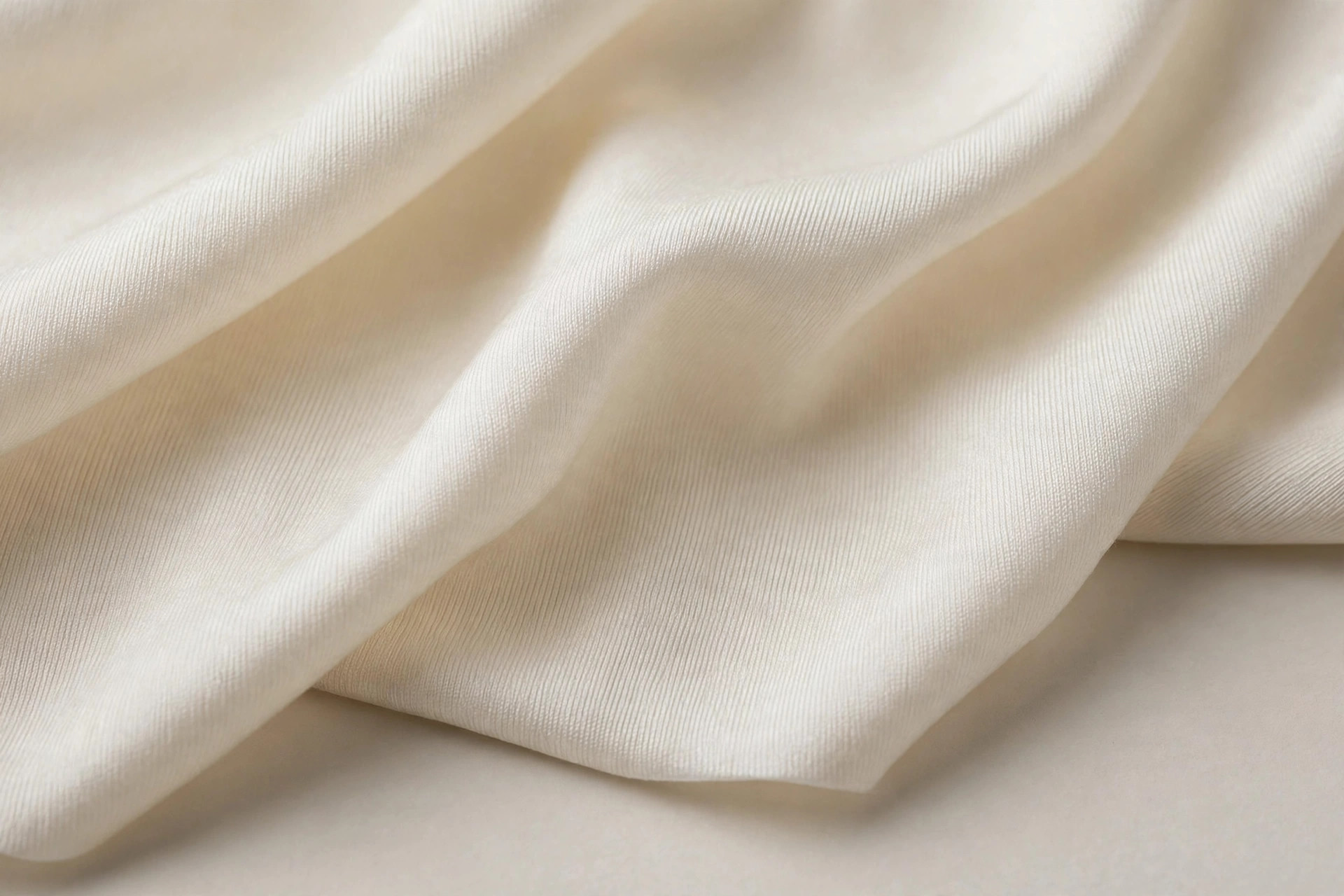
Drape and handle. Those same shallow-angled underlaps act as hinges. A one-needle underlap pins adjacent wales close together; a two-needle underlap lets neighbouring wales shear slightly against each other, course by course, and the fabric falls in the soft, fluid folds the photograph at the top of this page shows. Knitted in continuous-filament nylon or polyester, locknit has the cool, smooth, slightly lustrous hand that made it the default fabric for slips and camisoles.
Stability and curl. Because the two bars lap in opposition, their underlap tensions largely cancel: the loops stand upright instead of leaning, and the fabric is far better balanced than a single-bar structure. Locknit still tends to curl toward the face at the sides, as most tricot-machine fabrics do, but heat-setting — standard for nylon and polyester locknit — relaxes the curl and locks in the finished width. Shrinkage in the grey fabric can be considerable, of the order of a fifth to a third of the knitted width, and finishers plan for it rather than fight it.
Extensibility. The longer front underlap gives locknit more give, especially across the width, than the firmer members of this family such as sharkskin and queenscord. It stretches enough to be comfortable next to the skin and to ease over the body in a lining, without the uncontrolled growth of a satin-lap fabric. Add a few percent of elastane on a third bar, or plaited in, and the same basic structure becomes the stretch locknit of modern shapewear and swimwear linings.
Uses of Locknit
Lingerie and intimate apparel is locknit’s home ground: slips, camisoles, briefs, nightdresses and bra cups and wings, where the smooth face sits comfortably against the skin, the cover protects modesty at very low weights, and the fabric’s reluctance to ladder matters in garments that are washed constantly.
Linings. A locknit lining slides over other fabrics instead of gripping them, does not fray at cut edges the way a woven lining can, and stretches slightly with a knitted outer garment instead of fighting it. Dress, skirt, jacket and swimwear linings are all standard locknit territory, usually in lightweight polyester or nylon.
Dresses and blouses. In heavier filament yarns, and especially when printed, locknit’s even, closed surface takes colour well and its drape suits fluid styles. Interlinings and fusible substrates use its stability and its tolerance of heat-setting and coating. Finally, locknit is the base cloth into which many warp-knit velours and brushed fabrics begin life: raise or shear the front bar’s long underlaps and the same locked ground that makes the plain fabric so serviceable holds the pile in place.
Locknit, Tricot, Satin and Sharkskin Compared
All four fabrics come off the same two-bar tricot machine, threaded the same way, and all four repeat in two courses. Nothing changes except the lapping: which bar travels, and how far. That single choice — underlap length, and whether the long underlap sits in the front bar or the back bar — is the whole difference between a lingerie fabric, a dress fabric and a printing base.
Tricot
One bar, or two identical bars, on a 1-and-1 lap: every underlap crosses a single needle space. Light, economical and open, but the short underlaps give the least cover and the least resistance to a ladder in this family.
Locknit
A two-needle front underlap over a one-needle tricot back lap. The extra front-bar yarn buys cover, opacity, drape and a smooth face — the balanced all-rounder of the group.
Warp-Knit Satin
The long lap moves to the front bar and stretches to three needle spaces, floating flat filament across the face. The most lustrous and draping fabric here, and the least stable of the four.
Sharkskin
The long lap moves to the back bar instead: three needle spaces of underlap locked behind a plain tricot front. The firmest, heaviest and most dimensionally stable of the four.
Two relatives complete the picture. Queenscord abandons the balanced two-lap idea altogether, tying a long back lap down with a pillar stitch front bar to make the firmest, most corded fabric of the family. And every fabric above except queenscord contains the plain tricot lap in one of its bars, which is why tricot is the right place to learn the notation first.
Common Questions
- What is the difference between locknit and charmeuse?
- In the warp-knit trade the two names describe the same two-bar structure: locknit is the technical name for the lapping combination, and charmeuse is the long-established trade name for the smooth filament fabric knitted in that structure, especially in nylon. Neither should be confused with woven silk charmeuse, which is a satin-weave fabric made on a loom.
- Why does locknit resist ladders better than plain tricot?
- Because its two bars lap in opposite directions with underlaps of different lengths. The front bar underlaps cross behind the back bar loops at every course, trapping each bar yarn under the other. A broken yarn is therefore held at the next crossing instead of pulling loop after loop out of the wale, as it can in a single-bar fabric.
- Which yarns is locknit usually knitted from?
- Continuous-filament nylon and polyester are the classic choices, because filament yarn gives the smooth, cool, slightly lustrous face the fabric is known for and heat-sets well. Finer gauges use finer deniers; elastane is added when the fabric needs real power stretch, as in shapewear and swimwear.
- Does locknit stretch?
- Yes, moderately, and more across the width than along it. The two-needle front underlaps let neighbouring wales shear slightly, which gives both drape and give. It is noticeably more extensible than sharkskin or queenscord, and less extensible than a warp-knit satin made with a longer front lap.
- What machine knits locknit?
- A two-bar tricot warp knitting machine, typically at fine gauges for lingerie and lining weights. The two guide bars are fed from separate beams at different run-in rates, because the front bar, with its longer underlaps, consumes more yarn per course than the back bar.
More Knit Structures
- Knit Stitches & Structures — the parent index of every knit structure in this guide, weft and warp alike.
- Sharkskin (Warp Knit) — the firm two-bar fabric whose back bar travels three needle spaces.
- Queenscord — a pillar bar tying in a long back lap to raise firm wale cords.
- Warp-Knit Satin — the lustrous two-bar fabric built on a long floating satin lap.
- Pillar Stitch (Warp Knit) — the chain lap: no underlap at all, the anchor bar of queenscord.
- Tricot Knit — the plain 1-and-1 lap that forms one bar of almost every fabric here.
Back to Knit Stitches & Structures
This page is one part of Knit Stitches & Structures, Apparel Search’s deep guide to the structures inside the Knitwear Construction Guide series on how knitted fabric is made.
Search Apparel Search