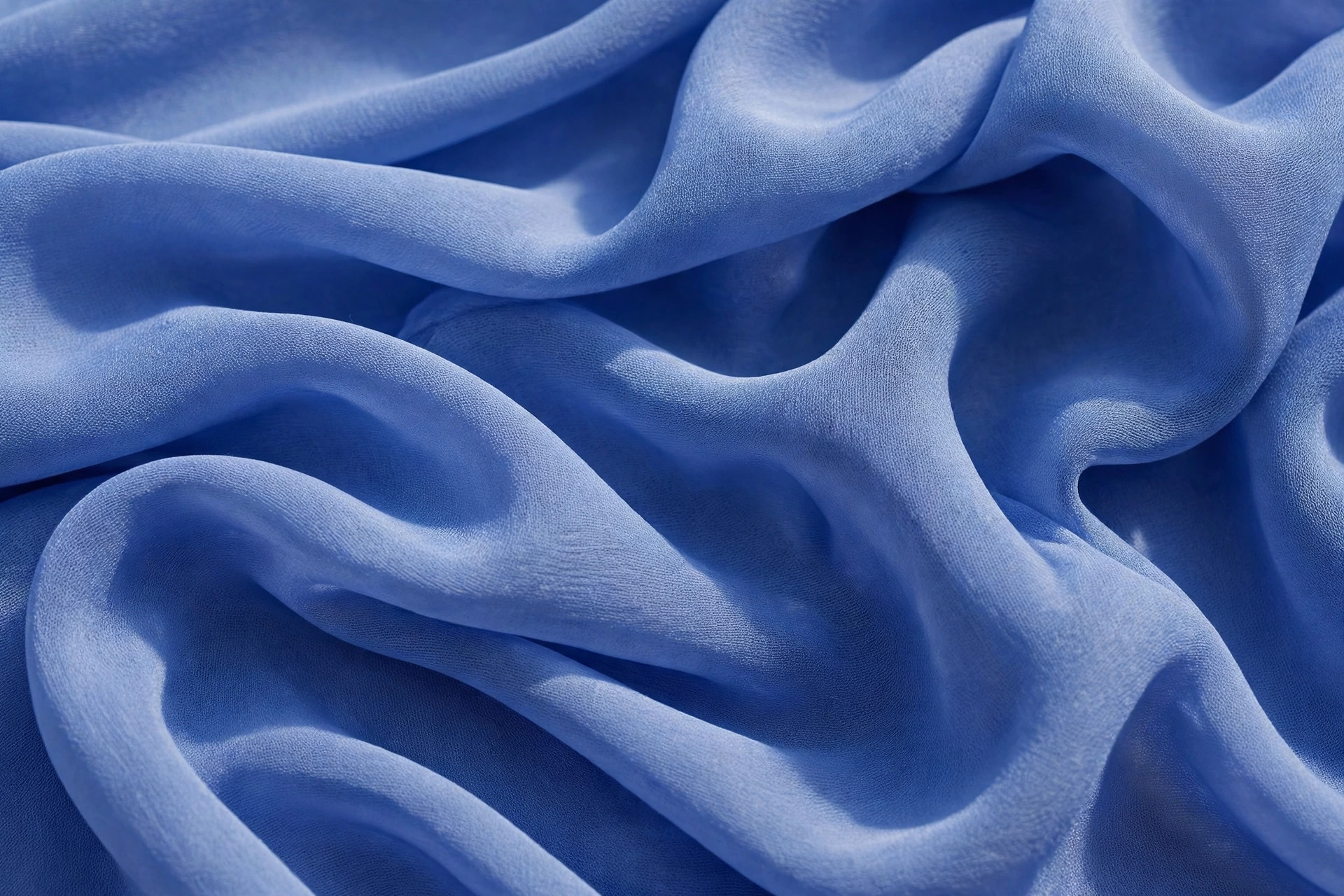
If pillar stitch is a yarn refusing to travel, tricot is a yarn taking the shortest possible trip. On each course the guide bar wraps a needle, travels behind the needles by exactly one needle space, wraps the neighbouring needle, and travels back. That modest zigzag — the 1-and-1 lap — is enough to tie every wale to its neighbours, and the result is a true fabric: light, smooth, soft and produced at some of the highest speeds in all of knitting. Tricot gives its name to the tricot machine, to a whole family of warp-knit fabrics, and to the base structure from which most commercial warp knits are developed. It is a warp knit, introduced in Weft Knitting vs Warp Knitting, and its lapping is the reference point for every other structure in this part of the Knit Stitches & Structures index.
Tricot knit (1-and-1 lap), defined. A warp-knit structure in which one guide bar overlaps alternately on two adjacent needles, with an underlap of one needle space between courses. In chain notation the closed-lap form is 1-0 / 1-2 //, a two-course repeat. Knitted with two bars working complementary 1-and-1 laps, it becomes two-bar tricot, the standard commercial fabric.
How Tricot Is Knitted
The lapping. Follow one yarn in the diagram. On course 1 the guide wraps the left-hand of two neighbouring needles. Behind the needles it then shogs one space sideways — the underlap — and on course 2 it wraps the second needle. Behind the needles again it shogs back, and course 3 repeats course 1. Every yarn in the fabric is doing the same two-step, one wale over, so each course’s loops are tied to the loops of the wales on both sides, and the sheet holds together in both directions. The face of the fabric shows fine, slightly slanted vertical wales; the back shows the short diagonal underlaps as a soft zigzag grain.
Reading the notation. As on the pillar stitch page in this series, the notation is the standard chain notation of Spencer’s Knitting Technology. Needle spaces are numbered from the left, as printed along the foot of the diagram. Each pair of numbers gives the guide’s positions before and after one course’s overlap: 1-0 wraps the needle between spaces 1 and 0; the guide then underlaps behind the needles from 0 to 1, and the second pair, 1-2, wraps the neighbouring needle between spaces 1 and 2, before the underlap from 2 back to 1 closes the two-course repeat, written 1-0 / 1-2 //. The lap is closed because each overlap runs opposite to the underlap that follows it, crossing the feet of the loops; you can check the notation against the drawing, since the marked needle changes exactly when the notation’s numbers change. Give the same bar a longer underlap and the structure stops being tricot — underlap two spaces and it is a 2-and-1 (cord) lap; longer still and it approaches the satin family.
The machines. Tricot is knitted on tricot machines: fine-gauge warp-knitting machines built for speed, historically with bearded needles and now usually compound needles, running at several thousand courses a minute, with the yarn supplied from warp beams — great wound sheets of parallel yarns, one yarn per needle per bar. The fineness of the gauge and the short, simple lapping are what make the speed possible, and they also set the fabric’s character: tricot is a lightweight, fine fabric by nature, knitted in filament yarns — nylon and polyester above all, often with elastane laid in or knitted for stretch — rather than in the spun yarns of sweater knitting. Gauge and yarn are matched as described in Knit Gauge Explained.
Two-Bar Tricot and the Fabric’s Properties
Why two bars? A single bar of 1-and-1 lap does make a fabric, but a poor one: thin, unstable, prone to skew, with loops that can shift. Commercial tricot is therefore almost always two-bar tricot, in which a second guide bar works its own 1-and-1 lap in the opposite phase — conventionally written 1-2 / 1-0 // against the first bar’s 1-0 / 1-2 //. Every needle now receives two yarns per course, the two sets of underlaps cross and lock each other on the back, and the fabric gains cover, stability and a smoother face. Two-bar tricot is the base cloth of the warp-knit industry, and it is also the platform for development: lengthen the front bar’s underlap and balance the bars differently and you arrive at locknit, the most widely used two-bar structure of all.
- Surface — a smooth, fine face with a subtle lengthways grain and a slightly rougher back where the underlaps lie; soft and cool against the skin in filament yarns.
- Weight and drape — light, fluid and clinging rather than structured; tricot drapes like a second skin, which is precisely what lingerie and linings ask of it.
- Stretch — moderate widthways stretch from the zigzag underlaps, limited lengthways stretch; elastane versions recover crisply and serve athletic and dance wear.
- Stability — does not curl like single jersey and does not fray; cut edges are well behaved, a practical gift in linings and layered garments.
Running and laddering. Warp knits have a reputation for not laddering, and tricot mostly deserves it — with a qualification worth understanding. A weft-knit jersey ladder runs because each loop hangs from the one below it in a single chain per wale. In tricot, each loop is additionally tied sideways by its underlaps, so a broken yarn usually damages a small area rather than unzipping a whole column, and a snag stays local. A run can still travel along a wale in a single-bar or lightly built tricot if loops slip through one another, which is one more reason the locked, two-bar construction is the commercial standard: its crossed underlaps hold each loop in its neighbours’ grip.
Uses of Tricot Knit
Lingerie and underwear come first — slips, camisoles, briefs and bra linings — where tricot’s smooth face, light weight and non-curling edges made it the default fabric long before modern elastane blends, and where nylon tricot remains a byword. Linings are the second great use: dress, skirt, jacket and bag linings in polyester or acetate tricot, chosen because the fabric is slippery, stable and kind to the garments it lines. Sportswear takes the elastane versions — leotards, dancewear, gym and team-kit panels and athletic linings — anywhere a light, stretchy, smooth layer must move with the body. Beyond clothing, the same structure serves as interlining and fusible backing, as a soft layer in medical and hygiene textiles, and as the ground fabric for flocking, coating and lamination, where its even surface takes a finish uniformly. Few fabrics are worn by so many people while being named by so few of them: tricot is the quiet inside layer of the wardrobe.
Recognising Tricot — and Placing It in the Family
Hold the fabric to the light. Tricot shows a fine, even texture: on the face, close vertical wale lines with a faint slant; on the back, the short diagonal underlaps making a delicate zigzag grain. It feels smooth and slightly cool, stretches more across than along, and a cut corner does not roll up. Against its neighbours in this series the distinctions are mechanical: pillar stitch has no underlaps and makes chains, not cloth; tricot adds the one-space underlap and becomes the first true warp-knit fabric; locknit keeps tricot’s back bar and lengthens the front bar’s underlap for a smoother, more stable cloth still. Almost everything else in warp knitting is a variation played on those decisions — how far the bars travel, and in what combination.
Common Questions
- What does ‘1-and-1 lap’ mean?
- It describes how far the guide bar travels. In a 1-and-1 (tricot) lap, the overlap wraps one needle and the underlap behind the needles crosses one needle space, so each yarn alternates between two adjacent needles, course by course. Larger numbers mean longer underlaps and different structures: a 2-and-1 lap is a cord lap, and longer laps lead toward satin and velvet structures.
- What is the chain notation for tricot?
- The closed-lap 1-and-1 lap is written 1-0 / 1-2 //. The first pair is the overlap on the first course of the repeat, the second pair the overlap on the second course, worked on the neighbouring needle after a one-space underlap; the double slash closes the two-course repeat. A second bar in two-bar tricot works the complementary lap, 1-2 / 1-0 //.
- Is tricot a fabric or a machine?
- Both, which is why the word can confuse. Tricot machines are the fine-gauge, high-speed family of warp-knitting machines. Tricot fabric is the cloth built from the 1-and-1 lap, most often the two-bar version — and in the trade, tricot on a fabric ticket almost always means that two-bar warp-knit cloth, usually in nylon or polyester filament.
- Does tricot knit ladder or run?
- Much less readily than weft-knit jersey. Each tricot loop is tied to its sideways neighbours by underlaps as well as to the loop below, so damage tends to stay local instead of unzipping down a wale. Light single-bar tricot can run along a wale if loops slip, but the standard two-bar construction, with its crossed and locked underlaps, is notably run-resistant.
- What is tricot fabric used for?
- Principally lingerie and underwear, garment linings, and elastane sportswear such as leotards and dancewear, plus interlinings and coated or laminated ground fabrics. Its smooth face, light weight, fluid drape and non-curling edges suit it to any job that needs an unobtrusive, stable, skin-friendly layer.
More Knit Structures
- Knit Stitches & Structures — the parent guide: the four basic stitches and the main structures built from them
- Locknit — the two-bar development of tricot, and the most widely used warp knit of all
- Pillar Stitch (Chain Lap) — the zero-underlap lapping: chains instead of fabric, and warp knitting’s baseline
- Sharkskin (Warp Knit) — two bars with long underlaps: tricot’s firmer, more stable relative
- Warp-Knit Satin — a long-underlap lap whose floats give the back of the fabric its sheen
- Weft Knitting vs Warp Knitting — the two machine families of knitting, and where tricot machines sit
Back to Knit Stitches & Structures
This page is one part of Knit Stitches & Structures, Apparel Search’s deep guide to the structures inside the Knitwear Construction Guide series on how knitted fabric is made.
Search Apparel Search