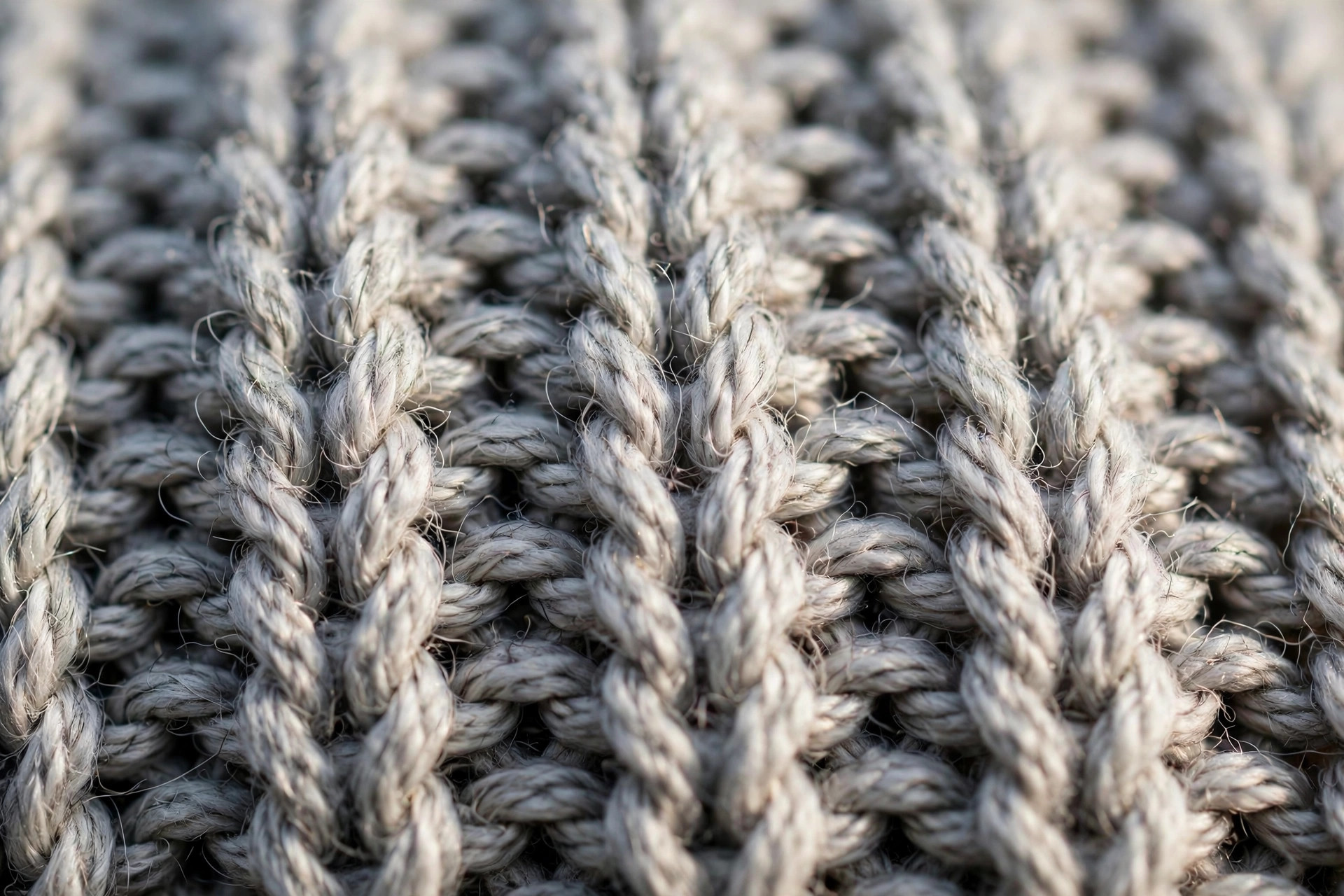
If the Knitwear Construction Guide is about how knitwear is made, this page is about the alphabet it is written in. A knitting needle can only do four things to a yarn — and yet those four actions, arranged in different sequences, produce everything from a gauze-fine interlock polo shirt to a fisherman's sweater dense enough to shed rain. Understanding the four stitches explains why fabrics behave as they do: why jersey curls, why ribs grip, and why a tuck-stitch cardigan feels spongier than a plain one.
The four basic stitches. Knit (plain): the new loop is drawn through the old loop from back to front, giving the smooth V shapes on the fabric's face. Purl (reverse): the loop is drawn through from front to back — the same loop, seen from the other side, showing as a horizontal bump. Tuck: the needle receives a new yarn but does not cast off the old loop, so an extra strand is held in the stitch, thickening and widening the fabric. Miss (float): the needle holds its loop while the yarn passes by without knitting, leaving a float on the back — the stitch that makes color patterns and many textures possible.
The Main Structures
Structures are what you get when one stitch pattern is repeated across the whole fabric. Each structure below knits on standard machinery, and each has a personality that decides where it is used.
Single Jersey (Stockinette)
All knit stitches, one needle bed. The face shows smooth V columns; the back shows purl bumps. Light, cheap, very stretchy across the width — and unbalanced, so it curls toward the face at the sides. The default structure of T-shirts, underwear, and fine sweater fronts.
Rib
Alternating columns (wales) of knit and purl stitches, worked on two needle beds — written 1×1, 2×2 and so on for the column counts. The columns pull together, so rib is dramatically elastic across the width, lies flat, and looks the same on both sides. That grip is why ribs finish cuffs, collars, and hems, and why a ribbed sweater body clings.
Purl (Links-Links)
Alternate courses of knit and purl stitches, so both faces show purl bumps. Thick, soft, and exceptionally wide-stretching with very little lengthwise give; it lies flat and has a subtle horizontal texture. Used for baby clothes, scarves, and textured sweater panels; historically knitted on double-ended "links-links" needles that flip between courses.
Interlock
Two 1×1 ribs intermeshed back to back, so both faces look like the smooth face of jersey. Firmer, thicker, and more stable than jersey, with no curl. Interlock is the premium T-shirt and polo fabric. The head-to-head comparison is set out in the Apparel Search term page on jersey vs interlock fabric.
Milano
A refined double structure built from courses of rib and jersey combined, giving a firm, smooth, almost woven hand with excellent shape retention and a soft sheen in fine yarns. Milano is a favorite for structured knit jackets, dresses, and tailored knitwear that must hold a silhouette like a woven garment.
Cables & Transferred Stitches
Not a base structure but a family of effects: stitches are transferred sideways so columns cross, forming ropes and braids. Cables consume extra yarn and pull the fabric narrower, which is why a cabled sweater feels denser than a plain one at the same gauge. See the Apparel Search entry on cable knits.
How Structure Changes the Fabric
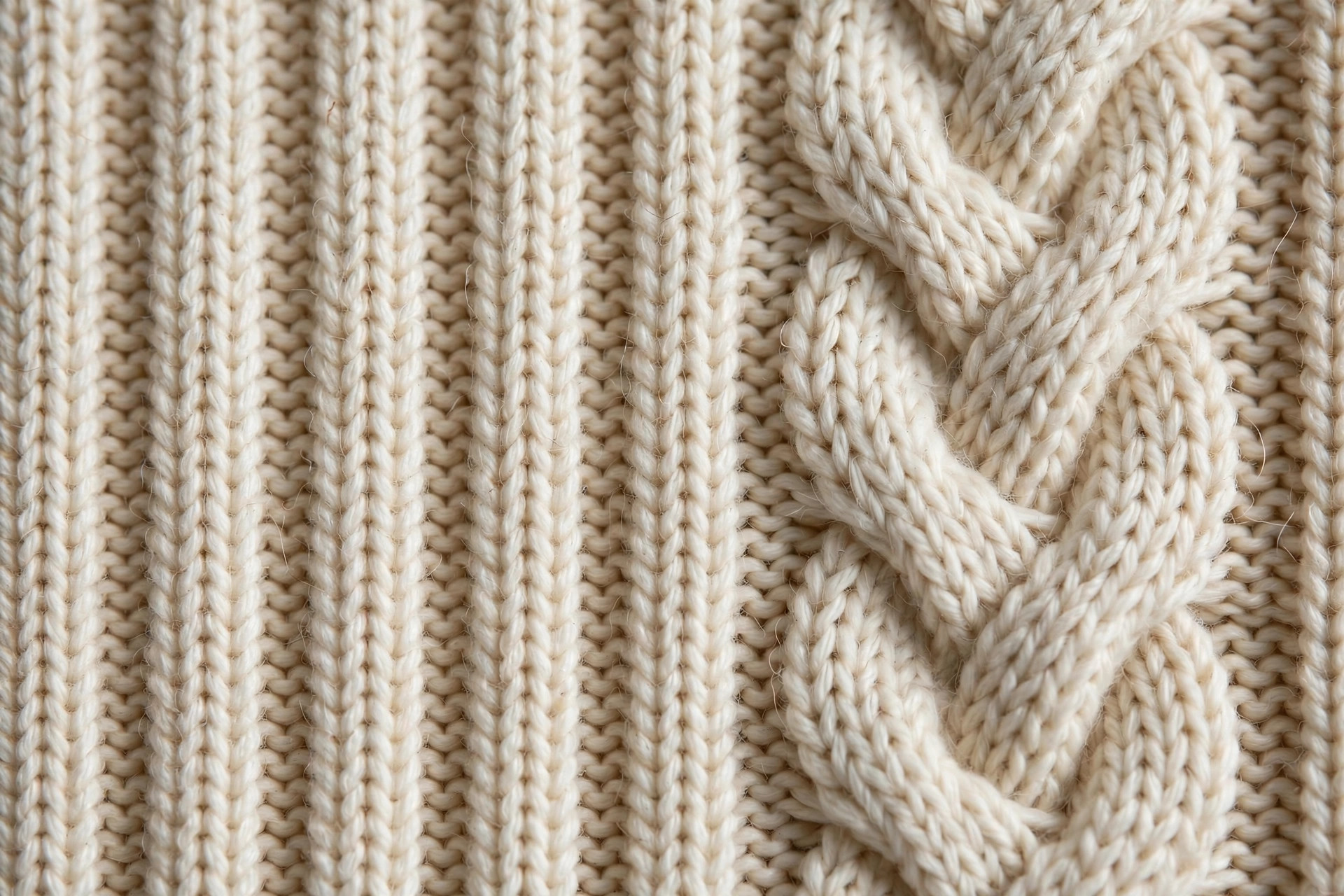
Three properties follow directly from the stitch plan. Balance: structures with knit and purl loops on both faces (rib, purl, interlock) lie flat, while one-sided jersey curls. Elasticity: rib structures can stretch well over half again their width because the columns concertina open; jersey stretches less and mostly in one direction; interlock's double construction makes it the most stable of the common structures. Bulk and warmth: tuck stitches and double-bed structures trap more air per square inch, which is why thermal underwear and winter knits lean on interlock, rib, and brushed or tuck-based structures — the same principle of trapped air that purpose-made thermal insulation fabrics are engineered around.
Structure also decides the surface. A designer choosing between jersey and interlock for the same yarn is choosing between a soft, fluid drape and a smooth, body-holding one; between a fabric that shows every contour and one that skims. None of this is visible from the fiber content on the label — it all lives in the stitch plan, which is why the construction guides in this series start here, with the loops themselves. The two machine families that form these structures are compared in Weft Knitting vs Warp Knitting.
Common Questions
- What are the four basic knit stitches?
- Knit (plain), purl (reverse), tuck, and miss (float). The knit stitch pulls a new loop through from behind; the purl stitch is the same loop formed from the opposite side; a tuck stitch holds the new yarn without drawing it fully through, adding thickness and texture; and a miss stitch lets the yarn float across the back of the needle while an existing loop is held. Every knitted structure is a combination of these four actions.
- Why does stockinette (jersey) fabric curl at the edges?
- Single jersey is unbalanced: all its loops face the same way, and the yarn's natural tension pulls the fabric toward the face at the sides and toward the back at the top and bottom. Structures that alternate knit and purl loops — rib, purl, and interlock — balance those forces and lie flat.
- What is the difference between jersey and interlock?
- Jersey is a single-bed structure with a distinct face and back; it is light, stretchy, and curls at the edges. Interlock is two ribs intermeshed on two needle beds, so both sides look like the face of jersey; it is thicker, firmer, smoother, and lies flat. Interlock costs more because it uses more yarn and knits more slowly.
- How are cable patterns knitted?
- Cables are made by transferring stitches: groups of loops are swapped in position so columns of stitches cross over each other, producing the familiar rope effect. On a machine this is done by transferring loops between needles (or needle beds); by hand, the stitches are held on a cable needle while their neighbors are worked.
More in the Knitwear Construction Guide
- Weft Knitting vs Warp Knitting — the two families and their machines
- Knit Gauge Explained — fineness, yarn, weight, and price
- Intarsia Knitting — clean single-layer color blocks
- Jacquard Knits — pattern from individually controlled needles
- How Sweaters Are Made — from knitted panels to finished garment
Back to the Knitwear Construction Guide
This page is one part of the Knitwear Construction Guide, Apparel Search's series on how knitted fabric and sweaters are made — stitches, gauge, colorwork, and production.