Every knitted fabric ever made belongs to one of two families, and the difference starts with a single question: which way does the yarn travel? This page is the foundation of the Knitwear Construction Guide — once the weft/warp distinction is clear, the stitch structures, gauges, and colorwork methods in the rest of the series fall into place.
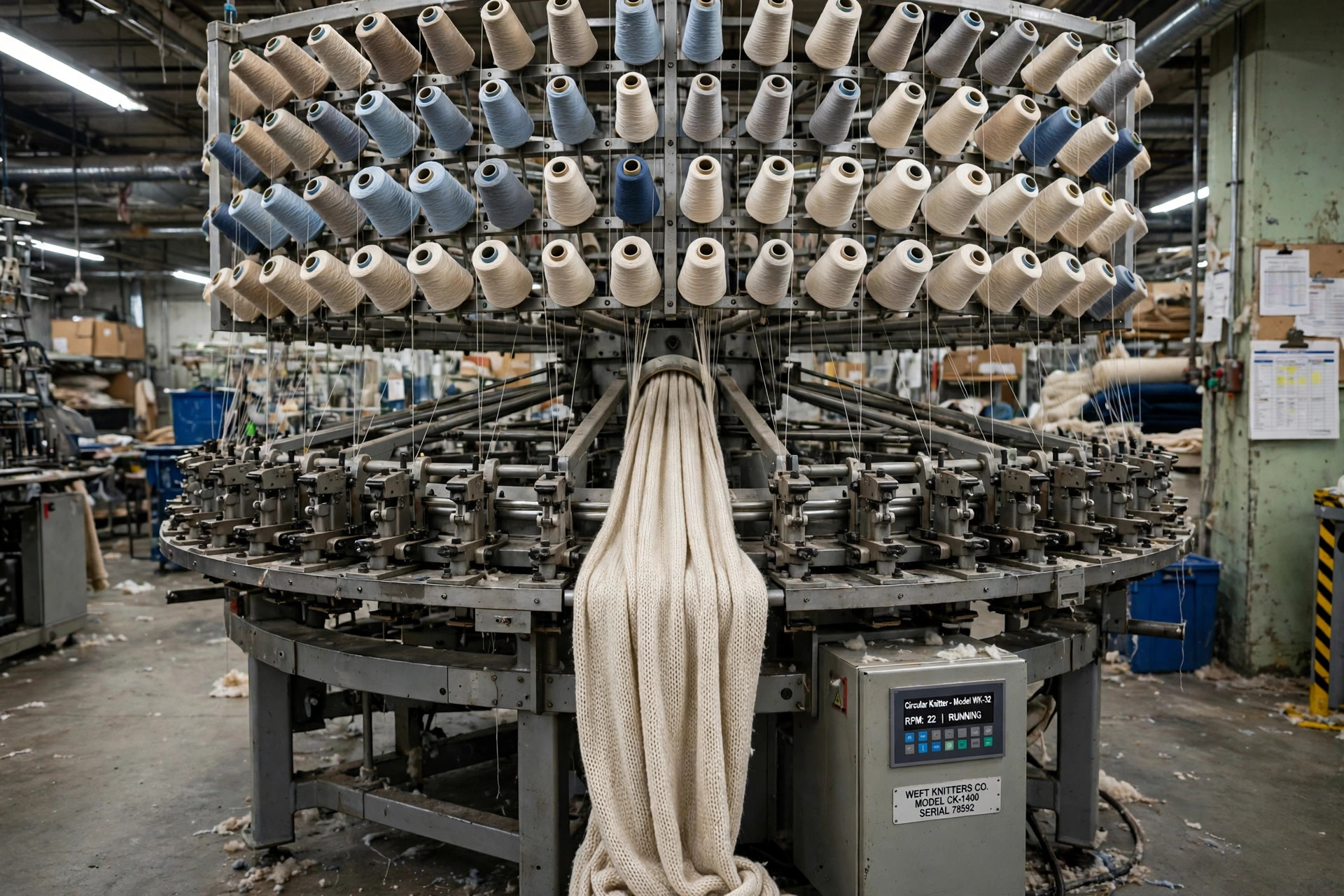
Weft knitting forms loops from a yarn that runs across the width of the fabric, building it one course (row) at a time — the industrial version of hand knitting. See the glossary entry for weft.
Warp knitting forms loops from many yarns at once, each fed from its own position on a warp beam and looping vertically down the length of the fabric. See the glossary entry for warp.
How Weft Knitting Works
In weft knitting, needles across the machine draw a single yarn (or one yarn per feeder) through the loops of the previous course, creating a new row. Because each course is completed before the next begins, the fabric is versatile: the machine can change yarns between courses, transfer stitches to shape a panel, work rib and cable structures, and knit color patterns — all within one piece of fabric. It is also the family's weakness: the last course is held in place only by friction and the loops below, so a broken yarn can ladder, and a free yarn end can be pulled to unravel the fabric course by course. Anyone who has pulled a loose thread on a cheap sweater has demonstrated weft knitting's defining flaw.
Weft knitting runs on three machine types. Circular machines arrange their needles in a cylinder and knit a seamless tube of fabric at very high speed — this is how single jersey for T-shirts, fleece, and interlock are produced, a process described in the circular knitting definition. Flat-bed (V-bed) machines carry two needle beds angled like an upside-down V; they knit flat panels and are the workhorses of sweater production, handling shaping, ribs, cables, intarsia, and jacquard. Straight-bar and hand frames survive in niche fully-fashioned production, the descendants of the original stocking frames.
How Warp Knitting Works
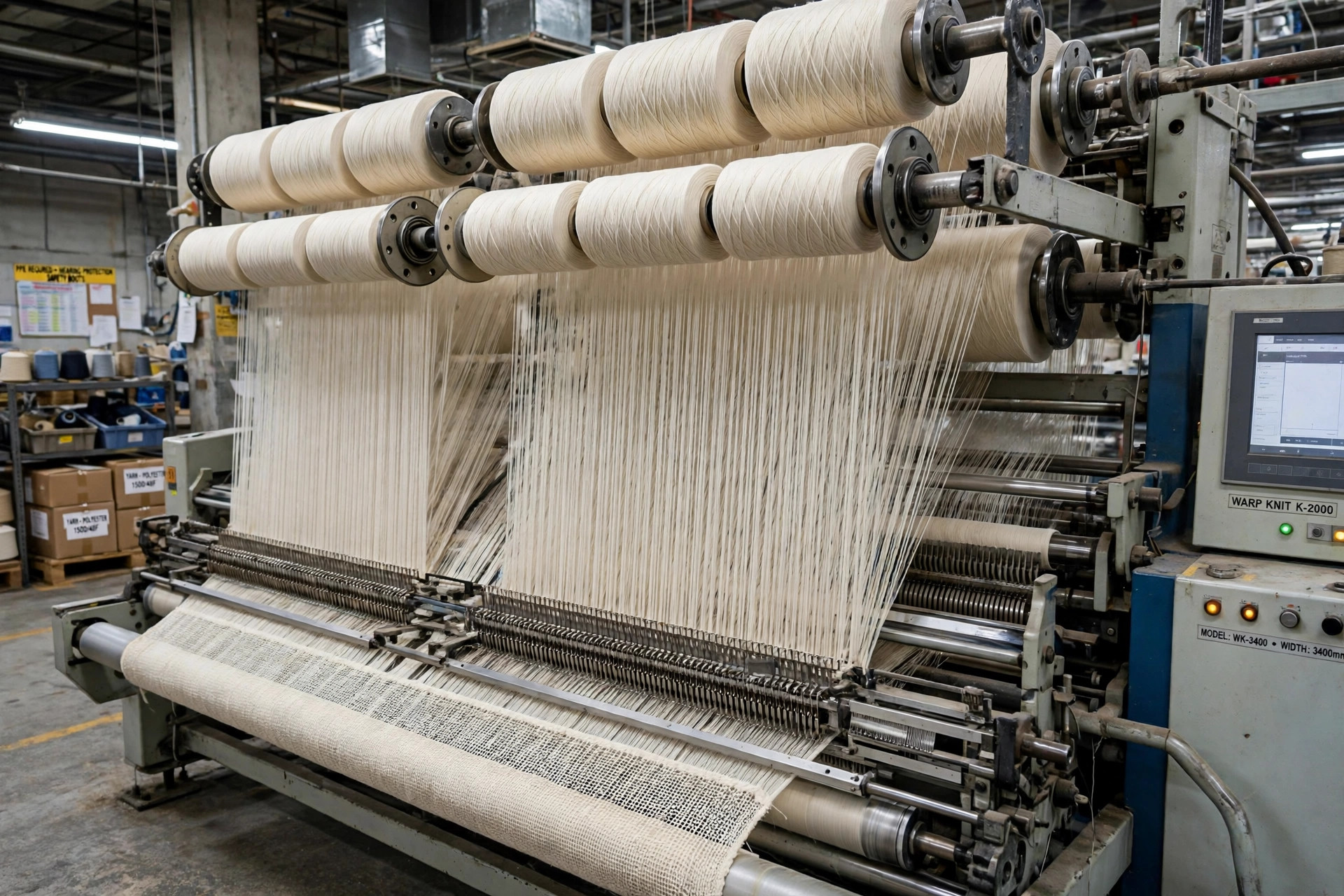
Warp knitting borrows its preparation from weaving: hundreds or thousands of yarn ends are wound side by side onto beams, like a warp. On the machine, each yarn is controlled by its own guide and forms loops vertically, in columns called wales, while simultaneously zig-zagging sideways to loop around neighboring yarns. That sideways interlock is the key to the fabric's character — every yarn is knitted into its neighbors, so warp-knitted fabric will not unravel, ladders very reluctantly, and holds its dimensions far better than weft knits. The trade-off is flexibility of design: all yarns run continuously for the full piece, so shaping panels or changing yarns mid-piece is impractical, and production is economical mainly in long, continuous runs.
Two machine families dominate. Tricot machines knit fine, smooth, close-structured fabrics — the tricot of lingerie, linings, brushed athletic linings, and swimwear. Raschel machines handle coarser and more open work: lace, power net for foundation garments, tulle and veiling, sports mesh, and the engineered mesh now common in shoe uppers. Raschel machines with jacquard patterning produce the intricate laces used in intimate apparel and bridal wear.
Side by Side
Weft Knitting
- Yarn path: horizontal, across the fabric, one course at a time
- Machines: circular, flat-bed (V-bed), hand frames
- Fabrics: single jersey, rib, interlock, purl, sweater knits, fleece
- Stretch: high, especially across the width
- Unravels? Yes — can ladder and unpick from the last course
- Shaping: panels can be knitted to shape (fully-fashioned)
- Typical products: sweaters, T-shirts, socks, knit dresses
Warp Knitting
- Yarn path: vertical, many yarns looping in parallel columns
- Machines: tricot and raschel, fed from warp beams
- Fabrics: tricot, raschel lace, power net, tulle, mesh
- Stretch: moderate; stable lengthwise, some width stretch
- Unravels? No — interlocked structure resists runs
- Shaping: fabric made in continuous lengths, then cut and sewn
- Typical products: lingerie, swimwear, lace, linings, shoe mesh
In practice the two families divide the wardrobe between them. If a garment is soft, stretchy, shaped, or patterned in the yarn, it is almost certainly weft knitted; if it is a fine, stable net, lace, or lining that refuses to fray, it is warp knitted. The structures each family can produce are explored further in Knit Stitches & Structures, and the fineness at which both families work is covered in Knit Gauge Explained.
Common Questions
- Which type of knitting is used for sweaters?
- Sweaters are weft knitted, almost always on flat-bed (V-bed) machines or by hand. Weft knitting lets the machine shape panels, work ribs, cables, intarsia, and jacquard patterns, and change yarns freely — none of which suits the continuous, beam-fed warp knitting process.
- Why does weft knitting unravel but warp knitting does not?
- In weft knitting each row of loops is held in place by the next row, so if a yarn breaks or an end is pulled, the loops can slip out course by course. In warp knitting every yarn loops around its neighbors in a zig-zag path, so the structure locks itself and a cut edge will not ladder or run.
- What fabrics are warp knitted?
- Tricot (smooth, fine fabric for lingerie, linings, and athletic wear), raschel fabrics (lace, power net, tulle, mesh, and open-work knits), and Milanese. Warp knits are also widely used for swimwear, sportswear mesh, and shoe uppers.
- Is a T-shirt weft or warp knitted?
- A T-shirt is weft knitted — usually single jersey produced on a large circular knitting machine. Circular weft machines knit a continuous tube of jersey at high speed, which is then cut and sewn into garments.
More in the Knitwear Construction Guide
- Knit Stitches & Structures — the four basic stitches and the fabrics they build
- Knit Gauge Explained — fineness, yarn, weight, and price
- Intarsia Knitting — clean single-layer color blocks
- Jacquard Knits — pattern from individually controlled needles
- How Sweaters Are Made — from knitted panels to finished garment
Back to the Knitwear Construction Guide
This page is one part of the Knitwear Construction Guide, Apparel Search's series on how knitted fabric and sweaters are made — stitches, gauge, colorwork, and production.