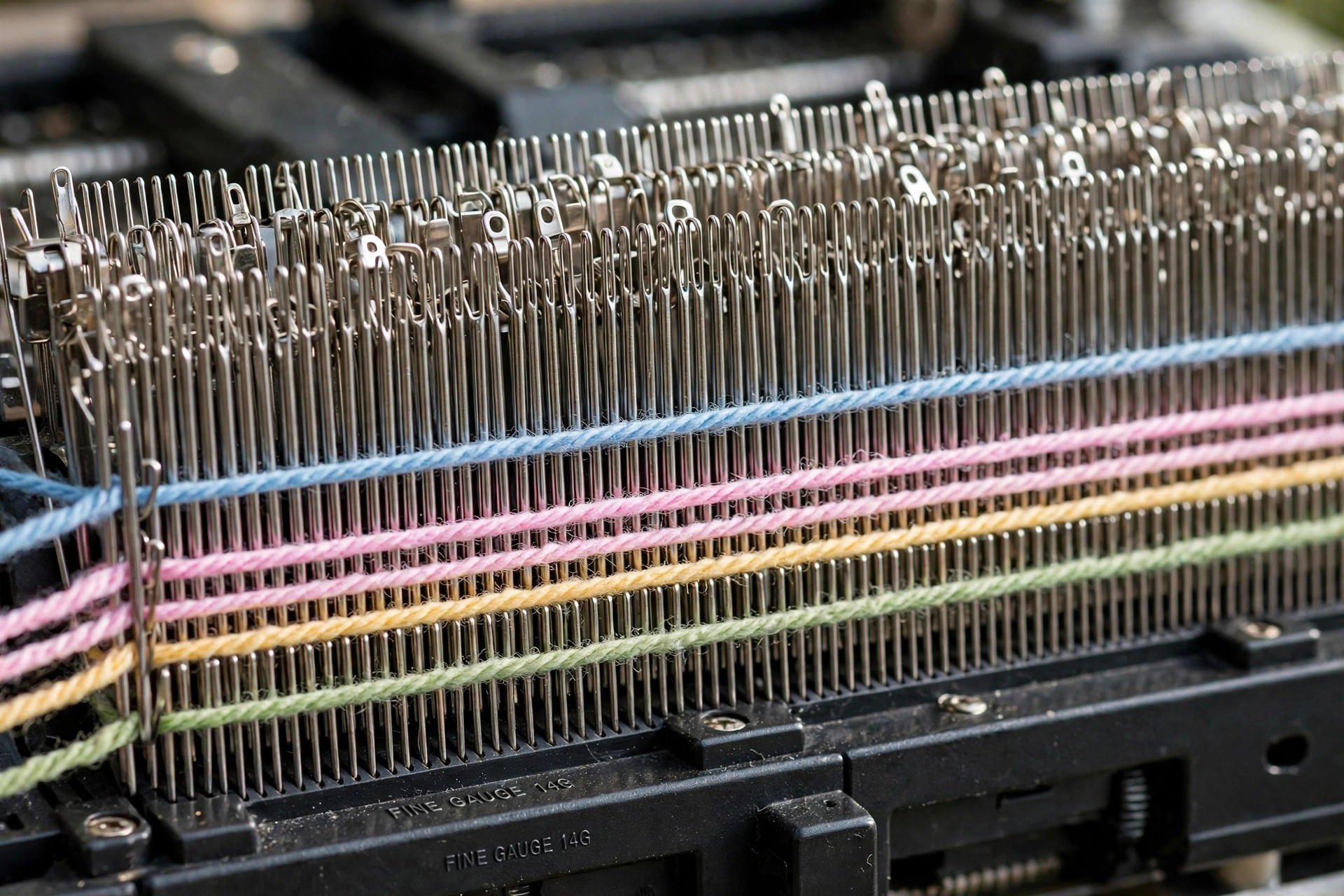
Ask a knitwear technician to describe a sweater in one word and they will give you a number: its gauge. This page of the Knitwear Construction Guide explains what that number measures, which gauges produce which kinds of knitwear, and why the number on the spec sheet quietly decides how a sweater will look, feel, fit, and cost.
Gauge (written gg) is the number of needles per inch across the needle bed of a knitting machine. A 12-gauge machine packs twelve fine needles into every inch; a 3-gauge machine has three stout ones. The needles set the maximum stitch size, so gauge is effectively the resolution of knitted fabric — higher gauge, smaller stitches, finer cloth.
The Sweater Gauge Scale
Flat-bed sweater machines are built in a standard range of gauges, and each band of the scale has its own territory. The bars below widen as the stitches — and the yarns that form them — get chunkier.
Circular machines for jersey run much finer still — gauges in the 20s and 30s are routine for T-shirt fabric — because their fabric is yardage, not shaped garments. On any gauge, the yarn must match: fine needles need fine, even yarn (often described by its count, such as 2/48s worsted), while coarse gauges take thick rovings or several ends of finer yarn plied together. A 12-gauge panel contains roughly sixteen times as many stitches as the same panel at 3 gauge, which brings us to the economics.
Why Gauge Drives Weight, Drape — and Price
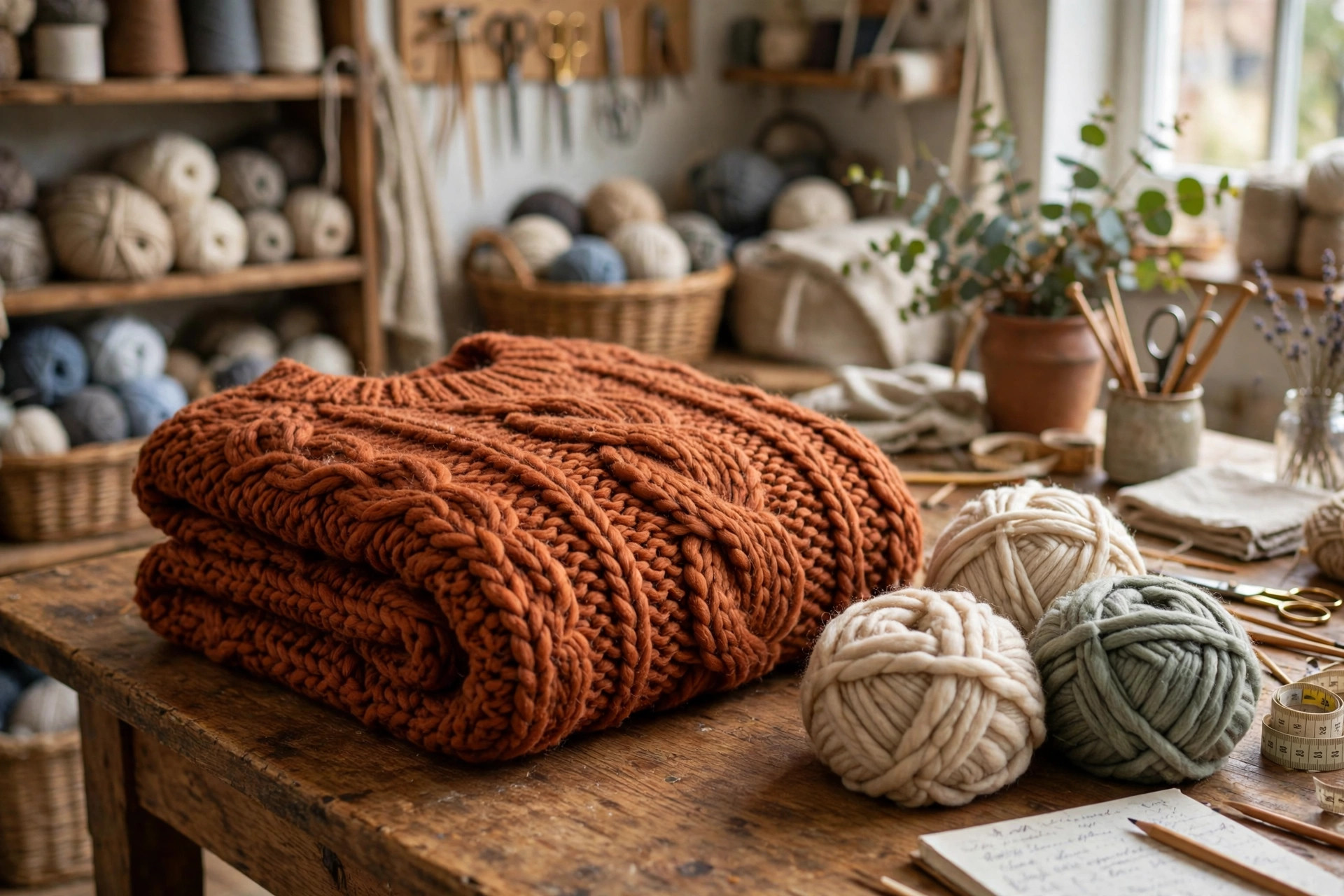
Weight and warmth. Coarse gauges build thick, lofty fabric that traps air and insulates; fine gauges build thin, dense fabric that layers without bulk. Neither is "warmer" in absolute terms — the fine knit is the one you wear under a blazer, the chunky one is the outer layer itself.
Drape and fit. Small stitches make a supple fabric that follows the body; large stitches make a sculptural fabric that stands away from it and adds visual volume. This is where gauge meets sizing: a chunky 3-gauge sweater adds measurable bulk over the body it covers, while a 14-gauge knit skims close — a relationship worth understanding alongside the ease and fit principles in the Sizing and Fit Guide. Designers choose gauge the way they choose silhouette, because at the extremes the two are the same decision.
Price. Fine gauge costs more at every step. The yarn must be finer and more uniform (defects show immediately in small stitches), the machine runs more courses to cover the same area, and patterned work — intarsia and jacquard — takes proportionally longer. Coarse gauge knits quickly but consumes heavy yarn by weight. A fair rule of thumb: among sweaters of similar fiber and construction quality (see How Sweaters Are Made), the finer gauge carries the higher making cost, while the chunkier knit carries the higher material weight.
A note on hand knitting. Hand knitters use the word differently: their "gauge" is a measured swatch — stitches and rows per 4 inches — taken to check tension before starting a garment. It answers the same question (how dense is this fabric?) but is measured from the output rather than specified by the machine. When a pattern says "22 stitches to 4 inches," it is doing the same job as the machine's gg number: fixing the size every stitch is allowed to be. The structures those stitches form are covered in Knit Stitches & Structures.
Common Questions
- What does 12 gauge mean on a sweater label?
- It means the sweater was knitted on a machine with 12 needles per inch of needle bed — a fine gauge. The resulting fabric has small, smooth stitches, a light weight, and a refined surface that layers well under jackets. By contrast, 5 or 7 gauge is a medium, textured knit, and 3 gauge is a chunky knit.
- Is a higher gauge sweater better quality?
- Not automatically — gauge describes fineness, not quality. A well-made chunky 3-gauge sweater in good wool outlasts a poorly made 14-gauge. But fine gauge does cost more to produce: it needs finer, more even yarn, contains far more stitches per garment, and knits more slowly, so fine-gauge knitwear is legitimately more expensive to make.
- How is machine gauge different from a hand knitter's gauge?
- Machine gauge counts needles per inch on the needle bed — a property of the machine. A hand knitter's gauge (also called tension) counts the stitches and rows actually produced in a measured swatch, usually per 4 inches or 10 cm, and depends on the knitter, yarn, and needle size. The two numbers describe the same idea — stitch density — from opposite ends.
- Can any yarn be knitted on any gauge?
- No. Yarn and gauge must match: the yarn has to pass through the needle hook and form a loop without straining the machine or leaving the fabric sleazy. As a rule, finer gauges need finer yarn counts, and one yarn may be plied up — several ends knitted together — to suit a coarser gauge. A mismatch produces holes, dropped stitches, or a board-stiff fabric.
More in the Knitwear Construction Guide
- Weft Knitting vs Warp Knitting — the two families and their machines
- Knit Stitches & Structures — the four basic stitches and the fabrics they build
- Intarsia Knitting — clean single-layer color blocks
- Jacquard Knits — pattern from individually controlled needles
- How Sweaters Are Made — from knitted panels to finished garment
Back to the Knitwear Construction Guide
This page is one part of the Knitwear Construction Guide, Apparel Search's series on how knitted fabric and sweaters are made — stitches, gauge, colorwork, and production.