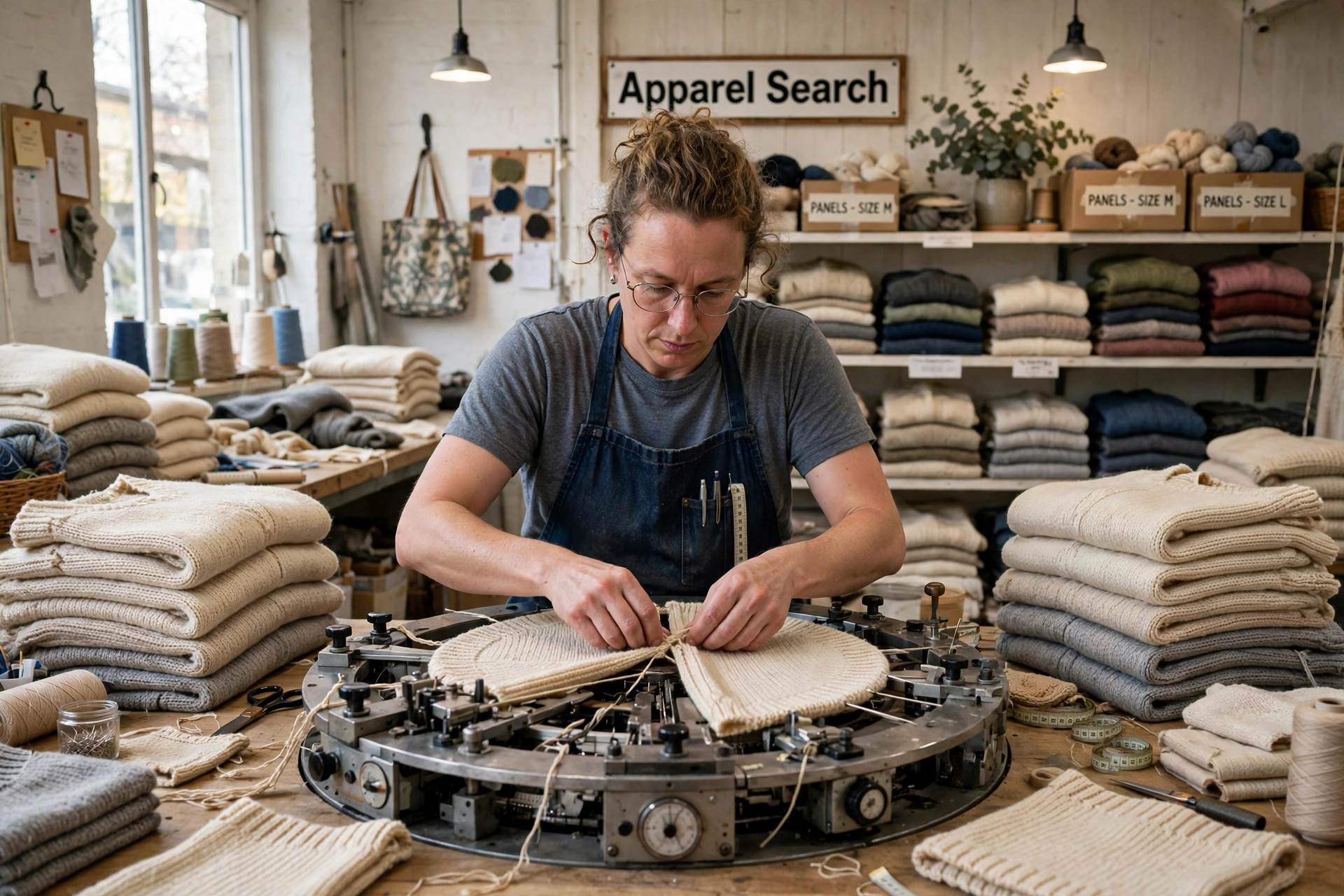
A sweater (see the sweater definition) looks simple, but factories build one by three quite different routes, and the route decides the garment's seams, its waste, and much of its price. This final page of the Knitwear Construction Guide walks through all three methods and the finishing steps that follow. Apparel Search's guide to manufacturing knitwear and sweaters introduces the business side; here we stay on the factory floor.
Method 1: Fully-Fashioned Knitting
The classic quality method. Each panel — front, back, two sleeves, collar — is knitted to its final shape on a flat-bed machine: stitches are transferred inward or outward at the edges (the increases and decreases called fashioning) so the armholes curve, the neck scoops, and the sleeve tapers exactly as the pattern requires. The shaped edges carry small doubled stitches known as fashioning marks, still used by informed buyers as a quality tell. Almost no yarn is wasted, because nothing is cut away; the cost is time, since shaping slows the knitting and the panels must then be linked by hand-guided machine. Most fine-gauge merino and cashmere sweaters at the quality end of the market are made this way, at the gauges described in the gauge guide.
Method 2: Cut-and-Sew
The volume method, borrowed from woven garment production. Knitters produce plain yardage — often on fast circular machines — and cutters lay paper patterns on it and cut panels out, exactly as with cloth. Panels are joined on overlock (serging) machines, which trim and stitch the seam in one pass. Cut-and-sew is fast, flexible, and cheap per garment, which is why most budget knitwear, sweatshirts, and jersey tops are made this way. Its costs are hidden in the seams and the bin: seams are thicker and less elastic than linked ones, the cut edges can ladder if the overlocking is skimped, and cutting typically wastes 15–25% of the knitted fabric — yarn that was spun, dyed, and knitted only to be thrown away.
Method 3: Whole-Garment (Seamless) Knitting
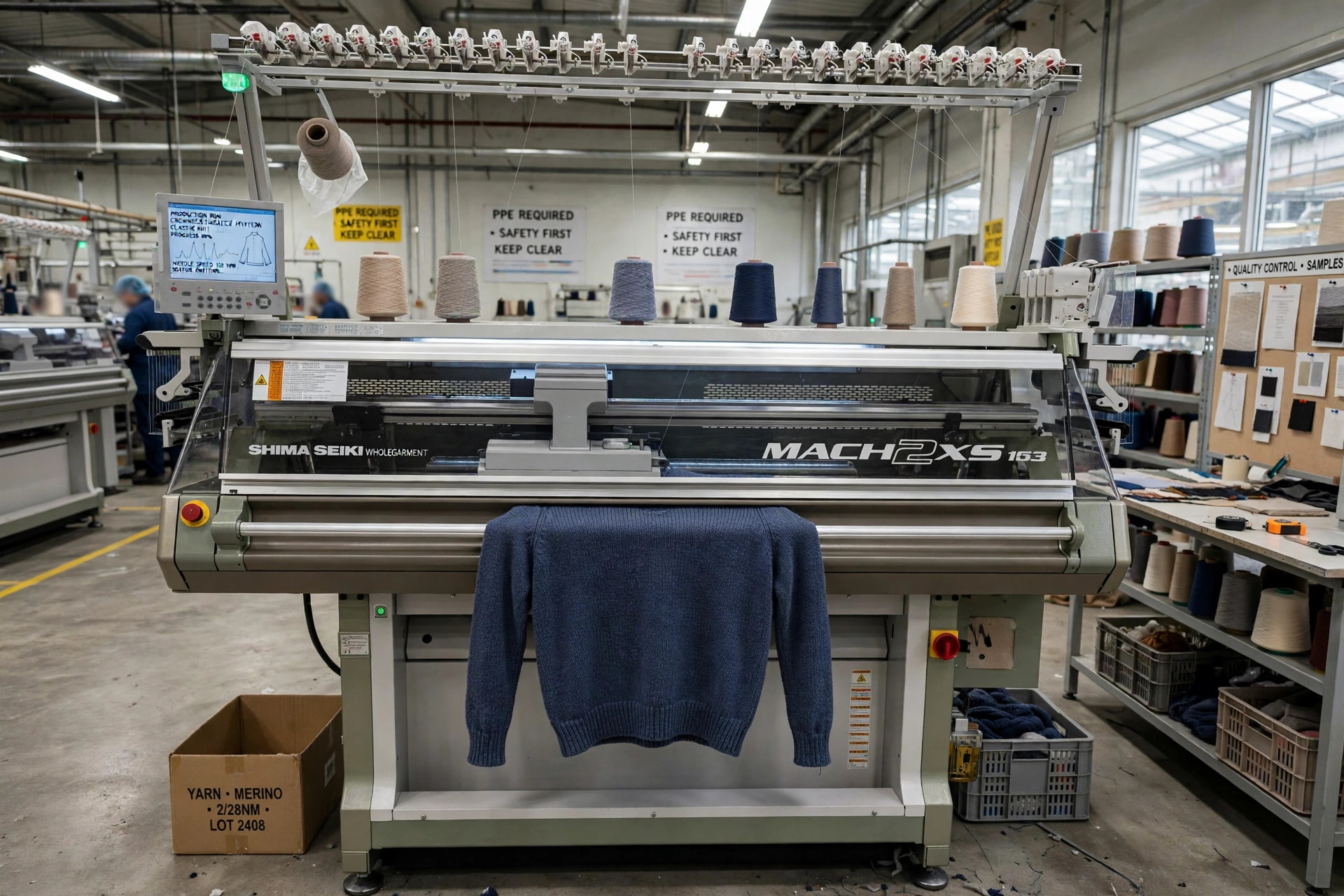
The newest method removes assembly almost entirely. On a whole-garment machine, body and sleeves are knitted as tubes and joined on the machine at the underarm, so the sweater comes off the needles complete: no panels, no linking, no sewing. The result wears beautifully — nothing rubs at the seams because there are none — and waste is near zero. The trade-offs are real: the machines are expensive and slower per garment than panel knitting, patterns and shaping must be engineered within the seamless format's limits, and a fault late in the long knitting cycle scraps a whole garment rather than one panel. Whole-garment production has found its strongest foothold in premium knitwear, seamless activewear, and footwear uppers.
From Pieces to Finished Sweater: The Shared Steps
However the pieces are knitted, what follows is broadly the same sequence — the steps numbered below are where much of a sweater's final quality is won or lost.
Knit the pieces
Panels (fully-fashioned or for cutting), yardage, or a complete garment come off the machine at the specified gauge and structure — jersey, rib, cable, intarsia, or jacquard — and are rested so the loops relax before handling.
Link or sew the seams
Fully-fashioned panels are linked: a worker places the edge loops of two panels onto the points of a circular dial linking machine, which chain-stitches through loop for loop with a matching yarn, leaving a flat, elastic seam. Cut-and-sew panels are overlocked instead; collars, cuffs, and hems knitted separately are attached at this stage too.
Wash and relax
The assembled sweater is washed to remove knitting oils, relax the loops to their true dimensions, and bloom the yarn's surface. This is the garment's first real test: it only has a size once it has been washed and dried, and measurements are checked against the spec here, not before.
Mend and inspect
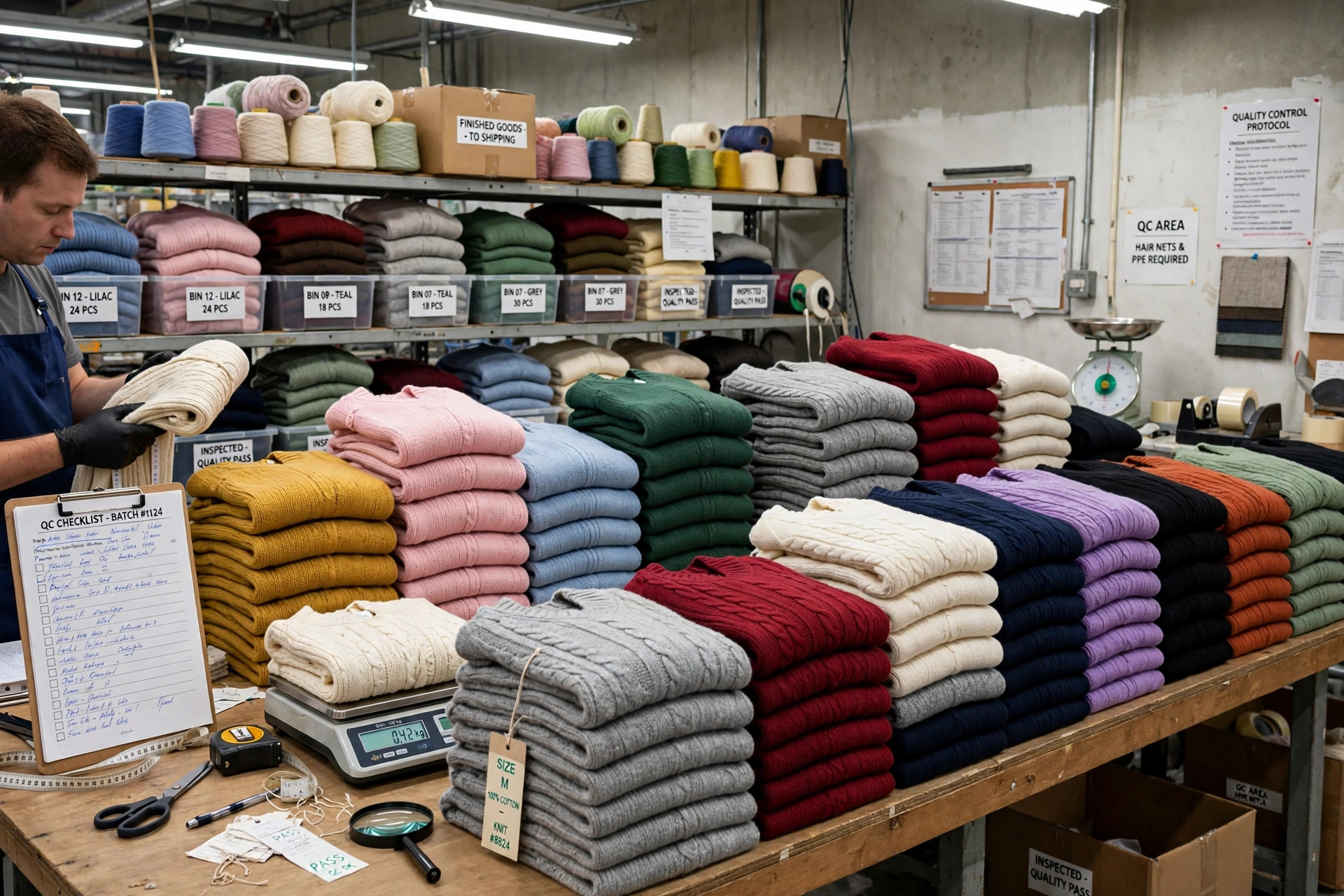
Inspectors examine every garment on a light table or form, mending dropped stitches and flaws by hand with a latch needle, and checking seams, pattern placement, and symmetry. Faults that cannot be invisibly repaired downgrade the garment to seconds.
Press and measure
Steam pressing (and blocking to a board for some styles) sets the final shape and dimensions; chest, length, sleeve, and neck are measured point by point. Careful pressing is what gives a new sweater its crisp retail finish — the home version of the same craft is covered in the Garment Care Guide.
Trim, label, fold, and pack
Loose ends are trimmed, buttons and trims attached, brand and care labels sewn in, and the sweater is folded — often with tissue and a board — and bagged. A final audit sample is checked before the cartons close.
Read backwards, the sequence explains the price ladder in any knitwear department. The cut-and-sew sweater skips the slow steps — fashioning, linking, careful mending — and pays for its speed in waste and seam quality. The fully-fashioned sweater pays for skilled time at steps 1, 2, and 4. The whole-garment sweater swaps labor for machine capital. Same loops, same basic stitches — three different bargains between time, waste, and money.
Common Questions
- What is the difference between fully-fashioned and cut-and-sew knitwear?
- Fully-fashioned panels are knitted to their exact shape on the machine by increasing and decreasing stitches, then joined by linking loop to loop — minimal waste, flat flexible seams, higher cost. Cut-and-sew knitwear is knitted as plain yardage, cut into panels with patterns like woven cloth, and overlocked together — faster and cheaper, but it wastes a significant share of the fabric and produces thicker seams.
- What is whole-garment (seamless) knitting?
- Whole-garment knitting produces a complete sweater — body and sleeves together — in one piece on a specialized flat-bed machine, with no linking or sewing afterwards. It eliminates seam bulk and post-knitting labor and wastes almost nothing, but the machines are expensive, knitting is slower per garment, and design freedom at the armhole and neck is more limited.
- What is linking in sweater making?
- Linking (also called looping) is the process of joining fully-fashioned panels by placing the edge loops of two pieces onto the points of a circular linking machine and chain-stitching through corresponding loops with a yarn. Done well, the seam is flat, elastic, and nearly invisible — the hallmark of quality knitwear — and 'fashioning marks' (small double stitches at the shaping edges) remain as a tell-tale sign.
- Why are sweaters washed before they are sold?
- The factory wash relaxes the knitted loops into their final dimensions, removes knitting oils and any milling finish, and lets the yarn bloom to its intended softness and surface. It is also a quality checkpoint: measurements are verified after washing and drying, because a sweater is only its specified size once it has been washed.
More in the Knitwear Construction Guide
- Weft Knitting vs Warp Knitting — the two families and their machines
- Knit Stitches & Structures — the four basic stitches and the fabrics they build
- Knit Gauge Explained — fineness, yarn, weight, and price
- Intarsia Knitting — clean single-layer color blocks
- Jacquard Knits — pattern from individually controlled needles
Back to the Knitwear Construction Guide
This page is one part of the Knitwear Construction Guide, Apparel Search's series on how knitted fabric and sweaters are made — stitches, gauge, colorwork, and production.