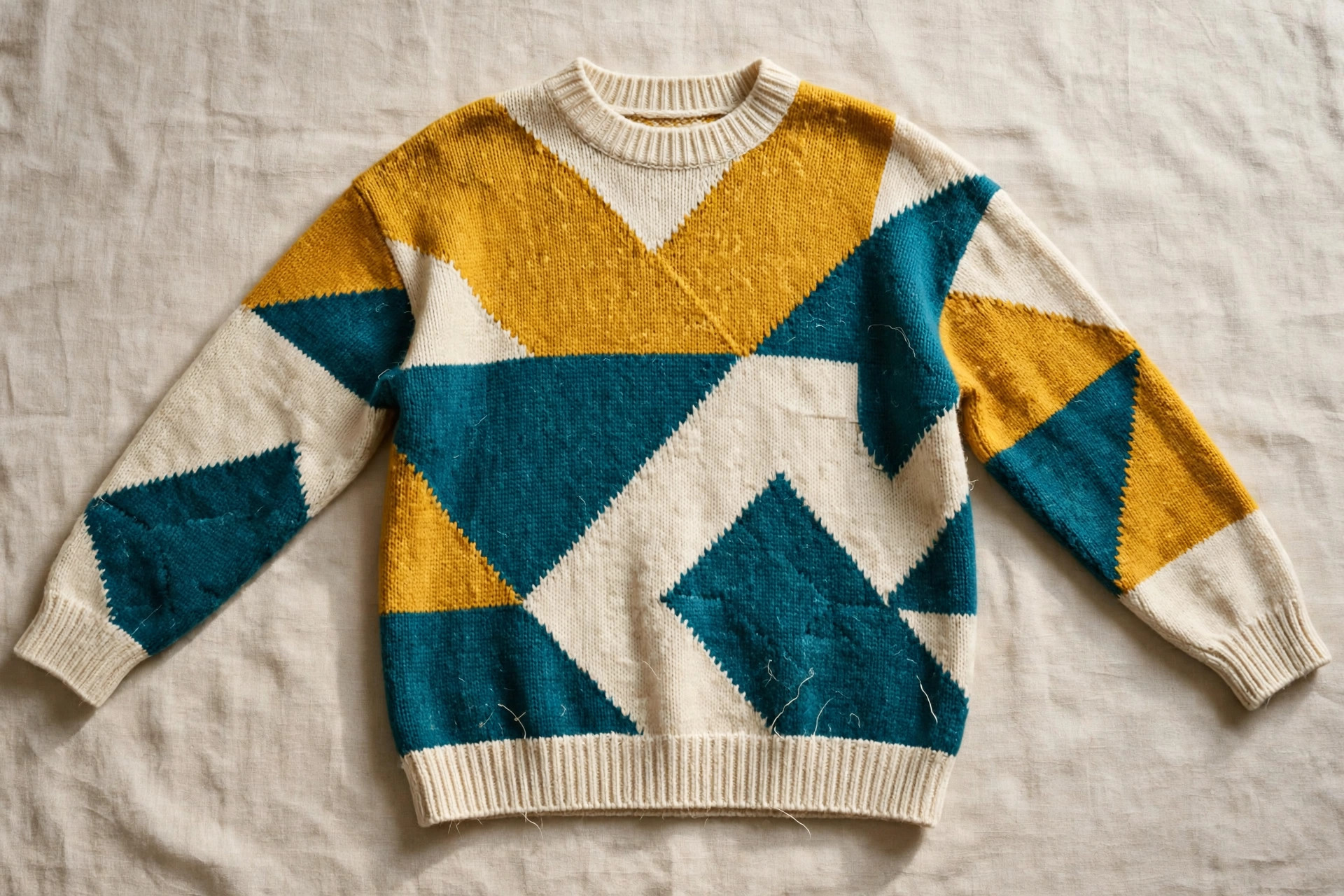
Most color in knitting is added by carrying yarns across the row and letting the unused colors float behind the work. Intarsia takes the opposite approach, and it is the approach that makes true "picture knitting" possible. This page of the Knitwear Construction Guide explains how intarsia works, where it excels, and how to tell it from its close relatives.
Intarsia (from the Italian intarsio, inlay — the same word used for inlaid wood marquetry) is a colorwork method in which every distinct area of color is worked from its own separate ball, bobbin, or yarn carrier. Where two colors meet, the yarns are twisted around each other to lock the boundary. No yarn ever travels outside its own territory, so the finished fabric is a single layer with a back almost as clean as the front.
How Intarsia Is Worked
Picture a sweater front with a large cream diamond on a teal ground. An intarsia knitter sets up three yarn supplies: teal, cream, teal again. Each course is knitted across in sections — teal to the diamond's edge, then the teal yarn is dropped, twisted around the cream yarn to prevent a hole, the diamond is knitted with cream, another twist, and the second teal supply finishes the row. The number of supplies grows with the design: a complex picture sweater may run a dozen bobbins dangling from a single row, each one responsible for one island of color.
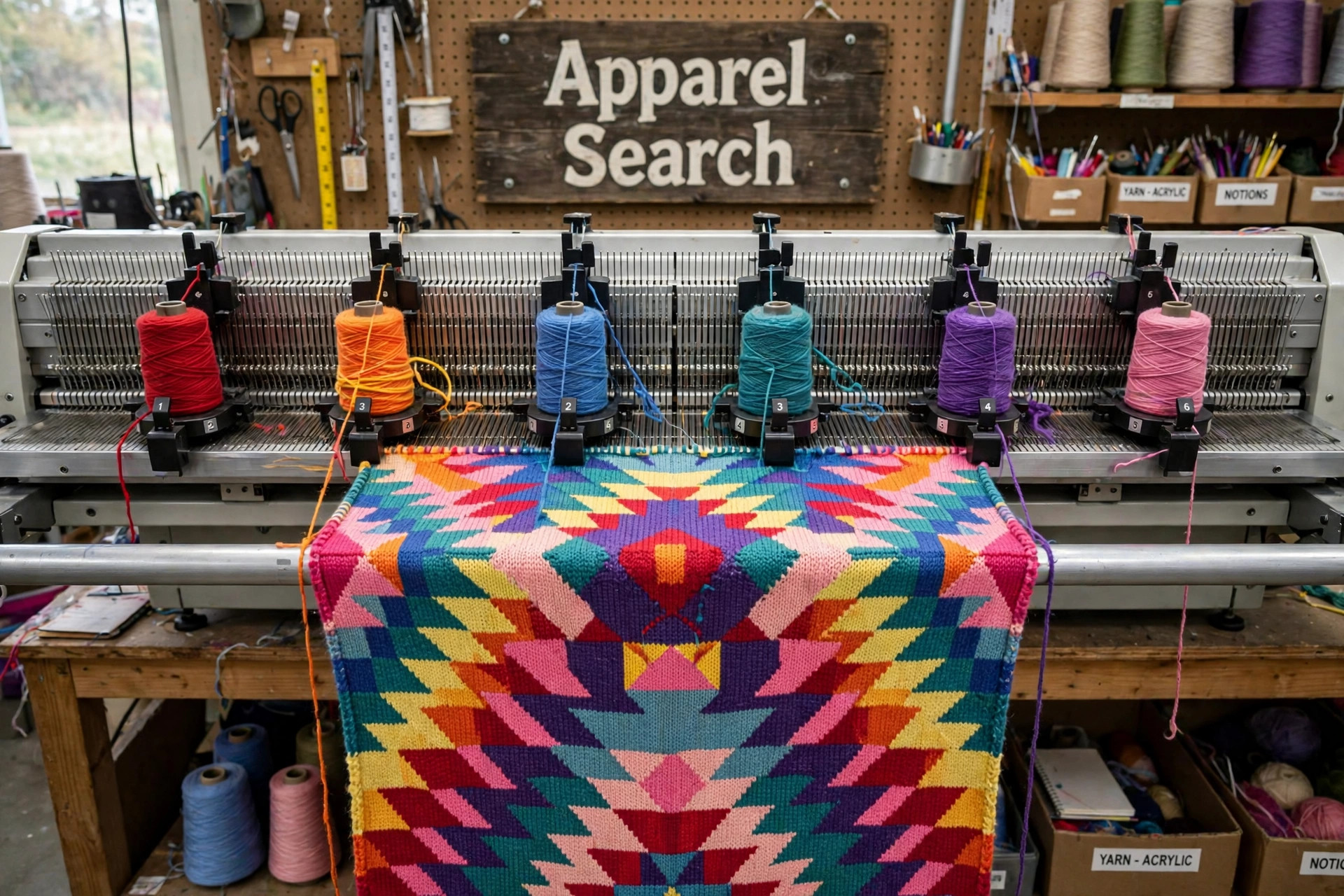
On a flat-bed machine the same logic is automated: multiple yarn carriers, each loaded with one color, are parked and activated in sequence as the carriage crosses the panel, laying each color only where the design calls for it. It is slow, exacting work compared with plain knitting — every color change is a stop, a twist, and a restart — which is why genuine intarsia pieces sit at the premium end of knitwear, and why the technique sings at the medium and fine gauges used for fashion sweaters.
Intarsia vs Stranded (Fair Isle) Knitting
The two techniques are often confused because both produce multicolor knitting, but they build fundamentally different fabrics:
- Yarn path. Stranded knitting carries two (occasionally three) yarns across the entire row; every stitch is knitted with one while the others float behind. Intarsia yarns never leave their blocks.
- Fabric thickness. Stranded fabric is effectively a layer and a half — warm and slightly padded by its floats. Intarsia fabric is exactly one layer everywhere, so a motif area feels identical to the ground around it.
- Pattern scale. Floats must be caught every few stitches, so stranded patterns are built from small, frequently repeating motifs — the peerie patterns and snowflakes of Fair Isle tradition. Intarsia handles motifs of any size, including a single motif as large as the garment itself.
- Boundaries. Intarsia draws crisp vertical edges and clean diagonals stepping one stitch at a time; fine curves and tiny details go stepped or are added later by embroidery — the classic argyle diamond is intarsia, with its thin crossing lines surface-stitched afterwards.
- Stretch. Floats limit how far stranded fabric can stretch sideways; intarsia fabric stretches like the plain stockinette it mostly is.
How to Recognize Intarsia
- The motif area is the same thickness as the rest of the garment — no padded pattern zone.
- The back is clean: colors appear in the same blocks, slightly less tidy, with no horizontal floats.
- Color blocks have sharp, stepped edges, and diagonal lines or lettering details are often embroidered on top.
- The garment was necessarily knitted flat and seamed — intarsia cannot be worked in the round.
Where Intarsia Is Used
Intarsia is the technique of choice wherever a sweater carries a distinct image: argyle socks and golf sweaters, club and team crests, brand logos, cartoon and novelty "picture" sweaters, and the bold geometric color-blocking that cycles through fashion every few seasons. Because the fabric stays light and flat, it suits fine-gauge fashion knitwear better than stranded work, and because each block is independent, a designer can place one large motif exactly where it belongs on the body rather than repeating a pattern across it. For repeating all-over pattern instead — where a computer, not a bobbin, should do the work — the industry turns to jacquard knitting, the subject of the next guide in this series. Both methods depend on the basic stitches and structures covered in Knit Stitches & Structures.
Common Questions
- What is intarsia knitting?
- Intarsia is a colorwork technique in which each area of color is knitted from its own separate supply of yarn, and the yarns are twisted around each other where colors meet. The fabric stays a single layer thick with no floats (strands) across the back, making it ideal for large, bold blocks of color and picture motifs.
- What is the difference between intarsia and Fair Isle?
- Fair Isle is a stranded technique: two or more yarns travel across the whole row, knitting the pattern stitches and floating behind the rest, which creates an all-over pattern and a thicker, warmer fabric. Intarsia uses a separate yarn supply for each color area, so the fabric is one layer thick with a clean back. Fair Isle suits small repeating motifs; intarsia suits large blocks and pictures.
- Is argyle knitted with intarsia?
- Yes — the diamond blocks of an argyle pattern are classic intarsia: each diamond is its own color area worked from a separate yarn supply. The thin diagonal lines that cross the diamonds are traditionally added afterwards with duplicate stitch (Swiss darning) or a fine surface embroidery.
- Why can't intarsia be knitted in the round?
- Because each color area's yarn must return to its own block on every row. Worked flat, the knitter passes back and forth and each supply stays in its area; worked in the round, the yarn would end each round on the wrong side of its block. Intarsia garments are therefore knitted in flat panels and seamed.
More in the Knitwear Construction Guide
- Weft Knitting vs Warp Knitting — the two families and their machines
- Knit Stitches & Structures — the four basic stitches and the fabrics they build
- Knit Gauge Explained — fineness, yarn, weight, and price
- Jacquard Knits — pattern from individually controlled needles
- How Sweaters Are Made — from knitted panels to finished garment
Back to the Knitwear Construction Guide
This page is one part of the Knitwear Construction Guide, Apparel Search's series on how knitted fabric and sweaters are made — stitches, gauge, colorwork, and production.