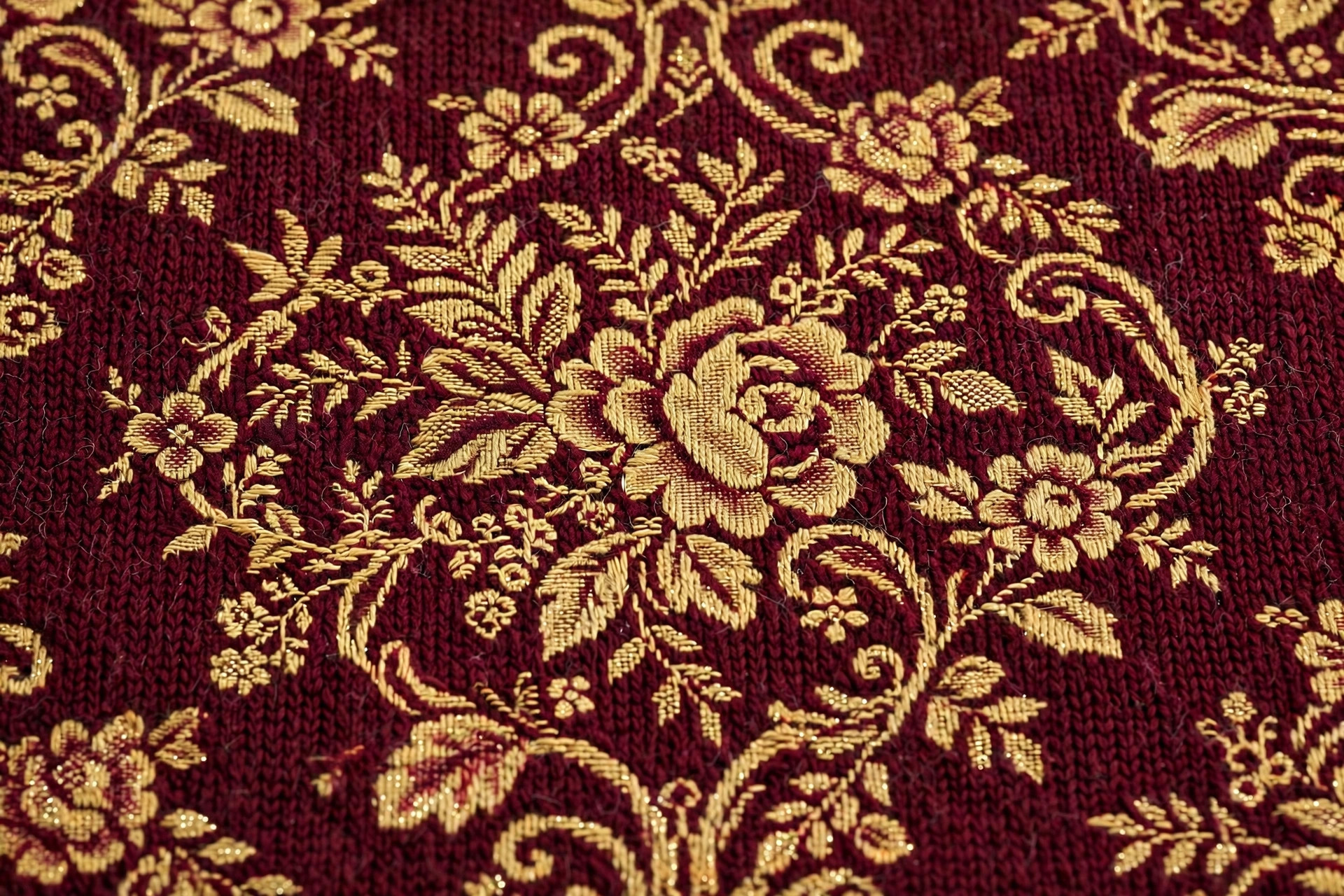
On a plain knitting machine, every needle in a row does the same thing. The jacquard mechanism breaks that rule — it lets the pattern choose, needle by needle and stitch by stitch, which needles knit, which tuck, and which miss. That single capability is what turns knitting from a fabric-forming process into a pattern-drawing one. This page of the Knitwear Construction Guide explains how jacquard knitting works and where it stands against the two other great colorwork methods, intarsia and Fair Isle.
Jacquard knitting is any knitting in which needles are selected individually under pattern control. The name honors Joseph-Marie Jacquard, whose 1804 punched-card system let a loom weave figured cloth automatically; knitting adopted the idea first with cards and mechanical selectors, and modern machines select needles electronically from a design file prepared in pattern software. The result: multi-color pictures, geometric patterning, cables-and-lace texture combinations, and even different stitch structures side by side, all knitted in one pass.
How the Pattern Gets Into the Fabric
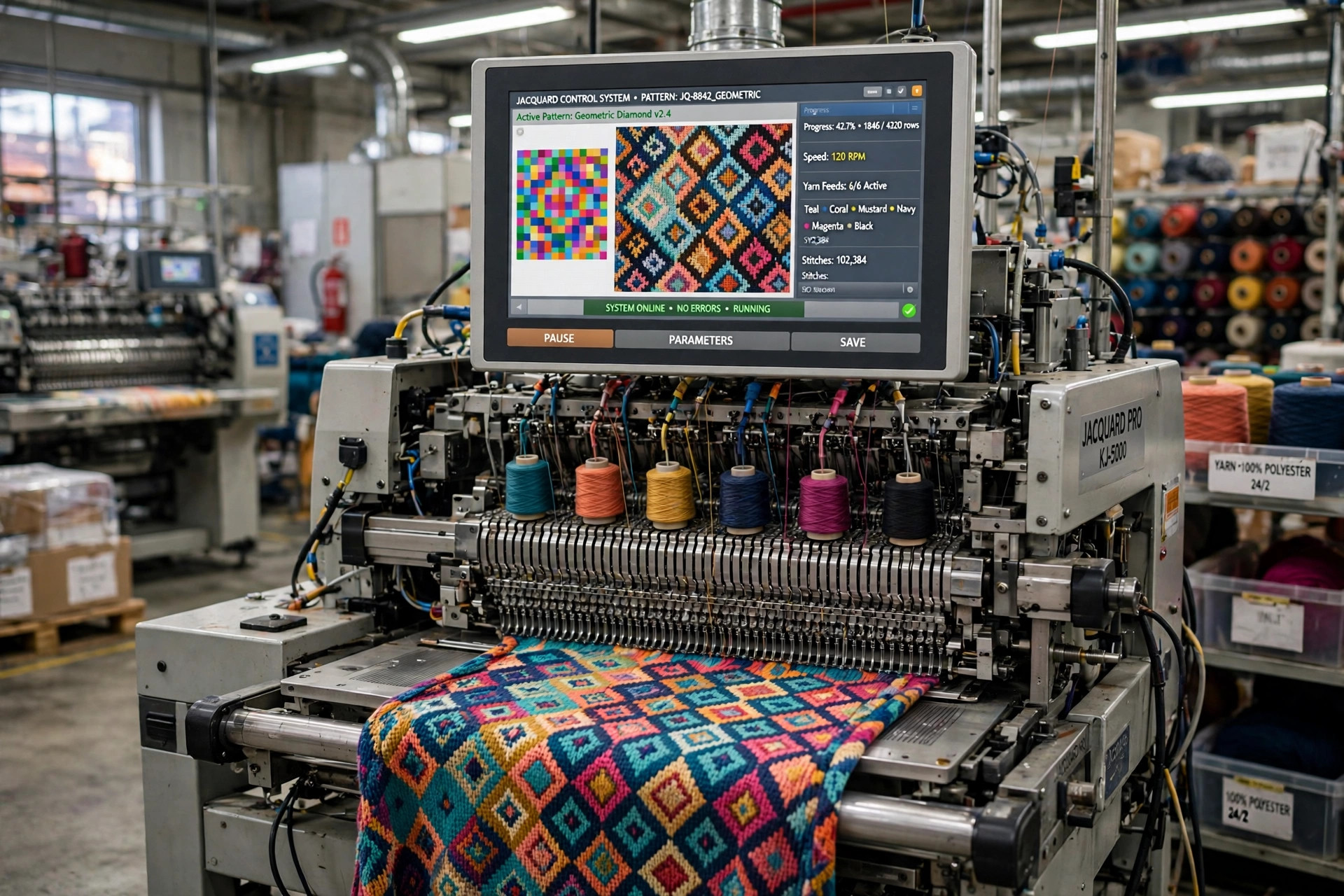
A jacquard design begins as a stitch-by-stitch map — today a digital file, in earlier generations a chain of punched cards. As each course is knitted, the selection system reads one line of the map and sets each needle's action for that pass: knit with color A, knit with color B, tuck, or miss. Because selection repeats every course, the design can be as tall as the garment; because it acts on every needle, it can be as wide. A designer can therefore knit a repeating snowflake band, a placement floral, or a full photographic image (in a handful of colors) without stopping the machine.
For color jacquard, the yarns not being knitted on the face travel as floats behind the stitches that are — this is stranded knitting under machine control. Well-engineered jacquards manage those floats: designs limit how far a color floats, and many machines knit the floats into a fine interlocked "bird's eye" backing on double-bed work, giving a smoother, snag-resistant reverse side. Texture jacquard uses no extra colors at all: knit, tuck, and miss stitches selected in pattern create blister, waffle, and lace effects from a single yarn. The same selection principle also drives raschel jacquard machines in the warp-knitting family, which produce most of the world's fine lace (see Weft Knitting vs Warp Knitting).
Jacquard vs Intarsia vs Fair Isle
Jacquard
Control: machine selects each needle from a pattern file. Back: floats (or bird's-eye backing). Best for: repeating all-over patterns, detailed motifs, texture effects, production volume. Thickness: face layer plus float layer.
Intarsia
Control: separate yarn supply parked for each color block. Back: clean, mirror of the front. Best for: one large motif, logos, argyle, bold color blocks. Thickness: single layer throughout.
Fair Isle
Control: knitter (or jacquard machine) strands two colors across each row. Back: short, regular floats. Best for: small geometric bands and yokes in the Shetland tradition. Thickness: warm double layer in pattern areas.
The honest summary is that the three overlap: Fair Isle began as a hand technique and a regional style, but the "Fair Isle" sweater in a shop today was almost certainly knitted on a jacquard machine programmed to strand its colors in the traditional way. Intarsia remains genuinely distinct — its yarns never travel — and jacquard is the umbrella technology that can imitate stranded work, textures, and much more, at production speed. Choosing between them is an engineering decision about pattern scale, fabric weight, and cost per piece, taken at the gauge the garment is designed for.
Common Questions
- What is a jacquard knit?
- A jacquard knit is a patterned fabric produced on a machine that can select needles individually, stitch by stitch, according to a stored design. Named after Joseph-Marie Jacquard's punched-card pattern control (invented for weaving in 1804 and adapted to knitting), the mechanism lets each needle knit, tuck, or miss independently — so complex multi-color pictures, textures, and lace effects can be knitted directly into the fabric.
- Is Fair Isle the same as jacquard?
- Not exactly. Fair Isle is a style and technique — traditional stranded colorwork with small geometric motifs in a limited palette, knitted by hand with the yarns carried across the row. But most machine-made 'Fair Isle style' sweaters in shops are actually produced on jacquard machines, which select the needles for each color automatically. All stranded machine colorwork is jacquard; not all jacquard is Fair Isle.
- How can you tell a jacquard knit from an intarsia knit?
- Turn the garment inside out. A jacquard knit has floats — loose strands of the unused colors running across the back wherever the pattern changes color. An intarsia knit has a clean back that mirrors the front blocks with no floats, because each color was worked from its own yarn supply. Jacquard patterns also tend to repeat across the fabric; intarsia motifs are usually placed once.
- Why do jacquard knits have floats on the back?
- In a jacquard pattern, each color yarn must travel to wherever the design next needs it, and in weft knitting the only route is across the back of the stitches it is not forming. Short floats are normal and harmless; better machines and designs keep them orderly, sometimes interlocking them into a fine 'bird's eye' backing so they do not snag.
More in the Knitwear Construction Guide
- Weft Knitting vs Warp Knitting — the two families and their machines
- Knit Stitches & Structures — the four basic stitches and the fabrics they build
- Knit Gauge Explained — fineness, yarn, weight, and price
- Intarsia Knitting — clean single-layer color blocks
- How Sweaters Are Made — from knitted panels to finished garment
Back to the Knitwear Construction Guide
This page is one part of the Knitwear Construction Guide, Apparel Search's series on how knitted fabric and sweaters are made — stitches, gauge, colorwork, and production.