Silicone Wash
Silicone wash (silicone finishing) contractors for fabric and apparel.
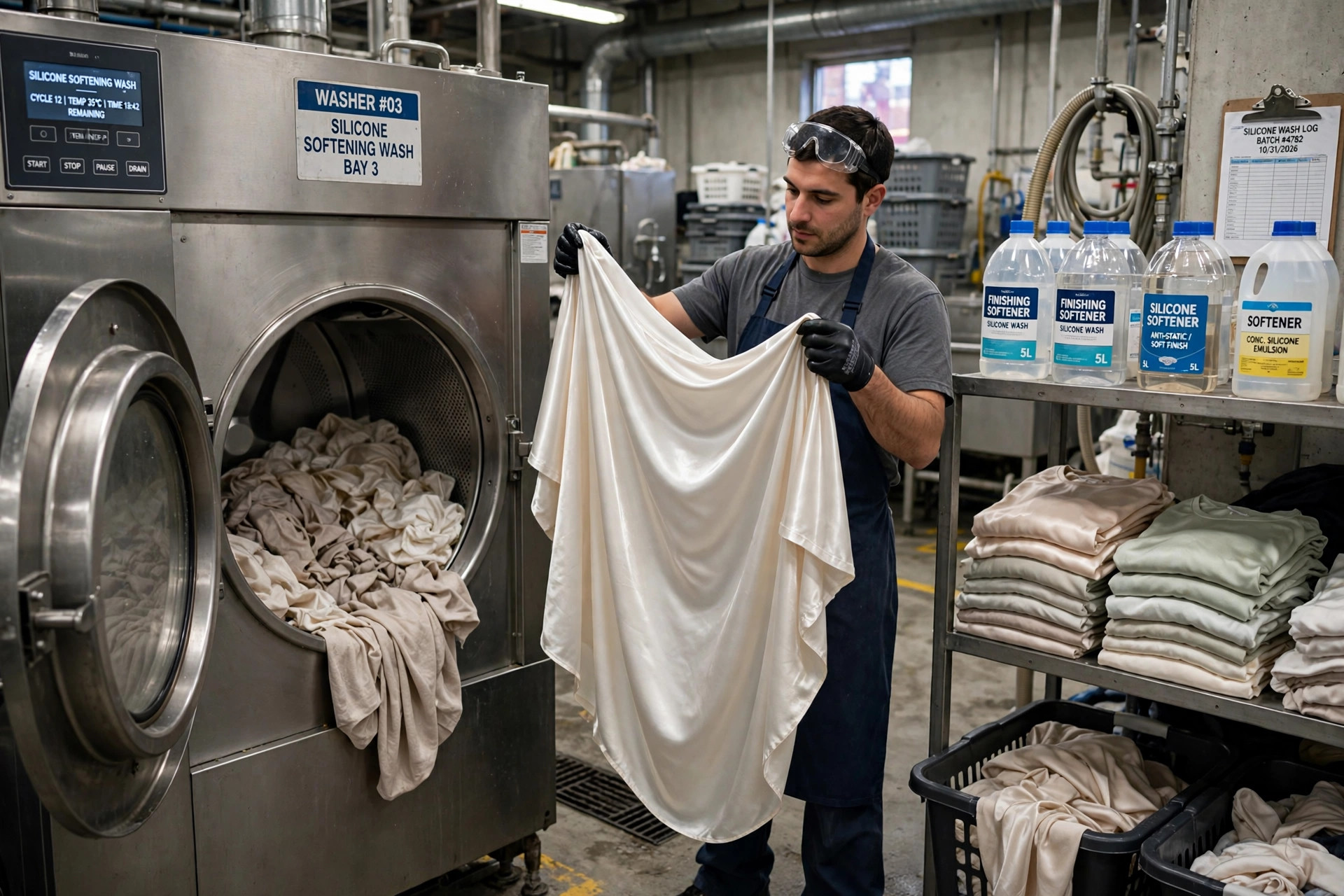
A silicone wash uses silicone softener to give a very soft, draped look and feel to garments. It is the finish behind the difference between a stiff, boardy new T-shirt and the fluid, almost liquid hand of a premium one: silicone softeners coat each fiber with a microscopically thin, slippery layer, so fibers slide over one another instead of gripping, and the fabric falls in soft folds, feels smooth against skin, and resists the harshness that washing and dyeing can leave behind.
This page explains how silicone finishing works in a garment wash, the types of silicone softeners contractors choose among, the spotting defect that ruins careless work, and how to specify the finish. The laundries below offer silicone wash among their garment services.
Silicone Wash Resources
How Silicone Softening Works
Silicone softeners are applied in the final bath of the garment wash, after cleaning, dye work and any fading are complete. The softener is an emulsion of silicone polymer in water; in the bath it deposits evenly onto the fibers, and as the garment is dried the polymer forms its lubricating film. Because the film sits on the fiber surface, the effect is immediate and pronounced: lower friction, smoother surface, better drape, and a hand that panel testers consistently rate softer than untreated controls.
The main families differ in durability and side effects. Standard (non-reactive) silicones give excellent initial softness but wash out relatively quickly. Amino-functional silicones bond more tenaciously to cotton, survive more launderings and feel even silkier, but can yellow whites at high drying temperatures if overdosed. Micro-emulsions penetrate yarn bundles for an inner softness, while macro-emulsions sit on the surface for a sleek, almost waxy touch. A contractor selects among them by fabric, shade and the durability the brand expects.
The Spotting Risk and Its Controls
Silicone’s characteristic defect is the silicone spot: a small, darker, grease-like mark that appears when emulsion droplets coalesce instead of spreading — caused by a broken emulsion, hard water, a bath overloaded with garments, or softener added too fast to a hot bath. Spots are notoriously hard to remove, sometimes needing solvent spotting by hand. Prevention is process discipline: stable emulsion, correct dosing into a running bath at the right temperature, and liquor ratios that let garments circulate freely.
Over-application has quieter costs too. Too much silicone reduces absorbency — a real failure on towels, underwear and sportswear that must move moisture — and can interfere with later printing or bonding. A good laundry trials the dose on the actual garment and tests absorbency where it matters, rather than applying a house-standard dose to everything that arrives.
Specifying a Silicone Wash
Specify by outcome: the hand feel target (best shown by a reference garment), the durability expected after home laundering, and any functions that must survive — absorbency for towels and base layers, printability for tees that will be decorated later. Ask which softener family the contractor proposes and why, and approve a washed-and-dried sample, because silicone hand can only be judged on a finished, conditioned garment, not one pulled damp from the machine.
Silicone wash is normally the last wet step, sequenced after enzyme, stone or bleach work and combined in the same visit as packaging by laundries that offer the full service — the two Allentown laundries below both list it alongside garment, enzyme and stone washing, fix wash, rework and packaging.
Silicone Wash Contractor Listings
Commercial laundries offering silicone wash (silicone finishing) for apparel.
Laundry Specialties
Laundry Specialties is a commercial laundry which specializes in processing garments for the apparel industry. Some of the services they provide are garment washing, enzyme washing, stone washing, bleaching (denims etc.), fix wash (crocking etc.) and silicone wash. They also provide rework services and packaging.
Services: commercial laundering, garment washing, enzyme washing, bleaching, fix wash, silicone wash, stone washing, refurbishing.
Contact: Richard or Chuck. Address: 431 N. Jordan Street, Allentown, PA 18102, USA. Phone: 610-351-3860. Fax: 610-770-1785. E-mail: richard@laundryspecialties.com
Magna Cleaners Inc
(Pennsylvania) Magna Cleaners provides commercial laundry service to a variety of clientele. Their facility is equipped with the latest washing, drying and finishing equipment. They process everything from bulk commercial laundry down to single piece sample lots. They also provide garment washing, enzyme washing, stone washing, bleaching (denims etc.), fix wash and silicone wash. They also do rework services and packaging.
Services: commercial laundering, garment washing, enzyme washing, bleaching, fix wash, silicone wash, stone washing, refurbishing.
Address: 361 W. Gordon St., Allentown, PA 18102, USA. Phone: 484-894-8906. E-mail: sales@magnacleaners.com. Contact: Al Fodero.
More Manufacturing Resources
Common Questions
What does a silicone wash do to a garment?
Silicone softener coats the fibers with a thin lubricating film, so the fabric feels much softer and smoother, drapes fluidly and loses the harsh, boardy hand that dyeing and washing can leave. It is applied in the final bath of the garment wash.
Does silicone softness wash out?
Gradually, yes. Standard silicones fade fastest; amino-functional silicones bond more strongly to cotton and keep their effect through many more launderings. The contractor’s choice of softener family is the main durability decision.
What are silicone spots?
Small dark grease-like marks caused by softener emulsion droplets clumping instead of spreading evenly — from a broken emulsion, hard water or overdosing. They are difficult to remove, so laundries prevent them with stable emulsions and careful dosing.