Stonewashing Fabric
Stonewashing processes and the stonewashing contractor directory.
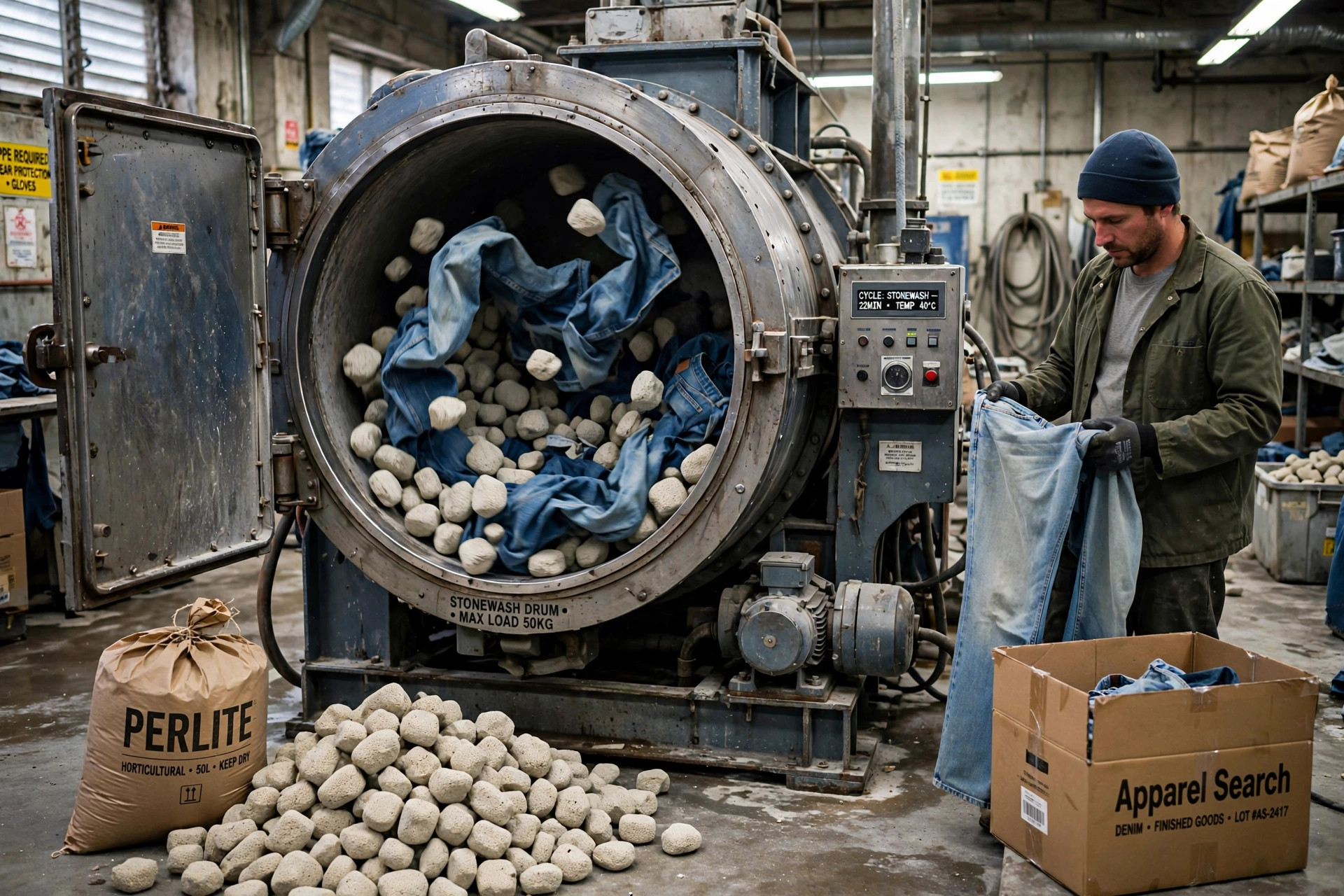
Stonewashing creates the faded, artificially worn appearance that consumers have wanted in denim for decades. For over thirty years, manufacturers of jeans and denim fabrics have used enzymes, stones and pumice to create the stonewashed look — to age new fabric so it looks worn and feels much softer. The process defined a fashion era, and in refined form it is still how most fashion denim gets its broken-in character: stone wash, usually used on denims, gives garments a worn look especially on seams.
This page brings together how stonewashing works — the stones, the enzymes, and the perlite that has replaced much of the pumice — with the controls that keep it from destroying garments and machines. Below the process guide sits the stonewashing contractor directory: the chemical suppliers, laundries and factories that provide stonewashing and its materials.
Stonewashing Resources
How Stonewashing Ages Denim
The classic recipe is simple to describe: after desizing, the denim is washed in large commercial machines with pumice stones, whose abrasive tumbling scours indigo from the yarn surfaces — most strongly where fabric folds, seams and raised areas strike the stones — while softening the cloth. The goal has always been to age the fabric so a new product looks old, worn and comfortable.
Today there is a wide selection of cellulases available for the stonewashing of garments. These cellulases include acids, neutrals, modified acids and hybrids; modified acids and hybrids tend to combine characteristics of acids and neutrals. Enzymes loosen the dyed surface chemically, so a modern stonewash is usually a partnership: enzymes for even overall fading, a reduced stone load for the mechanical highlights, each doing what it does best and neither pushed to the point of damage.
Perlite: the Stone That Is Not a Stone
Traditional stonewashing abuses the very machines it depends on, and basic denim can be abraded too much. During the last decades, alternatives to real stones (volcanic pumice) have been tested by all the major jean manufacturers, aiming to reduce machine maintenance and achieve a softer finish. After years of testing, many are using various grades of perlite. Perlite performs many of the same properties as stones: it produces a much softer, more pliable finish, reduces substantially the wear on the machines, and gives a worn, finished look throughout the fabric and not just on the upper surfaces. In some cases it has also allowed a reduction in the use of enzymes, which chemically attack the fibers and can ultimately result in fabrics that wear out quickly.
Many grades of perlite are used, ranging in size from the largest horticultural grade down to the finest filtration grades, and some manufacturers use a very fine grade similar in size and appearance to ground, milled diatomaceous earth. The exact gradations of perlite used and the special enzymes chosen are considered proprietary process information by the large finishing companies — and yet more and more stonewashing is being done every day with basic perlite, both in this country and many others. The Schundler Company, listed in the directory below, is the perlite source this guide has pointed readers to for years: a supplier of perlite and vermiculite products based in Metuchen, New Jersey.
Controls: Shade, Strength and Consistency
Stonewashing balances three variables that fight each other. More abrasion means a lighter, softer garment and a weaker one; more enzyme means faster fading and more fiber attack; more time multiplies both. The contractor’s controls are recipe discipline — fixed stone or perlite grade and load, enzyme dose, temperature, pH and cycle time — plus strength testing on finished lots and shade approval of every load against the master garment. Reject control matters too: stones must be removed from pockets and turnings before drying, or the next process inherits them.
For a buyer, the practical questions are which abrasive the laundry uses (pumice, perlite, or a blend), which cellulase family, and how shade is approved across a large order. The directory below spans the whole supply chain of the process — the perlite supplier, the textile chemical house whose lines include stonewashing enzymes and softeners, and the laundries and factories that run the wash itself.
Stonewashing Contractor Directory
Suppliers, laundries and factories providing stonewashing, its materials and its chemistry.
The Schundler Company
Supplier of perlite and vermiculite products, including the perlite grades used as a pumice alternative in stonewashing. For more information about perlite, please contact them.
Address: P.O. Box 513, Metuchen, New Jersey 08840, USA. Phone: 732-287-2244. Fax: 732-287-4185. E-mail: info@schundler.com
Bennett Dye Co
(USA) Bennett Dye Co. has been an established dye house for over 75 years, and has specialized in garment finishing since 1983. They offer many garment enhancements, including direct, reactive and pigment dyeing. In addition they do enzyme wash, garment wash, stone and acid wash (denim or cotton garments) as well as tie-dyeing.
Services: dyeing textiles (direct dyeing, reactive dyeing, pigment dyeing, tie dye), enzyme wash, garment wash, stone wash, acid wash, depilling garment wash, anti-microbial garment washing, water repellant garment wash, stain resist garment finishing.
Address: 2552 N. 3rd St., Philadelphia, PA 19133, USA. Phone: 215-739-0432. Fax: 215-426-3120. E-mail: Bennettdye@aol.com. Contact: Lee Sunderland.
Grant Industries
Grant Industries has been involved in the textile industry for over sixty years. Grant offers a complete line of textile specialty products, which include the following: preparation chemicals (desizing auxiliaries, bleaching, scouring and wetting agents, and detergents); dyeing auxiliaries (dyeing assistants, leveling agents, wetting agents, dispersing agents, fixes and lubricants for all natural and synthetic fibers); finishing chemicals (hand modifiers, permanent press resins, alkyd resins, lubricants, water repellents and softeners); stonewashing (acid and neutral cellulase enzymes, desizing, scouring agents, detergents and softeners); and coatings (formulated coatings for textiles used in apparel, luggage, ribbons and specialty markets).
Product lines: preparation chemicals, dyeing auxiliaries, finishing chemicals, stonewashing enzymes, coatings.
Hytex
The latest addition to their production process is laundering or wet processing — they offer specialized services to fit the needs of the apparel industry. They provide a full service garment dyeing facility with on-site testing, a full color lab, product development, and quality control throughout the finishing of each garment. For denim wet processing they offer all types of wash, including prewash, stonewash, bleached wash, enzyme washes, antique and sandblasting finishes, and more. Hytex started operating in 1981 as a company that does contract silkscreen printing in a rented shop-house; the business was then confined to manual silkscreen printing using long wooden tables.
Services: garment printing, garment dyeing, garment washing, enzyme wash, stonewash, bleaching, sandblasting.
Laundry Specialties
Laundry Specialties is a commercial laundry which specializes in processing garments for the apparel industry. Some of the services they provide are garment washing, enzyme washing, stone washing, bleaching (denims etc.), fix wash (crocking etc.) and silicone wash. They also provide rework services and packaging.
Services: commercial laundering, garment washing, enzyme washing, bleaching, fix wash, silicone wash, stone washing, refurbishing.
Contact: Richard or Chuck. Address: 431 N. Jordan Street, Allentown, PA 18102, USA. Phone: 610-351-3860. Fax: 610-770-1785. E-mail: richard@laundryspecialties.com
Luen Yat Garment Factory
(China & Macau) Luen Yat Garment Factory was established in 1986 by their director, Mr. Tony C.M. Chan. During these 20 years, the factory has been growing tremendously from a small enterprise into a widely-known and well-established garment factory in Asia. The company is originally based in Macau, with production factory and head office. The 46,000 sq. ft. air-conditioned premises accommodate around 350 employees divided into merchandising, shipping and administration, paper patterning, cutting, sewing, sample-making, washing and packing divisions. To cope with rapid business growth, they have set up two additional factories: Zhuhai Luen Yat (Claire) in 1996, with 60,000 sq. ft. premises and 20,000 sq. ft. of staff accommodation for 800 employees; and a site covering over 100 acres of land, with a production area of 500,000 sq. ft. including sewing, packing, in-house laundry, embroidery and a water treatment system, with 500 rooms of accommodation and recreational areas for 2,000 employees. Luen Yat’s annual capacity reaches 450,000 dozen of jeanswear for local and overseas markets, with current production of 80,000 pairs of jeans per month in the Macau factory and 370,000 pairs per month in the China factory.
Products: jeanswear. Divisions include an in-house laundry (washing) and water treatment system.
More Denim & Manufacturing Resources
Common Questions
What is the difference between pumice and perlite in stonewashing?
Both abrade denim in the wash drum. Pumice is the traditional volcanic stone: effective but hard on machines and garments. Perlite, an expanded volcanic mineral used in many grades, gives a softer, more pliable finish with substantially less machine wear and a worn look throughout the fabric, not just on upper surfaces.
Do stonewashed jeans still use real stones?
Often, yes — but usually fewer of them. Modern recipes combine a reduced pumice or perlite load with cellulase enzymes that do much of the fading chemically, which reaches the same worn look with less abrasion damage to fabric and machines.
Why do stonewashed garments vary in shade?
Abrasion is inherently uneven — seams, folds and raised areas strike the abrasive load more than flat areas, which is exactly what creates the authentic worn pattern. Contractors control the overall shade by recipe and approve each load against a master garment.