Stain Resist Garment Finishing
Contractors that apply stain resist finishes to garments.
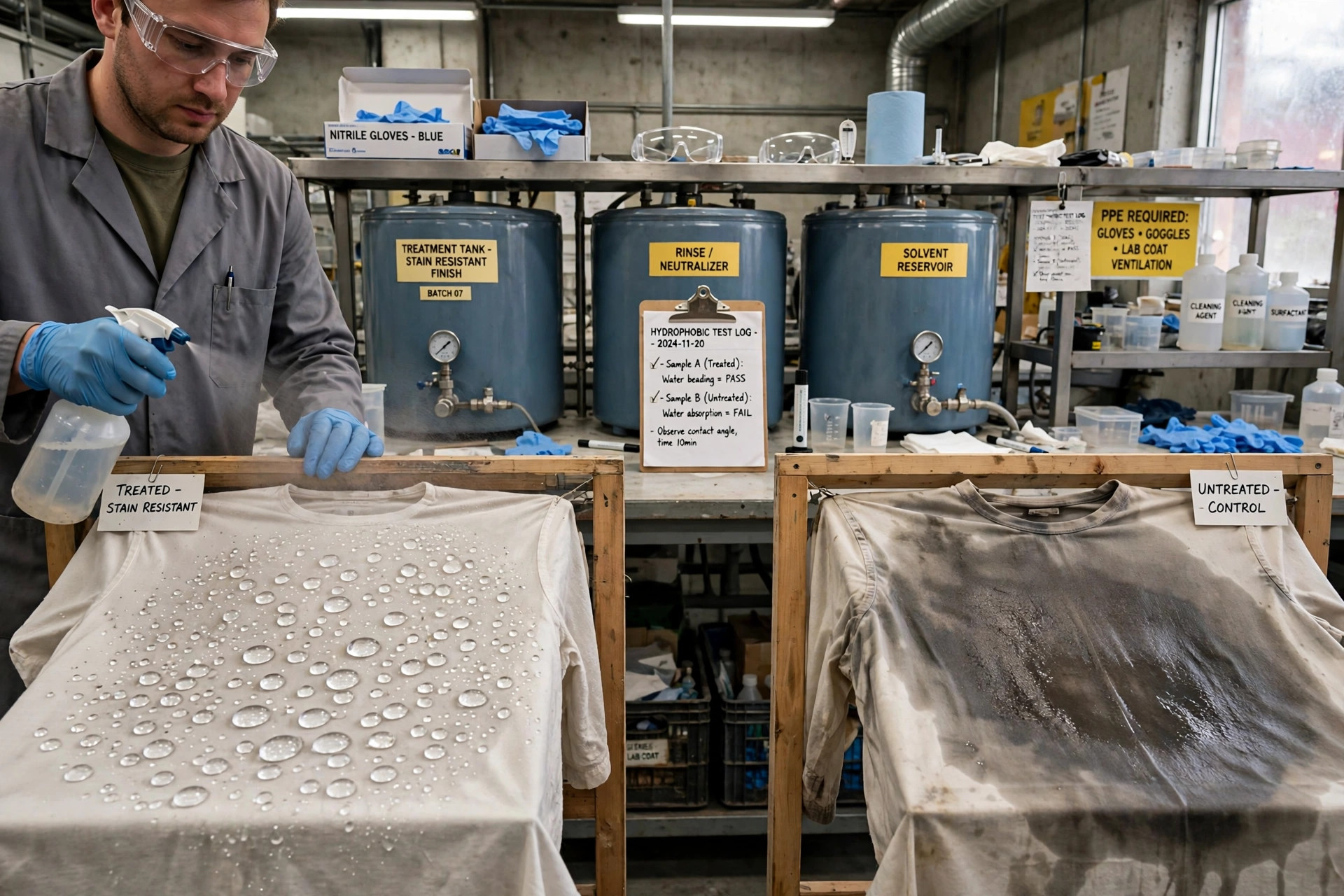
A stain resist finish changes what happens in the first seconds after a spill. On an untreated shirt, coffee or oil wicks instantly into the fibers and sets; on a stain-resistant garment, the liquid beads on the surface, giving the wearer time to blot it away, and what does penetrate releases far more easily in the wash. The finish is invisible and does not change the garment’s look — it is bought entirely for performance, on school uniforms, work shirts, table linens, trousers and children’s clothing where spills are a certainty of use.
This page explains how stain resist finishes work against both water-based and oil-based soiling, how they are applied to finished garments, how long they last, and how performance is tested. A garment finishing contractor listing the service appears below.
Stain Resist Resources
How Stain Resistance Works
Stain resist finishes lower the surface energy of the fibers so liquids cannot spread on them. Modern systems are built mainly on fluoropolymer or newer non-fluorinated repellent chemistries, often combined with a stain-release component: the repellent side makes water-based and oily liquids bead instead of soaking in, and the release side helps oily soils let go of the fiber during laundering rather than building up as a grey shadow. A finish that only repels can still trap oil that is rubbed in; a finish that only releases lets every spill soak through first. Good commercial systems do both jobs.
Oil repellency is the harder property. Water beads on many surfaces, but oils have far lower surface tension and wet almost anything that is not specifically treated for them — which is why stain resist specifications rate water and oil performance separately, and why a finish advertised only as water repellent should not be assumed to resist a salad-dressing spill.
Application, Durability and Testing
At fabric stage the finish is padded on, dried and cured, which bakes the polymer onto the fibers for maximum durability. At garment stage — the service this directory covers — the finish is applied by exhaustion in a wash bath or by spray application, then dried and, where the chemistry requires it, heat-set in the tumble dryer or a curing oven. Garment application treats the whole piece as worn, including seams and facings, and suits smaller runs and after-treatment of made garments.
Durability is expressed in wash cycles: a quality finish keeps useful performance through twenty to fifty home launderings, declining gradually. Performance is measured with standardized methods — spray and oil-repellency ratings (such as AATCC TM22 and TM118) for the repellent side, and stain-release grading (AATCC TM130) after washing for the release side. Brands should require ratings after laundering, not only on the freshly finished garment, since a finish that tests beautifully once and vanishes by the fifth wash is a labeling problem.
Specifying Stain Resist Work
State the garment’s use first: a school uniform needs oil and food release plus easy care; a waiter’s shirt needs water-based spill beading; workwear may need both plus industrial wash durability. Then set the test methods and minimum grades, the number of washes they must survive, and any chemistry restrictions your brand maintains — repellent chemistries are an area of active regulation, and a contractor should be able to state exactly which system they are applying and its compliance status.
Also agree the hand feel. Heavy repellent loads can stiffen fabric slightly, and on soft garments the finish is often paired with a light silicone softening — sequenced by the contractor so the softener does not undermine the repellent layer. Approve a finished, washed sample wearing the full treatment stack before production.
Stain Resist Finishing Contractor Listings
Garment finishing contractors that offer stain resist garment finishing among their services.
Bennett Dye Co
(USA) Bennett Dye Co. has been an established dye house for over 75 years, and has specialized in garment finishing since 1983. They offer many garment enhancements, including direct, reactive and pigment dyeing. In addition they do enzyme wash, garment wash, stone and acid wash (denim or cotton garments) as well as tie-dyeing.
Services: dyeing textiles (direct dyeing, reactive dyeing, pigment dyeing, tie dye), enzyme wash, garment wash, stone wash, acid wash, depilling garment wash, anti-microbial garment washing, water repellant garment wash, stain resist garment finishing.
Address: 2552 N. 3rd St., Philadelphia, PA 19133, USA. Phone: 215-739-0432. Fax: 215-426-3120. E-mail: Bennettdye@aol.com. Contact: Lee Sunderland.
More Manufacturing Resources
Common Questions
Is stain resist the same as waterproof?
No. Stain resist treatments make liquids bead and release in washing; they resist spills and soiling but are not designed to stop water passing through under pressure. A waterproof garment uses coatings or membranes, which is a different construction and a different trade.
How long does a stain resist finish last?
A quality finish remains useful through roughly twenty to fifty home launderings, declining gradually rather than stopping at once. Specifications should require repellency and stain-release ratings after a stated number of washes, not just on the new garment.
Does stain resist finishing change how a garment feels?
Slightly, at heavy application levels — the fabric can feel a touch firmer. Contractors balance the dose against hand feel and may pair the finish with a compatible softener, then prove the result on a washed sample before production.