Vintage Distress Finishing
Manufacturers of vintage distress finishes for fabric and clothing.
Vintage distress finishing manufactures memory. A distressed wash — for tees, jeans and other garments — gives a garment a more worn look than garment washing, but not as visually apparent as stone washing: the fading is uneven in the way real wear is uneven, the color is sun-tired rather than bleached, and the edges carry the small abrasions of a garment that has lived. Done well, a new shirt feels like a favorite found in a drawer; done badly, it looks like a new shirt that has been attacked, and the difference is judgment.
This page explains the techniques vintage distress programs combine, how the look is judged and kept consistent, and what to brief. The specialist manufacturer below creates distress finishes on T-shirts, and the resource links lead to the wider world of vintage fashion for design reference.
Vintage Distress Resources
The Techniques Behind the Look
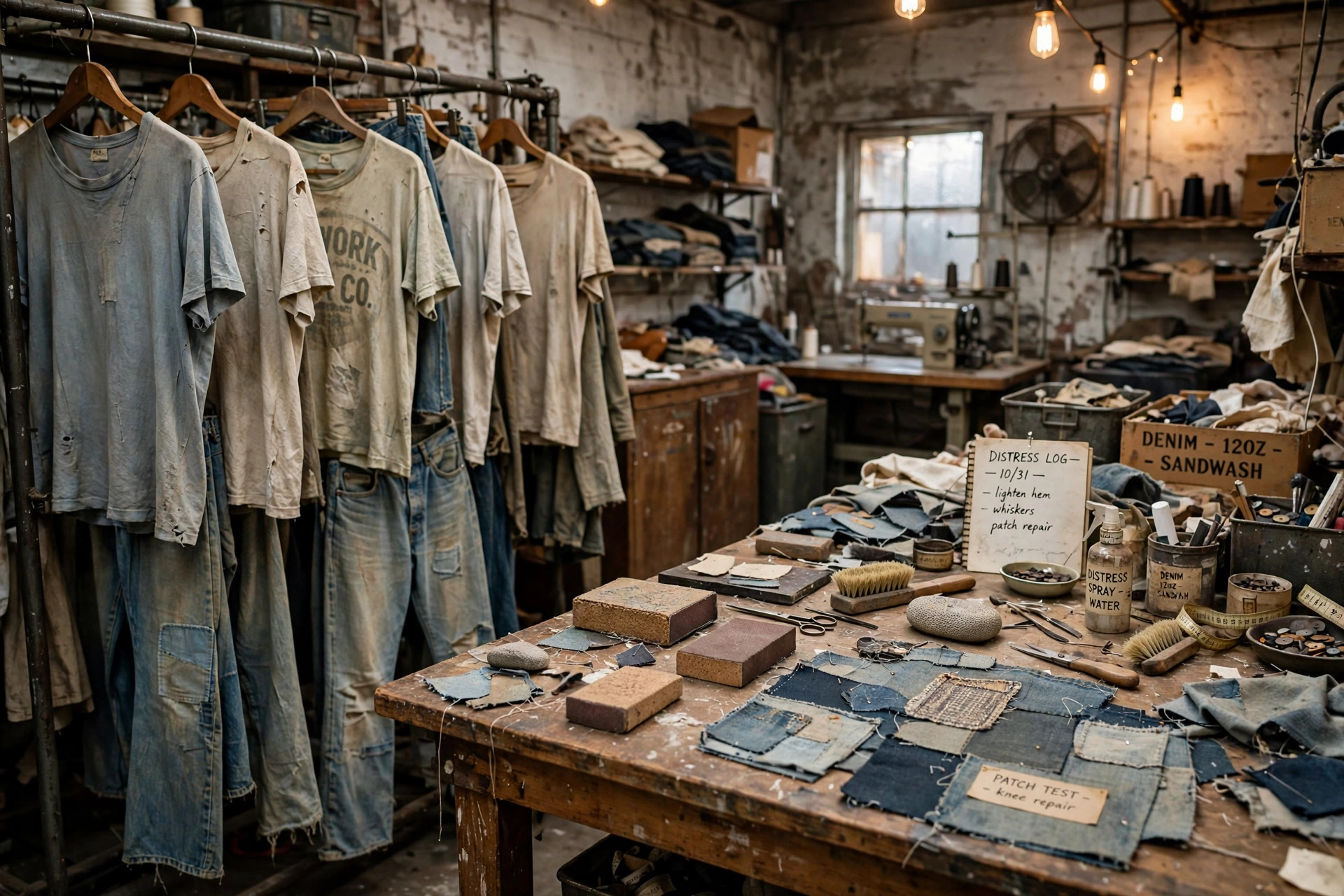
A vintage program is a stack of small effects, none of them sufficient alone. The base is usually an enzyme or light stone wash that takes the garment’s color down unevenly and softens the hand. Onto that go localized treatments: hand sanding or scraping at the natural wear points, whiskering on jeans, tinting or over-dyeing with a faint tea or grey cast to simulate age and sun, and edge work — stoneblasting collars, cuffs and hems so the places that fail first on a real garment fail first here too. Prints, when present, are cracked or faded to match the garment’s supposed age.
Sequence is the craft. Tint before the final wash and it settles into the low places; tint after and it sits on the surface and rubs. Edge grinding before softening reads harsher than the same grinding after. Manufacturers who specialize in vintage work develop a house sequence and hold it constant, varying only the intensity dials from program to program.
Judging Authenticity and Consistency
Authenticity is judged against real vintage garments, not against last season’s production. Good development rooms keep a reference library of genuinely old tees and jeans and compare fading patterns, fade color (real indigo fades toward a grey-blue; real black tees fade toward charcoal at the seams first) and the placement of wear. A distress map drawn from imagination usually puts wear where it looks good; a map drawn from real garments puts it where bodies actually bend, sit and carry.
Consistency is the production problem, because every technique in the stack is partly manual. The controls are the same as elsewhere in finishing — an approved master garment, written recipes, in-process checks against the master under fixed light — with one addition: sorting. Finished lots are blended so the natural spread of hand-work is distributed across cartons and sizes rather than concentrated where a customer can compare two extremes side by side.
Briefing a Vintage Distress Program
Start from a real reference: a vintage garment, a photograph, or a previous production sample, and mark the intensity honestly — light vintage (a season of wear), medium (years), or heavy (decades, with edge failure approaching holes). State which elements are wanted — overall fade, tint, edge grind, print distress — and which are forbidden; some brands want age without damage, others want the damage most. Approve a production-method sample on your own garment, as the specialist below offers, before committing the run.
For design context, the links below lead to the women’s vintage fashion guide and to vintage fashion stores, where the genuine articles that this finishing imitates can be studied — the surest way to brief a convincing program.
Vintage Distress Finishing Manufacturer Listings
Manufacturers specializing in distress finishes for clothing.
T & F Guy, Inc.
Specialize in creating the distress finish on T-shirts. Their stoneblasting technology allows them to accurately and precisely grind as narrow as 1/8 inch the rib on the collar, sleeves and bottom of a finished T-shirt, giving it a distressed look. The rest of the body is left untouched. Please call or e-mail for more information, or request a sample stoneblast on your T-shirt.
Address: 14 Whales Square #A16, Brooklyn, NY 11232, USA. Phone: 718-567-2111. E-mail: mltnyee@aol.com. Contact: Milton Yee.
More Vintage & Manufacturing Resources
Common Questions
What is a distressed wash?
A combination of washing, fading and abrasion treatments that makes a new garment look authentically worn. It gives a more worn look than a plain garment wash, but is usually less visually stark than full stone washing — the wear imitates years of use rather than a single dramatic effect.
Which techniques are combined in vintage distress finishing?
Typically a base enzyme or light stone wash for overall fade and softness, localized hand sanding and whiskering, tinting for a sun-aged cast, edge grinding on collars, cuffs and hems, and print fading — sequenced so the effects settle into each other naturally.
How do manufacturers keep hand-distressed garments consistent?
With an approved master garment, written recipes, checks under fixed lighting, and lot blending so the natural variation of hand work is spread evenly across sizes and cartons instead of appearing as two noticeably different garments side by side.