Apparel Search Consumer Guides
Men's Capsule Wardrobe
A fixed, small set of pieces in one palette — where everything combines and nothing hangs unworn.
A capsule wardrobe is the essentials idea with the discipline turned up: a deliberately small set of clothes — for most men, around thirty pieces including shoes — in which everything combines with nearly everything else, and nothing hangs unworn. This guide applies the method to men's wardrobes specifically: the palette is narrower, the pieces are harder-working, and the counting is honest. It is part of our men's wardrobe essentials guide; readers who want the general method and the women's version will find both in our companion capsule wardrobe guide.
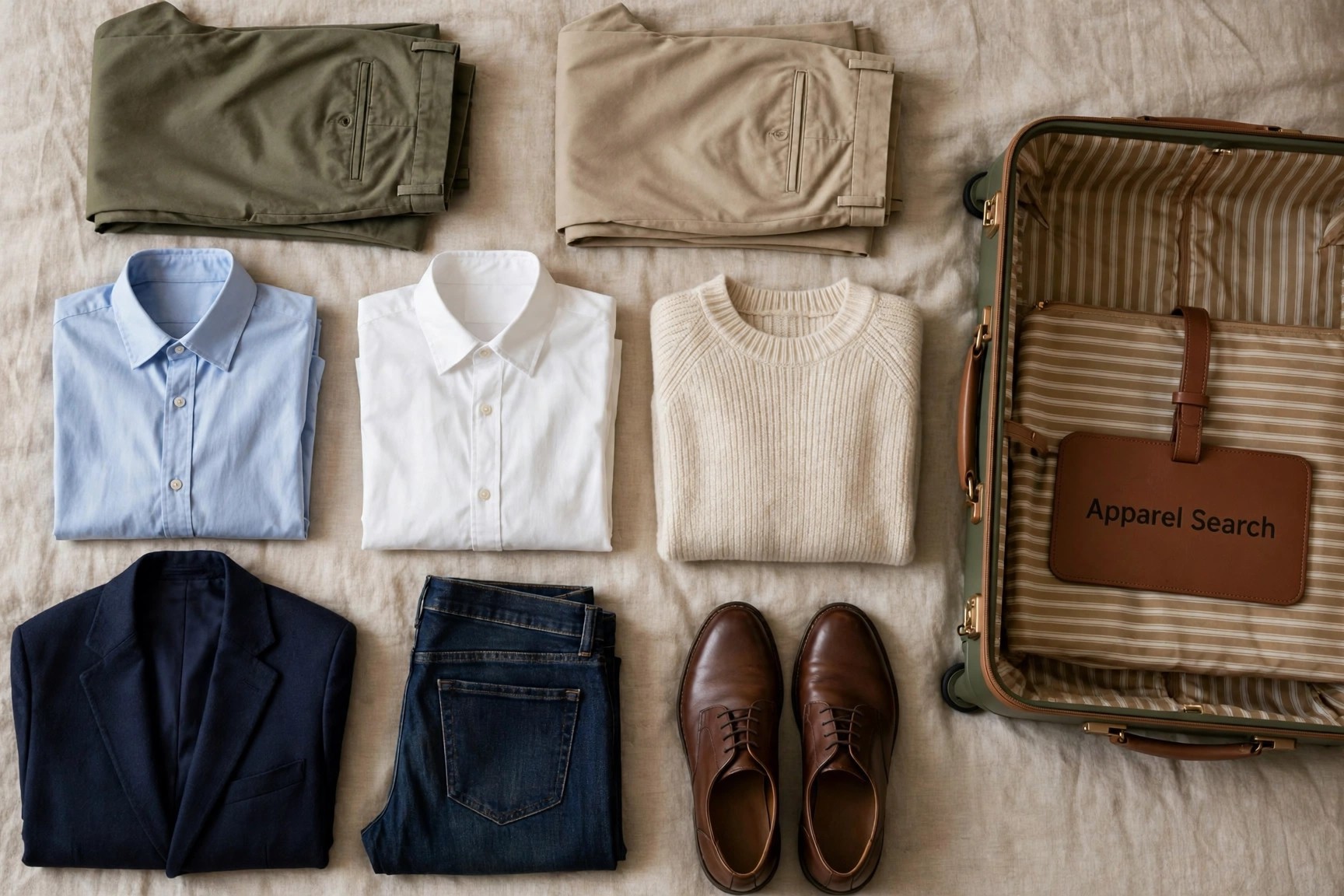
The Count: A Men's Capsule by Category
Thirty is a target, not a law — but the category counts below are a proven shape. Notice what is missing: no piece appears in two colors 'just in case', and every category is small enough to memorize.
- Suits and jackets (3). One navy suit whose jacket and trousers also work separately, one unstructured blazer in grey or a subtle check, one casual jacket — a bomber, field or denim jacket according to your life. Three jackets, three levels of formality, no gaps.
- Shirts and tops (9). A white dress shirt, two light-blue shirts (one dress, one Oxford), a second Oxford in white or a stripe, two polo shirts in navy and white, two plain tees, and one casual shirt — chambray, flannel or linen by season. Nine tops, each of which pairs with every bottom in the capsule.
- Knitwear (3). A navy crew-neck sweater, a grey crew or cardigan, and a quarter-zip or second cardigan. Knitwear is the multiplier: worn over a shirt it changes the outfit's register; worn under the blazer it changes its weight. Three pieces, dozens of combinations.
- Bottoms (5). Grey dress trousers, navy trousers, khaki chinos, dark indigo jeans with no fading or distressing, and one seasonal fifth — shorts in summer, cords or flannels in winter. Five bottoms times nine tops is forty-five combinations before a jacket is involved.
- Outerwear and shoes (6). One overcoat that fits over the suit, one rain-resistant jacket, and the four-pair shoe rotation — dress shoe, casual shoe, clean sneaker, boot — detailed in our men's shoes guide. Outerwear is where capsules fail in cold climates; count it honestly rather than pretending coats are not clothes.
One Palette, No Orphans
The capsule's real rule is not the count. It is the three-outfit test: every piece must make at least three different outfits with pieces already in the wardrobe, and the palette — navy, grey, white, light blue, khaki, brown leather — is what makes that test passable. An orphan piece, however handsome on the rail, breaks the system twice: it takes a slot, and it demands companions the capsule does not have room for. When something tempts you, name its three outfits out loud. If you cannot, it belongs to a different wardrobe than this one.
A Sample Week of Outfits
Seven days from the same rail, no outfit repeated:
- Monday. Navy suit, white dress shirt, dress shoes — the full formal setting, for the day that needs it.
- Tuesday. The blazer over the light-blue Oxford, grey trousers, and the dress shoes in a new combination.
- Wednesday. Navy crew-neck sweater over the second Oxford, navy trousers, casual shoes. The knitwear layer changes Tuesday's pieces beyond recognition.
- Thursday. Suit trousers with the polo shirt and casual jacket — the week's most relaxed office-acceptable combination.
- Friday. Dark jeans, white tee, unstructured blazer, clean sneakers: the capsule's smart-casual standard.
- Saturday. Chinos, casual shirt, quarter-zip if the weather asks, boots.
- Sunday. Jeans and the grey sweater, sneakers — the pieces rest; the system does not.
Count the pieces used: two jackets, four shirts or tops, two knitwear, four bottoms, three pairs of shoes — fifteen of the thirty, in a week with no repeats and no morning spent deciding. That headroom is the point: the capsule absorbs a formal event, a trip or a cold snap without new purchases.
Keeping It a Capsule
Two habits maintain the system. The first is one-in-one-out: a new piece enters only when the piece it replaces leaves, which forces the three-outfit test at the moment of temptation rather than at the next clear-out. The second is the seasonal swap: twice a year, exchange the seasonal fifth bottom and the heaviest or lightest knitwear with a stored box, and review what did not get worn — a piece that survived two seasons unworn has failed the only audit that matters. Buy replacements at the quality the wear count justifies; a capsule piece worn sixty times a year earns its cost-per-wear faster than anything in a larger wardrobe.
Shop Men's Capsule Wardrobe Pieces on Amazon
Ready to shop? Product links are kept in one place on the Apparel Search shopping guide:
Shop Clothing on AmazonThis link opens the Apparel Search shopping guide for Amazon, where the product links are kept in one place.
Common Questions
How many pieces are in a men's capsule wardrobe?
Most men's capsules land between twenty-five and thirty-five pieces including shoes and outerwear. The count matters less than the discipline behind it: one shared palette, and every piece able to make at least three outfits with the rest. A forty-piece wardrobe that follows those rules works better than a twenty-five-piece one that does not.
Does a capsule wardrobe work for a man who wears a suit to work?
Yes — a suit is two capsule pieces, not one. The jacket works as a blazer with odd trousers, the trousers work with knitwear and polos, and the full suit covers formal days. Suit-wearing men often get more combinations from a capsule than casual dressers do, because their pieces span a wider formality range.
What colors work best for a men's capsule wardrobe?
Navy, grey, white and light blue as the core, khaki or olive as a secondary neutral, and brown leather for shoes and belts — with black leather only if your formal pieces demand it. This palette is not about caution; it is the set of colors that combine with each other without exceptions, which is the capsule's whole mechanism.
How often should you swap a capsule wardrobe for the seasons?
Twice a year is enough for most climates. Store the off-season pieces — the heaviest knitwear and coat, or the shorts and linen — in a single swap box, and bring them back when the weather turns. The core of the capsule never rotates out: suits, shirts, trousers and shoes work in every month.
Back to the Men's Wardrobe Essentials Guide
The core list, how the pieces combine, and the work and shoe guides that complete the system.