Apparel Search Consumer Guides
Men's Wardrobe Essentials Guide
A short list of well-chosen pieces that carry a man's week — and combine without effort.
Most men wear a fraction of what hangs in their closet. The same few shirts, the same two pairs of trousers, the same shoes — while the rest sits as expensive storage. A wardrobe built on essentials flips that ratio. Instead of collecting pieces one impulse at a time, you start with a short list of clothes that fit well, share a restrained palette, and combine freely with each other. Dressing stops being a daily negotiation and becomes arithmetic: nearly any top works with nearly any bottom, because the pieces were chosen to work together.
This guide sets out that core list and how the pieces combine. The garment-by-garment detail — cuts, fabrics, sizing — lives in our men's clothes guide; the pages below cover the strategy: the capsule method for men who want the smallest workable wardrobe, the work wardrobe organized by dress code, and the short shoe and accessory rotation that finishes everything. Start here, then go as deep as your week requires.

Search Apparel Search
The Guides in This Section
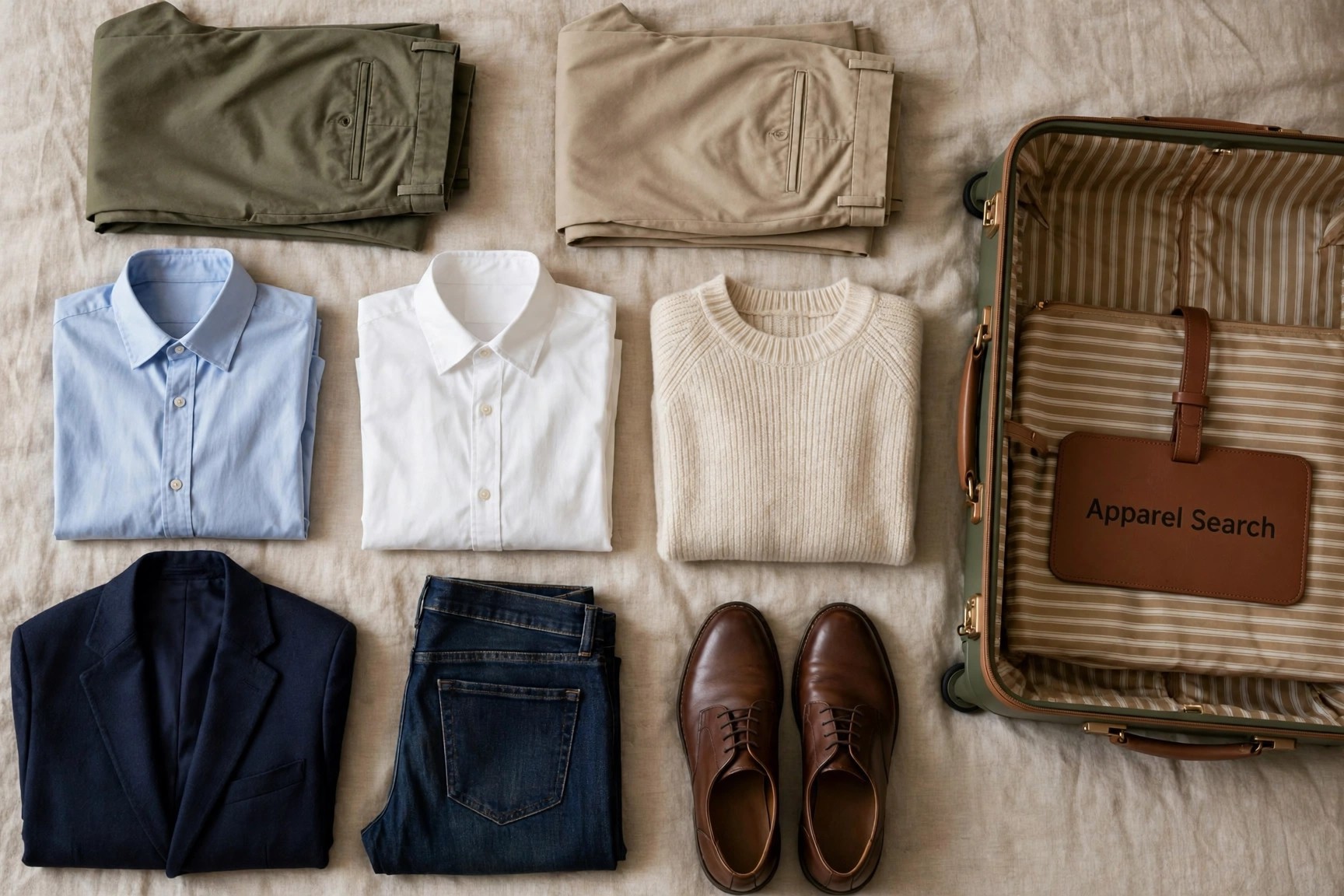 Men's Capsule WardrobeThe capsule method for men: roughly thirty pieces, one fixed palette, and a week of outfits that plan themselves.
 Men's Work Wardrobe EssentialsOffice essentials organized by dress code level, from suit-and-tie formality to the business-casual rotation.
 Men's Shoes & Accessories EssentialsThe four-pair shoe rotation, belts matched to leathers, and the watch and eyewear basics that finish an outfit.
The Core List
An essentials wardrobe is not large. These five groups — bought in this rough order, fitted properly, and kept in a navy-grey-white palette — cover the working week, the weekend, and most of what a social calendar asks.
- The suit and the blazer. One suit in navy or charcoal, bought to fit and tailored after purchase, handles weddings, interviews and every formal demand. One less-structured blazer, worn with odd trousers, covers the much larger territory between suit and casual. Together they are the skeleton of the wardrobe; our men's suits guide covers cloth, canvas and cut in depth.
- Shirts that layer and stand alone. White and light-blue dress shirts first, then Oxford button-downs that work with or without a jacket, then plain polo shirts and unbranded tees for the casual end. Five to seven shirts in rotation means laundry weekly, not daily, and every one of them pairs with every bottom you own.
- Trousers and jeans. Grey dress trousers, navy trousers or chinos, khaki chinos, and one pair of dark indigo jeans with no distressing. Four bottoms, each in the same palette, is enough: the variety comes from what you pair them with, not from owning twelve near-identical pairs.
- Knitwear. A crew-neck sweater in navy and one in grey or burgundy, plus a cardigan or quarter-zip for layering. Knitwear is what lets two shirts and a blazer look like a week of different outfits — it changes the visible layer without changing the structure beneath.
- Outerwear and shoes. One proper coat — an overcoat or topcoat that fits over a suit — and one casual jacket. Shoes get their own page in this section, because the rotation is small and specific: a dress shoe, a casual shoe, a clean sneaker and a boot carry nearly every situation a man meets.
How the Pieces Combine
The list works because of restraint, not despite it. When the palette is navy, grey, white, light blue and brown leather, combinations stop needing thought: the navy suit's trousers work with the grey sweater; the blazer works over every shirt and with three of the four bottoms; the brown shoes and belt work with everything except the charcoal suit, which takes black. Five tops and four bottoms in a shared palette make twenty outfits before knitwear and jackets multiply them further. The rule for adding anything new is simple — a piece that combines with at least three things you already own is an addition; a piece that demands new companions is a liability wearing a price tag.
Quality Over Quantity, Priced Per Wear
Essentials logic is also budget logic. A wardrobe of thirty pieces worn constantly costs less per use than a wardrobe of ninety pieces worn in rotation's leftovers. The measure is cost per wear: a $300 pair of shoes worn 150 times costs $2 a day; a $90 pair worn twice costs $45. Our cost-per-wear guide works through the arithmetic in full. Applied to essentials, it argues for buying the best version you can reasonably afford of the pieces on the core list — the suit, the shoes, the coat — because those are exactly the pieces whose wear counts run into the hundreds.
Garment Guides for Men
Common Questions
How many clothes does a man actually need?
There is no official number, but most men wear roughly twenty pieces in regular rotation and ignore the rest of the closet. A deliberately built essentials wardrobe of about twenty-five to thirty-five pieces — including shoes — covers a working week, weekends and most social occasions, provided the pieces share a palette and all combine with each other.
What colors should men's wardrobe essentials be?
Build on navy, grey, white and light blue, with brown leather for shoes and belts and khaki or olive as a secondary neutral. Neutrals in this family combine with each other almost automatically, which is what makes a small wardrobe feel large. Add stronger colors sparingly, in shirts and knitwear, where a mistake costs little.
What should I buy first if I am starting from scratch?
Start with what you wear most, in this order: the shoes you will wear daily, the trousers, then the shirts — fit matters more than quantity at every step. Add the suit and blazer once the basics fit properly, and buy knitwear and the coat last, sized to layer over what you already own. Five well-fitting pieces beat fifteen approximate ones.
How is an essentials wardrobe different from a capsule wardrobe?
The essentials list is the reliable core: the pieces every wardrobe needs, in whatever count your life requires. A capsule wardrobe applies a stricter method to the same idea — a fixed, small count, a single palette, and the rule that every piece must combine with nearly everything else. Essentials are the foundation; the capsule is the discipline.
Want the Smallest Workable Version?
The essentials list is a foundation, not a ceiling. If even thirty-odd pieces sounds like a lot, our men's capsule wardrobe guide applies the stricter capsule method: a fixed count, one palette, and a sample week of outfits built from the same hangers.