Apparel Search Consumer Guides
Men’s Body Types & Builds
Men’s style sources sort the male frame into five shapes, named for the outline the shoulders, chest, waist and hips draw. Find yours, and the fit advice stops being generic: each shape has its own emphasis, its own balance problem, and its own best cuts.
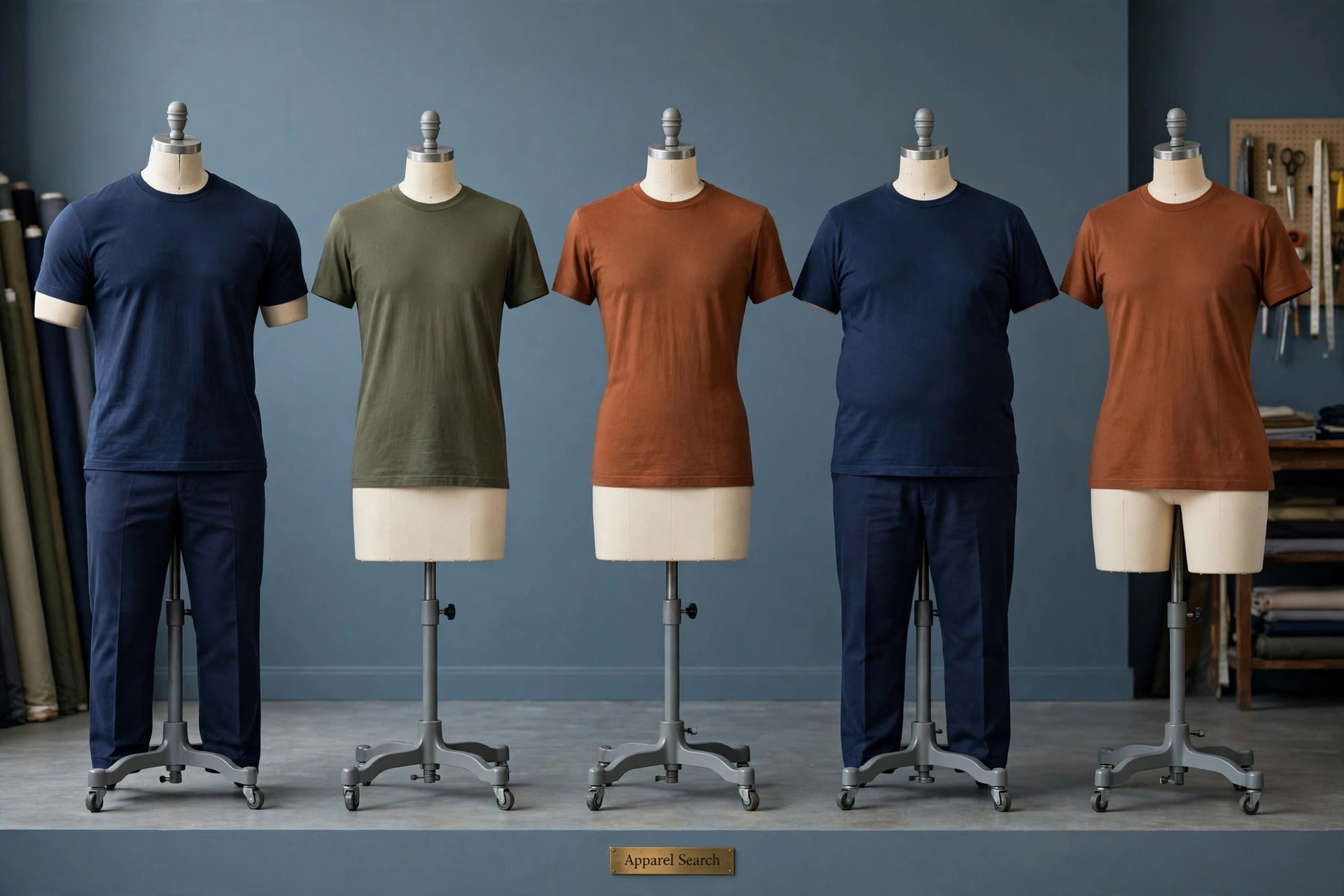
This is the shape half of our men’s style by height and build guides; the height half lives in the short men and tall men guides. It is also the men’s companion to our dress for your body type guide, which works the five women’s shapes; the men’s framework below is the one men’s style sources use, and its shapes are different because the widths being compared are different. Everything here is fit-level advice — what to emphasize, what to balance, which cuts cooperate — and a shape is a description of a frame at a moment in time, not a grade. Builds change with training, work and years; refit the advice when the frame changes.
Reading Your Shape: Four Widths
Stand in front of a mirror in a plain T-shirt and compare four widths: shoulders, chest, waist, hips. Which is widest, which narrowest, and how big are the differences? The outline those four points draw is the shape. A tape settles arguments — the measurement habit in our find your body type guide transfers directly, even though its shape names are the women’s set. Most men land between two shapes; dress the dominant one and borrow from the neighbour.
The Five Shapes
- Trapezoid. Shoulders and chest moderately wider than a defined waist, hips in proportion — the balanced outline most regular patterns are drafted from. Nearly every standard cut cooperates; the work is maintenance: clean fits, nothing oversized to blur the outline, nothing skin-tight to strain it. If this is your shape, fit quality matters more than fit strategy.
- Inverted triangle. Shoulders and chest much wider than the waist — the athletic, trained outline. Balance runs downward: avoid adding emphasis up top (heavy shoulder padding, wide horizontal chest detail, deep V necklines that deepen the V), and give the lower half its share — straight-leg rather than skinny trousers, colour and texture below the waist. Jackets want soft, natural shoulders; the structure is already built in.
- Rectangle. Shoulders, waist and hips close to one width — the straight outline. The task is to suggest a waist the frame does not draw on its own: structured shoulders on jackets, layers that open at the front, a belt or a tucked shirt that marks the middle, and contrast between top and bottom halves. Single flat blocks of one fabric from shoulder to shoe are the shape’s one real enemy.
- Oval. The waist is the widest point, with the outline rounding through the middle. Dress the vertical: open jackets and overshirts that hang in straight lines, a single dark family of tones, trousers worn at the natural waist — never slung below the stomach, which lengthens the oval instead of dressing it — and detail kept high (chest) or low (shoes), away from the middle. Fit must be exact: too tight maps the shape, too loose tents it.
- Triangle. Hips and thighs wider than the shoulders — the outline widens downward. Balance runs upward: shoulder structure and slightly wider lapels on jackets, texture and lighter colour up top, darker and plainer below. Trousers want room in the thigh and a clean taper below it; very low rises and very skinny legs both exaggerate the difference the shape is trying to even out.
Athletic Builds: The Sixth Fitting Problem
A trained build — big chest, back and thighs on a smaller waist — cuts across the shapes above and adds a mechanical problem: garments that fit the largest part swamp the rest. Jackets that close over the chest pull at the button; trousers that fit the thigh gap at the waist. The working method is the tailor’s: size for the largest measurement, then have the excess taken in where it is spare — waist suppression on jackets, waist taken in on trousers — and favour fabrics with a little give for the parts that move. Our suit fit guide gives the jacket checks in detail; expect to use its movement tests more than most.
Shape Meets the Rest of the Wardrobe
Shape is a lens for decisions you are already making. The men’s wardrobe essentials list is shape-neutral as a list — the same core pieces — but the versions change: the rectangle buys the structured blazer, the oval the open overshirt, the inverted triangle the straight-leg trouser. Height then adjusts the same pieces again on the length axis, which is why this guide sits inside the height and build cluster rather than alone: a short oval and a tall oval share a shape strategy and almost no measurements. Start with the shape for the cut, finish with the height guides for the lengths, and check the result against the four numbers in the parent guide.
Common Questions
What are the five men’s body types?
Trapezoid (shoulders and chest moderately wider than a defined waist — the balanced outline), inverted triangle (shoulders and chest much wider than the waist — the athletic outline), rectangle (shoulders, waist and hips near one width), oval (the waist the widest point, rounding through the middle), and triangle (hips and thighs wider than the shoulders). The names describe the outline four widths draw: shoulders, chest, waist and hips.
How do I find my men’s body type?
Compare the four widths — shoulders, chest, waist, hips — in a mirror, wearing something plain and close-fitting, and settle disputes with a tape measure. The widest and narrowest points name the shape: shoulders far ahead of the waist is an inverted triangle, waist ahead of everything is an oval, all four close together is a rectangle. Most men sit between two shapes; dress the dominant one.
Can your body type change?
Yes. Training adds shoulder, chest and thigh; weight change moves the waist first; age redistributes both. The shape framework describes the frame you have now, and the advice should be re-read when the frame changes — a jacket strategy that balanced an inverted triangle will overbuild a rectangle. This is one more reason to buy for the current shape rather than a remembered or intended one.
Is the trapezoid the ideal body type?
No — it is simply the shape regular patterns are drafted from, which makes its shopping easier, not its frame better. Every shape has cuts that flatter it and cuts that fight it; the inverted triangle borrows the trapezoid’s jacket problems in reverse, the oval dresses a vertical the trapezoid never has to think about. The framework is a fitting tool, not a ranking.
Related Guides
Men’s Style by Height & Build
The parent guide: shape is one axis, height the other — with the short-men and tall-men guides that work the length side of the same frame.