Apparel Search Consumer Guides
Style Guide for Tall Men
From about six foot two, regular sizes quietly run out of cloth: sleeves creep up the wrist, trouser hems ride, shirts untuck by noon. Tall dressing is a sourcing problem first — finding patterns that were actually lengthened — and a proportion problem second.
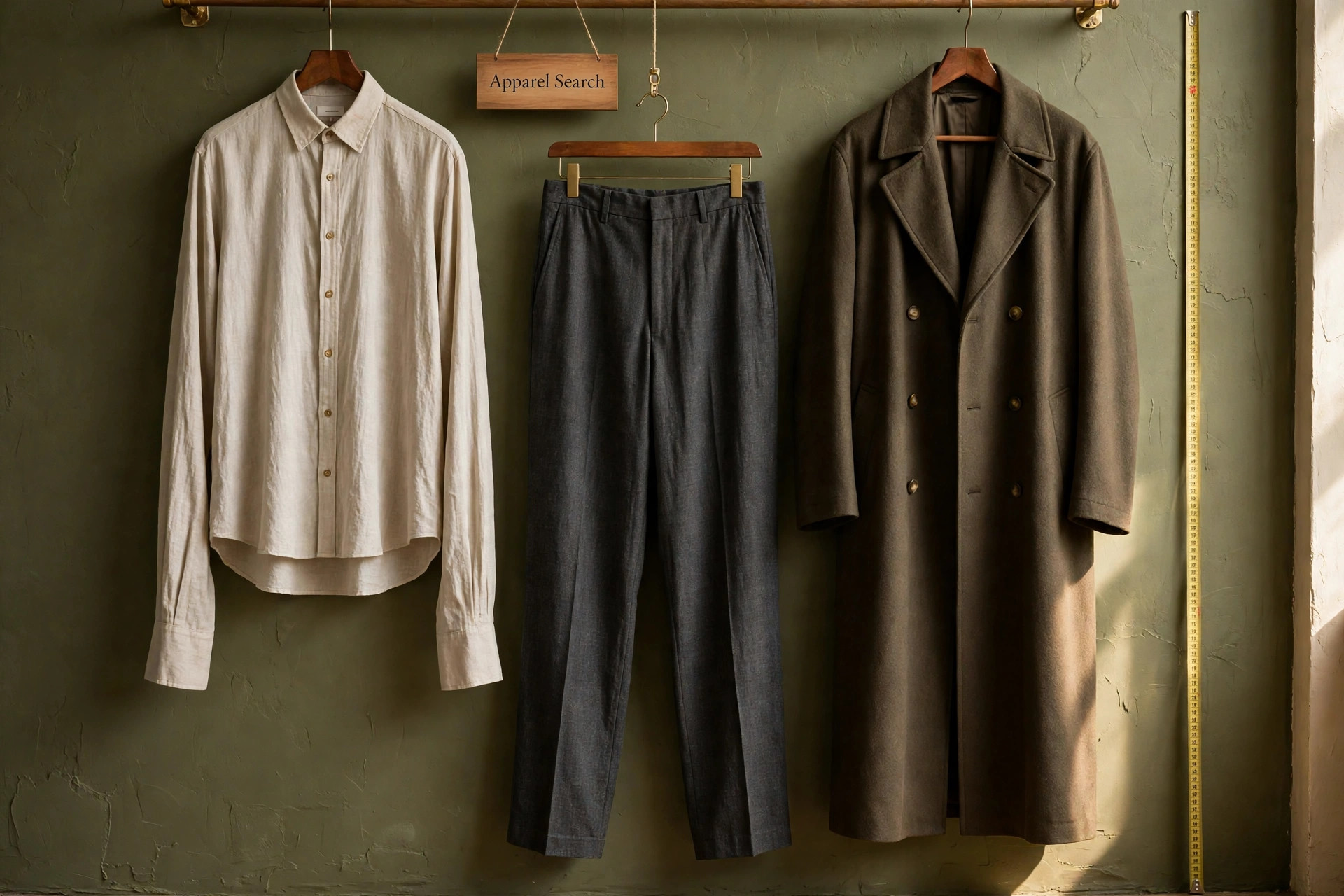
This guide is part of our men’s style by height and build guides, and it starts from the asymmetry that governs tall dressing: a tailor can take length away but cannot put it back. Everything here follows from that. The short man’s problem is proportion, solvable with rules and a hem; the tall man’s problem is supply — garments patterned long enough in the first place — and only then proportion. (The label logic has a parallel on the women’s side, translated in our tall sizing explained guide; the men’s labels below are a different chart.)
The Labels, Translated
LT and XLT are the casual and big-and-tall trade’s tall marks: the letter before the T is the width (L, XL, 2XL), and the T adds length — typically an inch to two inches on shirt and jacket bodies and sleeves over the same width in regular. Long (L) suit lengths — a 40L beside the 40R — add about an inch to the jacket body and sleeve and are the tailored equivalent. Inseams are sold honestly as numbers: 34 and 36 are common in tall ranges, 38 exists, and unfinished trousers hemmed to order remain the reliable route for dress trousers. Tall shirts add body length (the part that stays tucked) as well as sleeve; a merely bigger shirt adds width instead, which is the substitution to refuse. When a range offers only “big” and “tall” as a single combined rail, check which axis the garment in your hand actually extends.
The Length Checks
- Sleeve, arm bent. A dress shirt cuff should reach the wrist bone and stay near it with the arm bent; a jacket sleeve should show the classic sliver of cuff beyond it. This is the check regular patterns fail first on a tall frame, and the one our suit fit guide details for jackets.
- Trouser length, standing in shoes. Decide the break you want — the trouser break guide lays out the four — then confirm the garment can reach it. A tall man in a regular inseam does not have a shorter break; he has trousers that stop early, which reads as a mistake rather than a choice.
- The tuck test. Shirt tails should still be tucked after you sit, stand and reach. Tall bodies on regular shirts are why tall fittings add body length; if a brand’s tall version does not state added body length, it is probably only longer in the sleeve.
- Jacket and coat length against the torso. A jacket should cover the seat; on a long torso it must do so without the button stance climbing. Long suit lengths grade the stance down as they lengthen the body — another reason to buy the L rather than size up the R.
- Rise, for the long-torsoed. Height carried in the torso rather than the legs calls for a regular or higher rise to keep the waist where the body bends; height carried in the legs calls for the inseam and a standard rise. Know which tall you are before shopping either.
Proportion Balance
Once the lengths are right, the remaining work is visual balance. A very long, unbroken column can read as severity; tall dressing softens it by breaking the column deliberately — a belt that shows, a contrasting (not clashing) top and trouser, a layer left open, a pocket square or scarf at the chest. Pattern scale goes up, not down: wider stripe spacing, larger checks and bigger prints sit naturally on a long frame that dwarfs small patterns. And avoid the over-narrow cut: very skinny trousers and tight jackets on a tall man exaggerate length into lankiness; a straight, clean line keeps the height and loses the exaggeration. None of this is about looking shorter — it is about the outfit agreeing with the frame, the same standard the women’s tall women’s fashion guide applies at the other side of the shop.
Buy the Length, Tailor the Width
The tall man’s shopping rule inverts the short man’s. Seams hold only a small allowance — typically an inch or less of hem, sometimes nothing — so a garment that is short anywhere structural (sleeve, body, rise, inseam past its hem) cannot be rescued. Buy the tall fitting that covers every length, then let a tailor narrow, taper and suppress the width, which is routine work. The clothing alterations guide marks which jobs are easy, which are limited, and which are effectively impossible; nearly all the impossible ones are about adding.
Where Tall Sizes Are Sold
Three reliable sources. Big and tall retailers are the deepest stock of LT/XLT casual wear — our big and tall clothes guides cover that collection garment by garment, and a tall man shops its tall axis even if he never needs its width. Suit retailers stock Long lengths as a matter of course. Athletic and outdoor brands run tall lines in shirts, trousers and outerwear more faithfully than fashion brands do. Beyond them: made-to-measure, and the discipline of keeping your four numbers — inseam, rise, sleeve, back length — recorded, per our sizing and fit guide, so a new brand’s chart is a lookup rather than a gamble.
Common Questions
What height needs tall sizes in men’s clothing?
About six foot two and up is the retail line, but proportion decides as much as height: a man of 6’0” with a long torso or long legs will fail the same sleeve, body and inseam checks as a taller man. Use the checks, not the tape over your head — if regular shirts will not stay tucked and regular sleeves will not reach, you are a tall fitting whatever your height certificate says.
What is the difference between LT and XLT?
Width first, then length. LT is a Large made tall; XLT is an Extra Large made tall. The T contributes the same added length in both — roughly an inch to two inches on body and sleeve. Choose by the chest and waist you need, then let the T handle the length; do not buy XLT for length alone if a Large fits your frame, or you will pay for the length in spare width.
Can regular clothes be let out for a tall man?
Rarely, and barely. Trousers sometimes carry an inch or so of hem allowance, and jacket sleeves a little; shirt bodies, jacket bodies, rises and sleeves past their allowance cannot be lengthened at all — there is no cloth to let out. This is why tall men are told to buy length first and tailor width: the reverse order strands you with well-fitted clothes that are simply too short.
Are big & tall stores the only place to find tall sizes?
No, though they hold the deepest stock of LT and XLT casual clothing. Suit shops stock Long lengths routinely, athletic and outdoor brands run genuine tall lines, some general retailers carry tall ranges online that never reach their shop floors, and made-to-measure removes the question entirely. The tall man’s constraint is less availability than visibility: the ranges exist, but they hide under the big & tall heading.
Related Guides
Men’s Style by Height & Build
The parent guide: the length axis and the shape axis, the four deciding measurements, and the short-men and body-type companions to this guide.