Apparel Search Consumer Guides
Find Your Body Type
Three measurements, five minutes, one honest answer — and a plan for what to do with it.
Every guide in this section starts from the same three numbers, and this page collects them. It is part of our dress for your body type guide, and it does one job: measure your bust, waist and hips accurately, compare them honestly, and name the shape — apple, pear, hourglass, rectangle or inverted triangle — that your proportions describe. No judgment is involved. A shape is a set of measurements, the way a shoe size is a measurement, and knowing it simply makes every later clothing decision easier.
What You Need
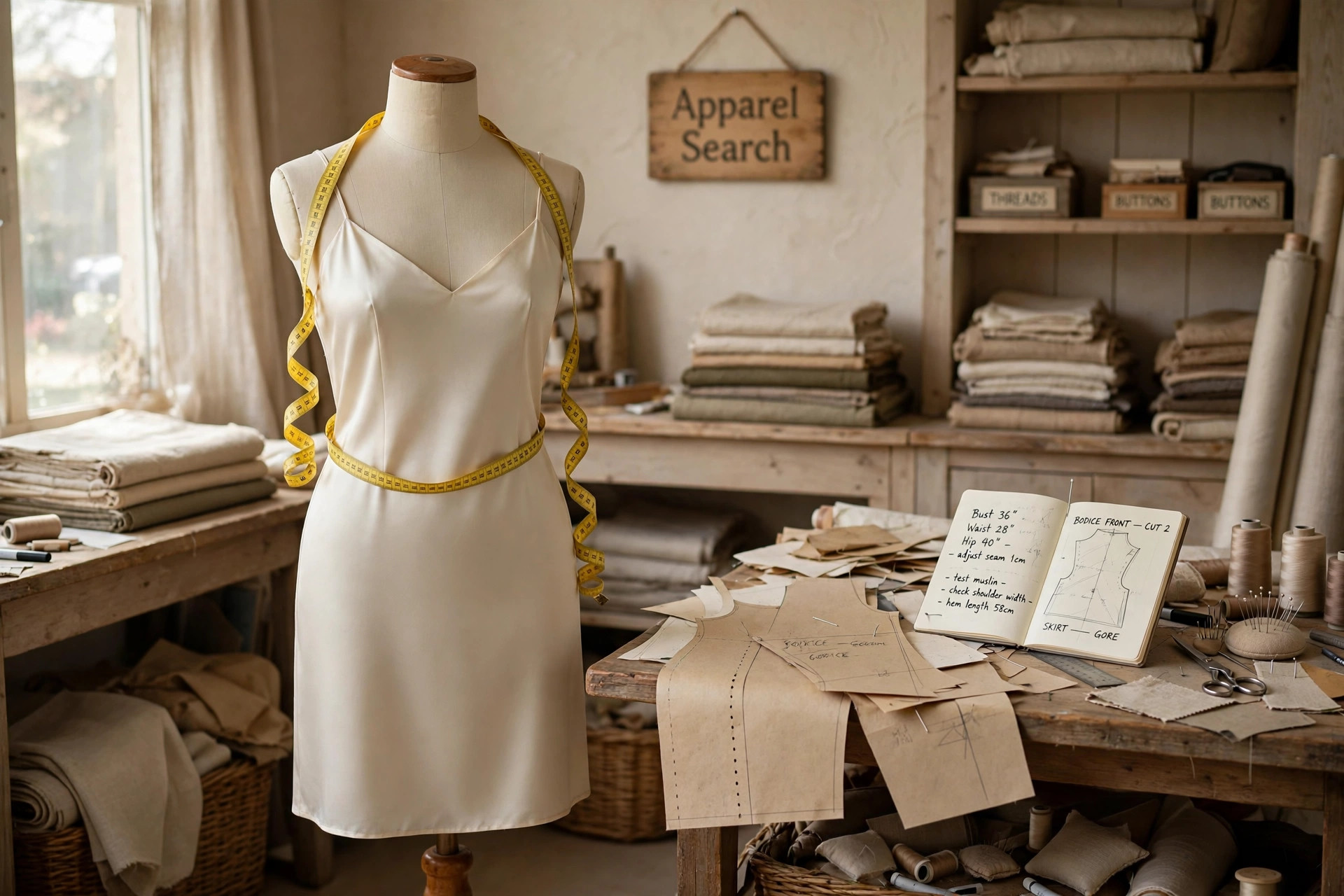
A soft tailor's tape measure, a mirror, and close-fitting clothes — underwear or a thin layer, never a sweater. Stand relaxed, feet together, and let the tape sit level all the way around: most measuring errors are really tape errors, a tape that has slid down at the back or twisted at the side. Our education section's body measurements walkthrough covers tape technique in full if you want the careful version before you start.
Take Three Measurements
- Bust. Around the fullest point of the bust, tape level under the arms and across the shoulder blades. Snug, not compressing — you should be able to breathe out fully and have the number stay put.
- Natural waist. Around the smallest point of your torso, usually just above the navel. If no obvious narrow point exists, that is information too — note the number at the navel line and move on.
- Hips. Around the fullest point of the hips and seat, feet together, tape level. This is the widest lower-body line, wherever it happens to fall on you.
Read the Comparisons
Write the three numbers down and look at their pattern, largest to smallest, and at how the waist compares with the other two:
Apple — bust and waist are the large numbers; the waist is close to the bust measurement, and the midsection carries the fullest line. Pear — hips are clearly the largest number, the waist is noticeably smaller, and bust and shoulders run narrower than the hips. Hourglass — bust and hips are close to each other, and the waist is dramatically smaller than both — roughly a quarter smaller or more. Rectangle — all three numbers sit within a few inches of one another; no single line dominates and the waist is only slightly smaller. Inverted triangle — bust is the largest number and the shoulders are broad, while hips are the narrowest line of the three.
The Five Shape Guides
When You Are Between Shapes
Blends are not a measuring failure; they are the most common result. If your hips lead but your waist is only modestly defined, you may sit between pear and rectangle. If your bust leads and your waist is catching up to it, apple and rectangle share your border. Two tiebreakers help. First, add the shoulder measurement: broad shoulders pull a rectangle reading toward inverted triangle. Second, notice where your body changes first when your weight shifts — the area that fills first is usually the area your shape is named for. Then read both neighboring guides and keep the advice that matches your mirror.
A Starting Point, Not a Box
Shapes shift across a lifetime — with muscle, with weight, with pregnancy and menopause — so treat today's answer as current, not permanent, and re-measure every few years. And keep shape separate from size in your mind: once you know your proportions, the clothing size conversion chart handles the separate question of which labeled size those proportions are wearing this season. Shape tells you what to look for; size tells you which one to take to the fitting room.
Keep a third question separate from both shape and size: proportion of length. If sleeves, rises and waist placement are consistently wrong even in the right size and the right shape, the issue is stature rather than shape — the situation of little people and adults of short stature. Our short stature style guide applies proportion thinking to length and scale, and the little people & short stature clothing guide covers the fit side and the sources.
Common Questions
What measurements do I need to find my body type?
Three: bust, natural waist and hips, taken with a soft tape over close-fitting clothes. Shoulders are a useful fourth number when the first three leave you between the rectangle and inverted triangle shapes, since shoulder width is what separates those two.
How accurate do the measurements need to be?
Within about half an inch is plenty. Body typing works on comparisons — which number is largest, and how the waist relates to the other two — so small measuring wobbles do not change the answer. Take each measurement twice if you want to be sure, and use the consistent reading.
What if my measurements match two shapes?
Then you are like most women. Shapes are descriptions of proportion, not species, and blends are the norm: pear-hourglass and apple-rectangle combinations are especially common. Read both shape guides, note where their advice agrees, and borrow the rest according to which features you recognize in the mirror.
Is body type the same as clothing size?
No. Size is scale — how large the frame is. Shape is proportion — how the frame's width is distributed among shoulders, bust, waist and hips. Two women who wear the same size can have completely different shapes, and the same shape exists at every size, which is why shape advice stays useful when size changes.
Back to the Dress for Your Body Type Guide
Five shapes, one principle: proportion. Find yours, and getting dressed gets simpler.