Apparel Search Consumer Guides
Little People & Short Stature Clothing Guide
Clothing that fits a body whose proportions — not just its height — differ from the standard pattern: the fit problem explained, and every realistic route to a wardrobe that works.
Most clothing advice for shorter people quietly assumes a standard body that happens to be short. That is the world petite clothing is built for, and for millions of women it works well. Adults of short stature — little people, including people with dwarfism such as achondroplasia — live in a different fit world. Their proportions differ from the standard pattern itself: in the most common forms of dwarfism the trunk is near average length while the limbs are markedly shorter, and other forms distribute length differently again. A garment can match such a body in overall size and still fail at every point that matters — sleeves, rise, waist placement, knee position. This guide treats that problem properly, as fit expertise: why it happens, where clothes genuinely come from, and how tailoring and made-to-measure close the remaining gap. Two companion guides go deeper: short stature fit and alterations covers proportions and the tailor's bench in detail, and our short stature style guide covers proportion strategy in finished outfits.
Search Apparel Search
The Guides in This Section
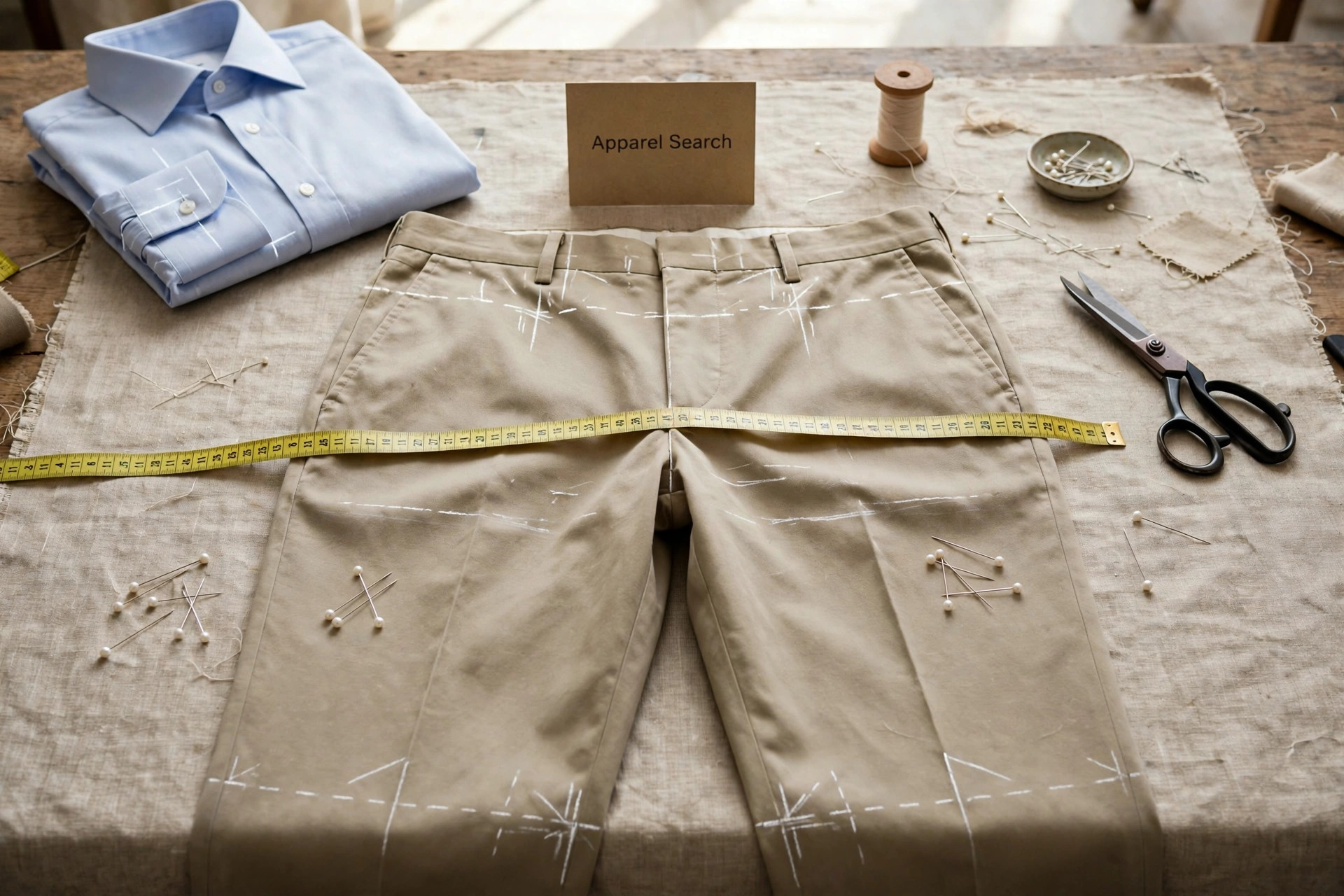 Short Stature Fit & AlterationsThe measurements that actually describe a short-stature frame, what a tailor can change, what a tailor cannot — and how to shop children's sizes with adult styling.
 Short Stature Style & ProportionLine, print scale, waist placement, footwear and accessories — proportion strategy for finished outfits, for women and men.
A Different Fit Problem: Proportions, Not Just Height
Standard sizing is built on a ratio. Pattern makers draft a base size for a body whose torso, arms and legs stand in fixed proportion to one another, then grade that pattern up and down — and, as our page on pattern grading explains, grading moves every point by small, assumed amounts. Petite ranges adjust the ratio slightly and evenly: a shorter back waist, a shorter sleeve, a shorter inseam, all reduced together for a frame around five foot three and under. Short stature breaks the ratio itself. Where limbs are short relative to the trunk, the sleeve and inseam need large reductions while the torso needs little or none; where the trunk is also short, the waist of a garment must land higher than any standard or petite pattern puts it. No single size on any standard chart encodes that, which is why the honest unit of short-stature fit is not the size label but the individual measurement — the subject of our fit and alterations guide.
Petite vs. Short Stature, in One Paragraph
Petite = an average-proportioned body at a shorter height; the whole garment is scaled down evenly. Short stature = proportions that differ from the average pattern — typically limb and torso lengths that do not scale together. Petite clothing is a useful partial source for some little people; it is not a substitute for fitting the proportions themselves.
Why Standard Sizing Fails, Point by Point
- Sleeves and inseams arrive far too long, while the body of the same garment may fit well — the classic sign that proportion, not size, is the problem.
- Waist placement lands in the wrong place on dresses, jumpsuits and fitted tops whenever torso length differs from the pattern's assumption, dragging every other feature with it.
- Rises and knee positions on trousers follow leg proportions a short-stature leg does not have, so shortening a hem alone still leaves a trouser that fits badly higher up.
- Children's sizes match some lengths but are cut and styled for children — the mismatch moves from fit to dignity, which is its own problem.
Where the Clothes Come From
Specialist short-stature brands and ranges. A small but real market of makers designs from short-stature proportions outward — the correct starting point, and the first place to look for tailored pieces, even if the ranges are narrower than anyone would like.
Petite departments. For women whose proportions are closer to the petite assumption — or for individual garments where only even scaling is needed — the women's petite clothing guide maps a large category, and the petite clothing stores directory lists where to buy. Treat petite as one shelf in the wardrobe, not the wardrobe.
Children's departments — and their limits. Plain knitwear, T-shirts, some leggings and trousers, and footwear basics can cross over, and many little people shop there pragmatically for those staples. The limits are real: children's patterns carry no adult shaping, styling reads young, and formal or tailored clothing rarely translates at all. Our children's clothes guide shows what those departments actually stock, which helps in judging what might work.
Made-to-measure. For suits, dresses, coats and anything structural, measuring the individual body and drafting to it sidesteps the ratio problem entirely. Our guide to made-to-measure clothing explains how the process works and where it sits between off-the-rack and bespoke.
Tailoring what you already found. The working backbone of most short-stature wardrobes: buy for the fit points that cannot be changed, alter the ones that can. Knowing exactly where that boundary sits is the difference between a strategy and a series of disappointments — it is mapped in full in the fit and alterations guide.
Footwear Fit Notes
Feet bring the same two issues as the rest of the wardrobe: small sizes and adult styling. Adult shoes in small sizes exist but thin out quickly below the middle of the standard range, children's shoes fill the size gap with children's styling and construction, and width matters as much as length — a point our shoe fit guide makes for every foot. Measure rather than assume: the guide to measuring your feet takes five minutes and settles length and width properly. Where a shoe must also work with orthotics or a particular heel height for comfort, fit the shoe around that requirement from the start rather than adapting afterwards.
A Note on Language
This guide uses "little people" and "short stature" — the terms the community itself most commonly uses — and talks about fit the way it talks about fit for any other body: as a pattern problem with practical solutions. Proportions are a specification, not a shortcoming.
Related Fit Guides
Shop Clothing on Amazon
Ready to shop? Product links are kept in one place on the Apparel Search shopping guide:
Shop Clothing on AmazonPetite ranges, small-size footwear and everyday basics are the categories where the Amazon guide is most useful for this wardrobe.
Common Questions
Is short stature the same as petite sizing?
No. Petite sizing is ordinary women's sizing scaled down evenly for a shorter frame of average proportions. Short stature — including the forms of dwarfism — involves different proportions: limb and torso lengths that do not scale together. A petite garment can help where proportions happen to match, but it is a partial source, not a designed solution.
Why don't children's sizes work for adults of short stature?
Children's garments are patterned for children's bodies and styled for children: different shaping, different details, and child-oriented fabrics and prints. Some basics — plain knitwear, T-shirts, some trousers — can cross over, but an adult wardrobe cannot be built from a children's department, and nobody should have to try.
Where do little people buy clothes?
From a mix of sources: the small number of specialist short-stature brands and ranges, petite departments where proportions allow, children's departments for selected basics, made-to-measure makers, and — very commonly — ordinary clothes plus a good tailor. This guide walks through each route and what it does well.
What is the single most useful fit measurement for short stature?
There is no single one, because proportion is the issue: back waist length, sleeve length, inseam and rise together describe a frame far better than height alone. Our fit and alterations guide explains each measurement and what it controls.
Everyday Dressing Ease: The Adaptive Clothing Guide
Closures, openings and seated dressing — the neighbouring fit subject, covered in depth.