Apparel Search Consumer Guides
Short Stature Fit & Alterations
Proportions measured properly, the tailor's boundary mapped honestly, and children's sizes used the adult way.
Our little people and short stature clothing guide explains why standard sizing fails this body; this page is the working half of that explanation — the numbers, and the needle. Fit for short stature is not a mystery and it is not a matter of taste: it is a small set of measurements whose relationships differ from the standard pattern's, plus a clear-eyed view of which of those relationships a tailor can renegotiate and which are built into a garment for good. Get those two things straight and shopping stops being trial and error: you will know, before a garment leaves the shop, whether it can be made to fit.
The Measurements That Matter
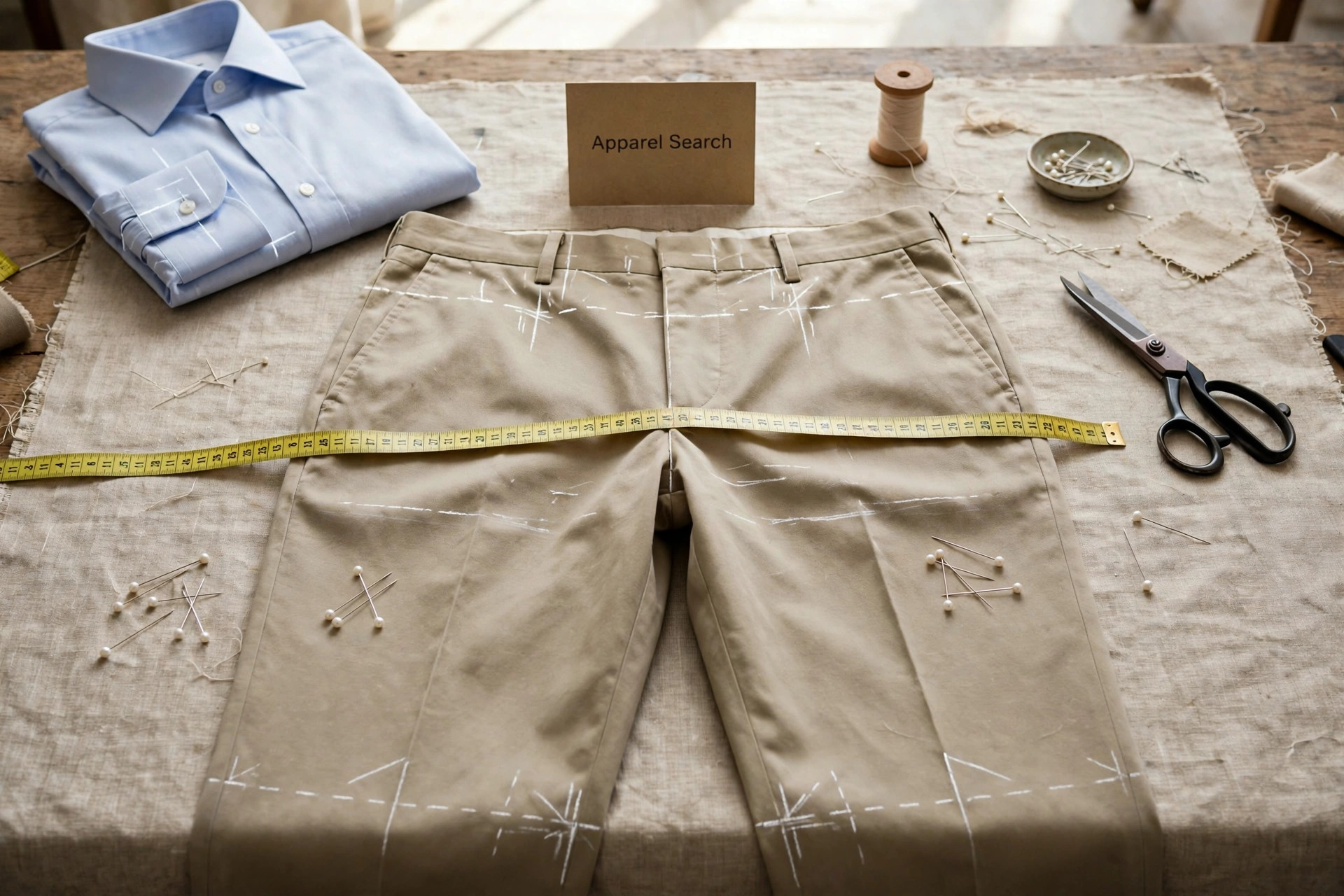
Height is the least useful number in this wardrobe. These are the useful ones — the landmarks behind them are the same ones used in our body measurements guide, and the way factories turn such numbers into size charts is explained in how size charts are built.
- Back waist length — neck point to natural waist, down the spine. This is the torso measurement: it decides where a garment's waist seam, darts and shaping will land, and it is the number standard and petite patterns most often get wrong for short stature.
- Sleeve length — shoulder point to wrist over a slightly bent arm. In the common forms of dwarfism this is where the largest difference from the pattern usually sits.
- Inseam and outseam — crotch to ankle bone, and waist to ankle bone. The gap between the two is the rise, and together they describe the leg completely.
- Rise — the distance from front waist, through the crotch, to back waist, best taken seated as well as standing if trousers are worn sitting for long stretches.
- Shoulder width and armhole depth — the quiet pair: they decide whether a jacket or fitted top can be altered at all, because neither can be changed after the fact.
- Measure in the clothes you fit for. Underwear and the shoes you will wear with the garment; heel height moves inseam and hem decisions.
- Take torso and limbs separately. Never derive one from the other — that derivation is exactly the assumption that fails.
- Write the numbers on a card. Back waist, sleeve, inseam, outseam, rise, shoulder. The card goes shopping; memory and size labels stay home.
- Compare against the garment, not the chart. Measure the actual trouser's rise and the actual jacket's back length in the shop. Garments, unlike charts, cannot exaggerate.
What Can Be Altered
- Hems, almost always. Trousers, skirts, dresses and coats shorten cleanly; plain hems are the cheapest alteration there is, and simple home hemming is covered in our hemming and basic hand sewing guide.
- Sleeves with plain cuffs. Shirts and knitwear shorten at the cuff easily; jacket sleeves shorten from the cuff where buttons and vents allow.
- Taper and take-in. Legs, bodies and sleeves can be slimmed where there is seam allowance and the shaping is simple.
- Waistbands, within limits. A waist can come in modestly, straps can be shortened, buttons and closures can move.
- Waist seam repositioning on simple dresses. On an unfitted or softly fitted dress, raising the waist seam is sometimes possible — ask before buying, not after.
What Can't — or Shouldn't — Be Altered
Our clothing alterations guide maps the tailor's boundary for everyone; for short stature these are the points on it that matter most.
- Re-proportioning a bodice. Armhole depth, dart position and torso shaping are set when the pattern is cut. A jacket drafted for a long torso cannot be shortened into a short-torso jacket: the pockets, button stance and balance all sit relative to that long draft, and they move wrongly or not at all.
- The rise of a trouser. Rise is structure, not length. A long-rise trouser hemmed short is still a long-rise trouser.
- Shoulder width. Narrowing shoulders means rebuilding the garment's top half; on anything but a bespoke budget it is a reason to put the garment back.
- Large-scale pattern and embellishment. Shortening through a border print, plaid match or beaded section destroys the design's own proportions even when the sewing is possible.
- Anything where the alteration costs more than the route around it. Extensive re-cutting of an off-the-rack garment can quietly exceed the price of made-to-measure — where the proportions are right from the first stitch. Cost and effort are fit information too: a garment needing four alterations is telling you it was drafted for somebody else.
Shopping Children's Sizes with Adult Styling
Children's departments are a legitimate shelf of this wardrobe — for the right garments. Plain knitwear, T-shirts and sweatshirts, some leggings and simple trousers, and footwear basics can cross over successfully, especially in the largest children's sizes. What does not cross over is shaping and styling: children's patterns carry no adult bust, waist or hip shaping, details read young, and formal pieces almost never translate. The adult styling happens around the garment — adult accessories, adult footwear, a tailored layer over a basic knit — and in choosing plain, well-made pieces over decorated ones. Used that way, the children's department is a pragmatic source for staples; treated as a whole wardrobe, it fails on both fit and dignity, and our hub guide sets out the fuller list of sources.
Briefing a Tailor
Bring the measurement card, wear the shoes the garment will live with, and ask the boundary question first — "what on this garment cannot be changed?" — before discussing anything else. A good tailor answers it immediately and specifically; the answer tells you whether to alter, exchange, or walk away. For tailored pieces, the fit principles in our suit fit guide apply unchanged — only the numbers differ.
Common Questions
Which measurements matter most for short stature fit?
Back waist length, sleeve length, inseam and rise — taken together, because the relationship between them is the fit. Height and a single size label describe an average-proportioned body; these four numbers describe yours.
Can a tailor shorten a jacket or coat for short stature?
Sleeves, yes, almost always. The body of a jacket can sometimes be shortened a little, but only until pockets, button stance and balance object — a jacket drafted for a long torso cannot be re-proportioned into a short one. Buy jackets for torso fit first and treat hem shortening as a bonus, not a plan.
Can trouser rise be altered?
Not meaningfully. The rise is built into the pattern's structure — crotch curve, waistband position and pocket placement all hang from it — which is why trousers are the garment to buy closest to correct and alter only at the hem and waist.
Is it worth altering children's clothes for an adult?
For basics, sometimes: a plain knit or trouser can be hemmed and restyled with adult accessories. For anything shaped or formal, the pattern itself is a child's pattern, and no alteration adds adult shaping. Spend the tailoring budget where the underlying pattern is already adult.
Back to the Little People & Short Stature Clothing Guide
The fit problem, the sources, and the footwear notes — the full picture.