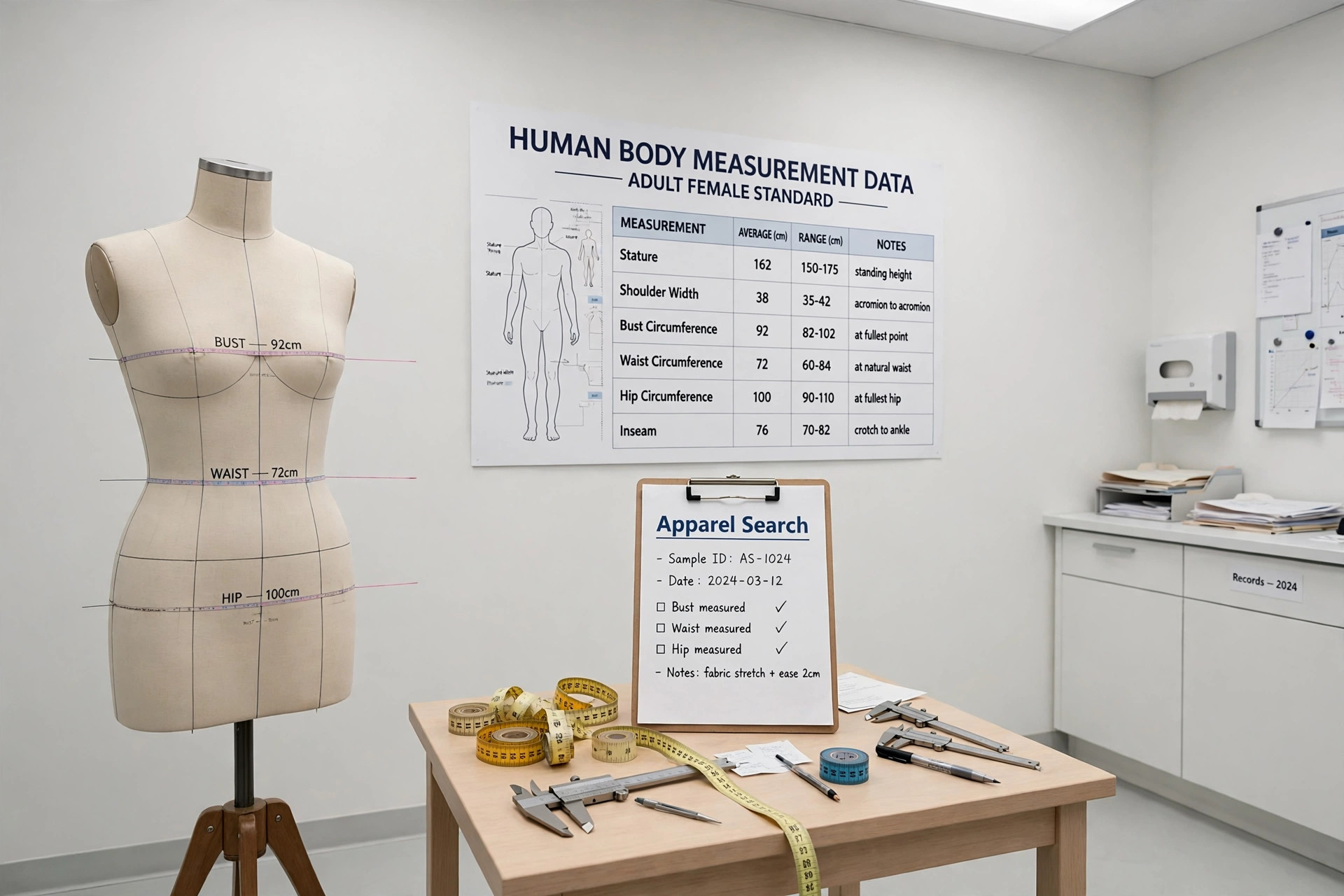
Anthropometrics is the science of measuring human bodies — and in the clothing industry it is where sizing truly begins, upstream of every pattern, grade rule and size chart. This page, part of our Clothing Sizing & Fit Guide, covers how body data is collected, how it is organised into percentiles and standards, and why the quality of this data quietly determines whether a brand's clothes fit its customers or come back as returns.
Measuring Bodies Properly
Anthropometric measurement is more disciplined than a tailor's quick tape work. Measurements are taken at defined anatomical landmarks — the natural waist at its narrowest point, the bust at its fullest, the hip at the greatest prominence — with the subject in a standard posture, breathing normally, in light clothing. Dozens of dimensions are recorded: stature, girths, torso and limb lengths, shoulder width, neck base, rise, and more. The landmarks matter because a waist measured 3 cm higher by one team and lower by another produces data that cannot be compared or combined — precision about where is what makes a database trustworthy. Our consumer-facing how to measure guides apply the same landmark logic at home scale.
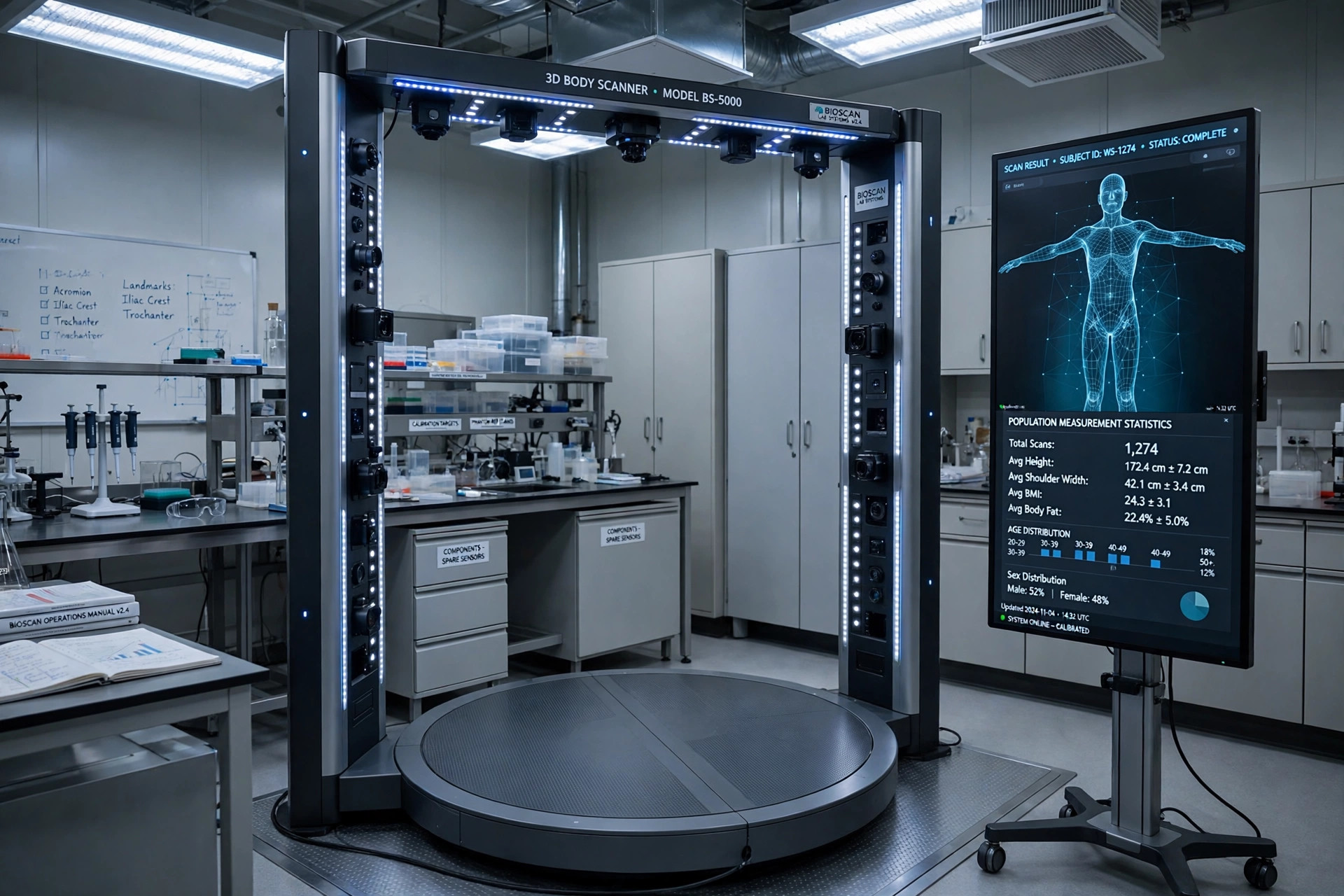
Historically the great datasets came from military surveys — armies needed uniforms that fit conscripts — and from national sizing campaigns run for the garment industry. Tape-and-calliper campaigns were slow and expensive, which is why datasets were rare and long-lived. Whole-body 3D scanning changed the economics: projects such as the CAESAR survey of North American and European civilians and national campaigns like SizeUK and SizeUSA scanned thousands of volunteers, capturing a full measurement set in seconds per person and preserving the body shape, not just its dimensions — a major advance, because two bodies with identical bust-waist-hip numbers can be shaped very differently.
Percentiles, Not Averages
Raw data becomes useful when it is organised statistically. For each measurement, a table can state the value at each percentile: the 50th percentile waist is the value half the population falls below; the 5th and 95th mark the practical edges a size range might try to cover. Brands work from these tables to decide which bodies each size serves — and, just as importantly, which bodies it will not serve, since no range covers everyone.
The classic trap is designing for the average. Combine twenty measurements and essentially nobody is average in all twenty: the median-height woman does not automatically have the median waist, hip, shoulder and arm length in the same body. Fit failures blamed on "the customer" are often this statistical reality surfacing. Good sizing teams therefore define a target profile — a coherent set of proportions drawn from a real cluster of similar bodies in the data — and then select a fit model whose body embodies that profile, so the base size is approved on a plausible person rather than a spreadsheet ghost.
The Standards That Organise the Data
Several published standards give the industry shared reference points; cited carefully, the main ones are these. ASTM D5585 is a standard table of body measurements for adult female misses, widely used in the US industry as a reference body for that market segment. The ISO 8559 series addresses size designation of clothes, including the definitions of body measurement points and procedures for anthropometric surveys, so that data collected in different countries means the same thing. In Europe, EN 13402 is the size designation standard built directly on body measurements in centimetres, designed so a label can state the body dimensions a garment is intended to fit. None of these forces a brand to make any particular sizes — they standardise the language and reference data, while the actual size system remains each brand's decision, as sizing systems around the world shows.
Data also ages. Populations grow taller across generations, average girths shift with lifestyle, and the ethnic mix of a market changes its proportion profile. A size system built on thirty-year-old tables fits a population that no longer exists; the slow drift shows up as creeping return rates and a base size that fits fewer and fewer of the customers it was drawn from. Refreshing the data — or at least re-validating the system against current returns and fit feedback — is unglamorous work that separates brands whose fit reputation improves from those whose quietly erodes.
Common Questions
- What is anthropometrics in clothing?
- Anthropometrics is the measurement of the human body — heights, girths, lengths and proportions — collected systematically across a population. In clothing it is the raw material of sizing: the tables of body measurements from which size systems, base patterns and grade rules are all derived.
- Why don't brands design for the 'average' body?
- Because the average body does not exist. A person can be average height with a long torso, or average bust with narrow shoulders — when dozens of measurements are combined, almost nobody is average in all of them at once. Brands therefore choose percentiles and a target customer profile instead of a mythical mean, and fit the base size on a real fit model whose proportions represent that customer.
- What is a sizing survey or measurement campaign?
- A measurement campaign recruits thousands of volunteers from a population and records their body dimensions — historically with tape measures and callipers, today mostly with whole-body 3D scanners that capture dozens of measurements in seconds. The resulting database lets standards bodies and brands see how a population's bodies are actually distributed, rather than guessing.
- How often does body measurement data need to be refreshed?
- Populations change — average heights, weights and proportions shift measurably over a generation, and migration changes the mix faster in some markets. Data more than about twenty years old should be treated as historical. Brands that build size systems on ageing tables gradually drift away from their living customers, which is one quiet cause of rising return rates.
More from the Sizing & Fit Guide
Back to the Clothing Sizing & Fit Guide Body data is the first link in the sizing chain. See the whole system in the Sizing & Fit Guide hub.