
There is no world clothing size. There are national systems, built separately from different populations at different times, and conversion charts that negotiate between them. This page explains how the major systems are constructed — the companion to our Clothing Sizing & Fit Guide — while the practical arithmetic lives in our clothing size conversion chart, which this page supports rather than replaces.
The Americas and Britain: Numbered Ladders
US women's sizing is a numbered ladder — 0, 2, 4, 6 and up for misses, odd numbers historically for juniors' younger, straighter fit — whose rungs were once tied to measurements and have since drifted, as our vanity sizing page recounts. Men's tailored clothing stays closer to the body: suit sizes name the chest in inches, and trousers are sold by waist and inseam, though both labels are applied with some freedom. Letter sizes overlay everything, unstandardised.
British women's sizing runs on a parallel ladder offset from the American — as a rule of thumb a UK size is one step, four numbers at the label level commonly expressed as "add 4", above its US counterpart — but it is a separate system with its own history and its own drift, not a conversion of it. Treating the offset as exact works for a first approximation and fails at the extremes of the range, where the two ladders' different intervals pull apart.
Europe: Measurement Heritage, National Variations
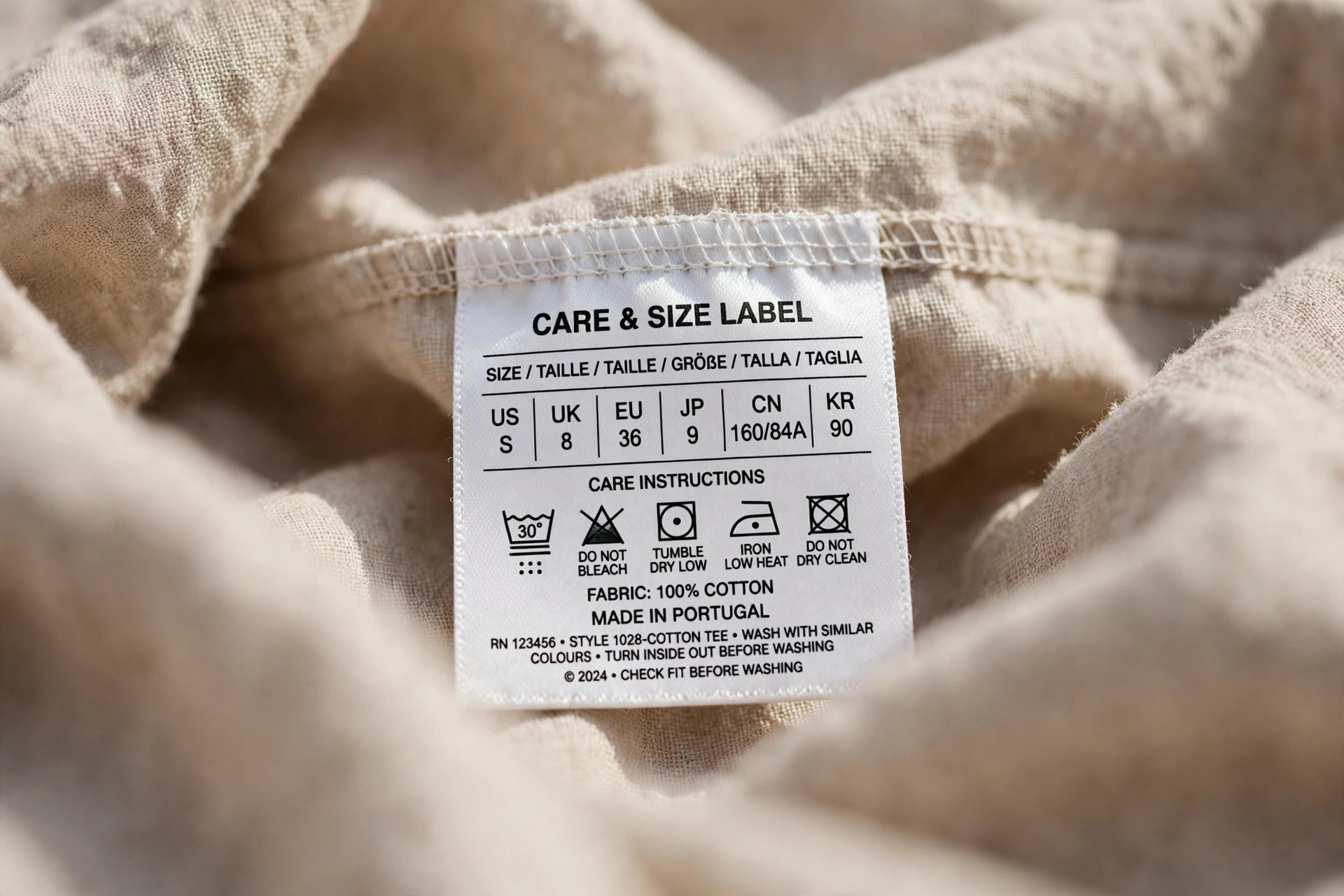
Continental European women's sizes — the 36, 38, 40 sequence — descend from systems built on body measurements, which is why the steps are even numbers marching by small, regular increments. But "European" conceals national families: French and Italian labels run on their own sequences, offset from the German-centred one, so a garment can carry three "European" numbers that disagree. The European standard EN 13402 was designed to cut through exactly this by labelling clothes with the body measurements they fit, in centimetres, with a standard pictogram — an idea every technician applauds and retail has adopted only partially.
East Asia: Compact Ladders and Measurement Labels
Japanese women's sizes use their own odd-number ladder (7, 9, 11, 13…) fitted to Japanese body data, alongside letter sizes that sit noticeably smaller than their Western namesakes. Korean women's sizing traditionally used a two-digit sequence (55, 66, 77…) and has moved toward centimetre-based labelling. China's GB/T 1335 system is the most explicitly measurement-driven of the major systems: sizes are designated by height and a key girth in centimetres, plus a body-type letter (Y, A, B, C) expressing the chest-to-waist relationship — the label tells you a shape, not just a magnitude. All three systems illustrate the same principle from the other side of the world: built from local anthropometric data, for local bodies, and only approximately translatable.
Why Conversion Is a Negotiation, Not a Calculation
Line the systems up and the obstacles are structural. The ladders start at different bodies, so their zeros disagree. They climb at different intervals — one system's step is another's step-and-a-half — so even a perfect match at size 10 has drifted by size 20, the cross-system cousin of grade rules disagreeing. And each system has been locally reinterpreted by brands, vanity drift included. A conversion chart therefore publishes the best correspondence, usually derived from the measurement ranges each size claims to serve — the method behind our conversion chart and the reason its own headnote tells you to let fit decide. Convert to find the size to try first; confirm with the brand's measurements and, where you can, the garment itself.
Common Questions
- Why can't sizes be converted between countries with a simple formula?
- Because the systems were built independently, from different populations, with different starting points and different intervals between sizes. A conversion chart is a negotiated correspondence between two ladders whose rungs don't align — close enough to shop by, never exact. The further apart the systems' origins, the rougher the correspondence.
- What is EN 13402?
- EN 13402 is the European standard for size designation of clothes based directly on body measurements in centimetres. Its core idea is that a label should state the body the garment is meant to fit — supported by a standard pictogram showing which measurements are meant — instead of a bare code number whose meaning varies by country and brand. Adoption has been partial, so code numbers remain common in European shops.
- Are letter sizes (S, M, L) the same everywhere?
- No. Letter sizes are unstandardised worldwide, and an M is anchored to each brand's own numeric scale, so it inherits all of that scale's local variation — a Japanese M, a US M and an Italian M are three different garments. Letters also span wider ranges than numbers, grouping several numeric sizes into one, which makes them the least precise labels in the store.
- What do the letters in Chinese clothing sizes mean?
- China's GB/T 1335 sizing system designates sizes by height and a key girth (such as chest or waist) in centimetres, followed by a body-type letter — Y, A, B or C — classifying the difference between chest and waist measurements, from slender to fuller builds. It is one of the most information-dense national systems: the label carries measurements and a shape class, not just a rank on a ladder.
More from the Sizing & Fit Guide
Back to the Clothing Sizing & Fit Guide National systems are one link in the chain from body data to size label. See the whole system in the Sizing & Fit Guide hub.