Retail Buying & Merchandise Planning · The Budget
Open-to-Buy Explained
The single number that disciplines fashion buying: how much money is still available to spend on stock — and what happens when buyers ignore it.
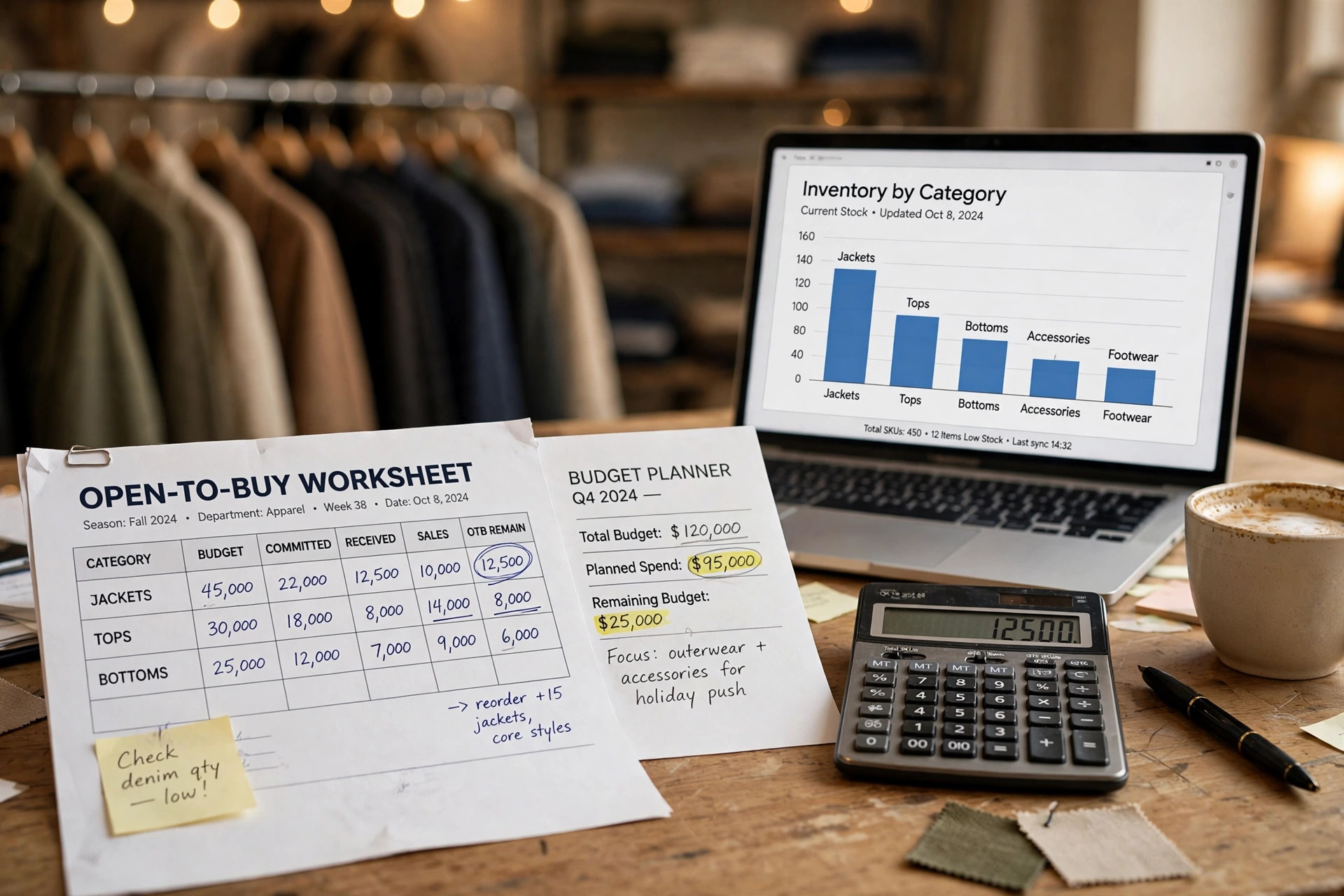
Ask a buyer in the middle of market week how much money they have left, and a good one answers instantly. That number is the open-to-buy (OTB): the uncommitted remainder of the season's purchasing budget. This page of the Retail Buying & Merchandise Planning Guide explains where the number comes from, walks through a complete worked example, and shows how buyers use it week by week. Apparel Search also offers a working open-to-buy planner tool if you want to run your own figures.
Open-to-Buy, Defined
Open-to-buy is the value of merchandise a buyer is still permitted to order for delivery in a given period, after accounting for the stock already on hand and the orders already placed. In plain form: planned purchases minus merchandise already received and on order. Planned purchases are themselves derived from the season plan — planned sales, plus planned markdowns, plus the stock planned for the end of the period, minus the stock on hand at its start.
Why the Number Exists
Buying fails in two opposite ways. Buy too little and the store runs out of its best sellers while the season still has weeks to run — lost sales that never come back. Buy too much and the season ends in a clearance event that hands the margin back. Open-to-buy exists to prevent both failures with one discipline: every order a buyer places spends against a budget that was set while the plan was sober, and the balance shrinks visibly as commitments are made. It converts “we should be careful” into arithmetic.
OTB also protects the most valuable money in the season — the portion deliberately held back. Experienced buyers do not commit the whole budget before the season starts. They hold a reserve of open-to-buy so that when a style takes off in week three, there is money available to chase it. A buyer who has spent everything by opening day can only watch a bestseller sell out.
A Worked Example
Imagine the women's dresses department of a mid-sized retailer, planning the month of April. The figures below are illustrative, drawn from the department's six-month plan:
| Open-to-buy calculation (at retail) | Amount |
|---|---|
| Planned sales for April | $120,000 |
| Planned markdowns for April | $18,000 |
| Planned end-of-month stock (April 30) | $210,000 |
| Planned purchases for April (120,000 + 18,000 + 210,000) | $348,000 |
| Minus stock on hand April 1 (beginning-of-month stock) | −$195,000 |
| Planned receipts for April | $153,000 |
| Minus orders already placed for April delivery | −$60,000 |
| Open-to-buy for April (at retail) | $93,000 |
Orders are placed with vendors at cost, not at retail, so the buyer converts the figure: at an average initial markup of 55%, the cost complement is 45%, and $93,000 × 0.45 = $41,850 of open-to-buy at cost. That is the real spending money for April — the ceiling for every new order and reorder the buyer writes this month, unless the plan itself is formally revised.
How Buyers Use It, Week by Week
Before the season: commit the backbone
Core styles and proven vendors are ordered early against the plan, typically using the majority of the budget — but never all of it. The reserve is a decision, not an accident.
In season: spend the reserve on evidence
Weekly sell-through shows which styles are earning their space. Reorders are funded from the open-to-buy balance, so chasing a winner automatically means not chasing something else.
When trading disappoints: defend the number
If sales fall behind plan, the open-to-buy shrinks — receipts must be cut, pushed back or cancelled, because the planned end-of-month stock no longer needs the same replenishment. Buyers who keep ordering into a weak season convert a sales problem into a stock problem.
At season's end: close the book
Remaining open-to-buy is not a target to spend. Money unspent on the wrong stock is worth more than stock cleared at 70% off, and the discipline of leaving it unspent is what separates planning from shopping.
Common Open-to-Buy Mistakes
Planning in dollars, reordering in feelings. The reorder that “just feels right” still spends the budget; if it is not in the OTB, it comes out of some other style's future. Forgetting markdowns. Planned markdowns consume stock value, so a plan that ignores them understates the receipts needed and quietly overbuys later. Treating on-order as free. An order placed is money spent, even though nothing has arrived — the deduction for outstanding orders is what keeps double-buying from happening. And revising sales up to rescue the budget: raising the sales plan on paper to create open-to-buy is the oldest trick in the trade, and it ends in the clearance rail.
Continue Through the Guide
Common Questions
What is open-to-buy in simple terms?
Open-to-buy is the amount of money a buyer still has available to spend on stock for a given period. It is what remains of the planned purchases after counting the stock already on hand and the orders already placed. If the open-to-buy is zero, the budget for that month is fully committed, no matter how tempting a new line looks.
Is open-to-buy calculated at retail or at cost?
Both are used. Planning is usually done at retail value because sales and stock plans are written at retail; the buyer then converts the retail open-to-buy to cost — multiplying by the cost complement of the markup — to know the actual money available to place orders with vendors.
What happens when open-to-buy goes negative?
A negative open-to-buy means the department has committed to more stock than its plan allows — it is overbought. The fixes are to cancel or push back orders where possible, increase the sales plan only if trading genuinely supports it (not as a paper exercise), or take markdowns earlier to convert slow stock back into selling power.
How often is open-to-buy recalculated?
Formally at least monthly, when actual sales, receipts and stock are known; in well-run buying offices it is reviewed weekly during the season, because every reorder, cancellation and markdown changes the number. It is a living budget, not a figure set once at the start of the season.
Back to the Guide
This page is one of six in the Retail Buying & Merchandise Planning Guide — return to the hub for the full buying cycle, from the six-month plan to the final markdown.