Retail Buying & Merchandise Planning · The Range
Assortment Planning
The bridge between a money plan and a stocked rail: how many options, at which price points, in what colors and sizes — decided before the showroom, not during it.
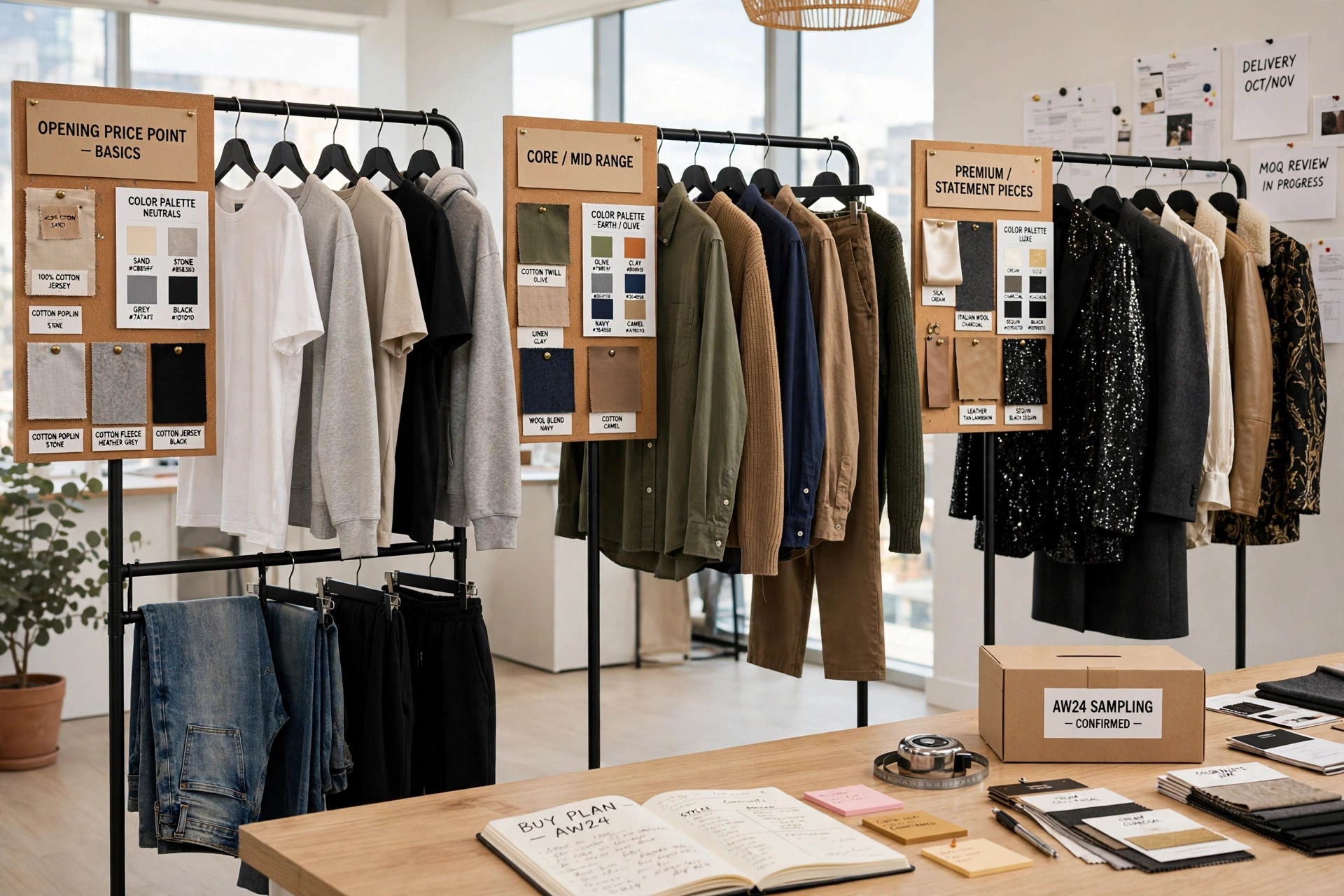
A financial plan says how much a department may spend; an assortment plan says what the spending becomes. Assortment planning is the stage of the Retail Buying & Merchandise Planning cycle where money turns into counted choices — categories, styles, price points, colors and sizes — before the buyer walks into a single appointment. Done well, it means every style bought later has a planned job to do. Done badly or not at all, the range is whatever impressed the buyer in the showroom, and the season's problems were ordered along with it.
Assortment Planning, Defined
Assortment planning decides the structure of a range: its breadth (how many different options), its depth (how many units of each), its price architecture (how options spread across price tiers), and its size and color ratios (how each style's units divide). The output is an option plan — a counted framework the buying team then fills with real styles during the buying process.
Breadth Versus Depth: The Central Trade-Off
The budget is fixed, so breadth and depth fight over the same money. A wide, shallow assortment — many styles, few units each — offers variety and freshness, but every style is one broken size away from a stalled sale, and reordering is hard because nothing was bought with depth to learn from. A narrow, deep assortment bets heavily on fewer styles: availability is excellent where the bet is right and brutal where it is wrong.
The right balance differs by category, and setting it is a core buying skill. Fashion-forward categories earn their drama from breadth — the customer expects newness — but are bought shallow because their risk is high. Core and replenishment categories (the white shirt, the classic jean, the basic knit) earn from depth, because their demand is proven and a stock-out is pure lost profit. Most ranges are a deliberate blend: a deep, safe core carrying the volume, a wider fashion layer carrying the interest, and a small number of statement pieces carrying the image.
Price Architecture: Good, Better, Best
Within each category, options are spread across price tiers so the department can serve the opening-price shopper and the premium shopper without confusing either. The classic structure has three jobs:
Good — Opening Price Points
The entry tier: sharp prices that bring customers in and carry volume. Bought widest and often deepest, with the tightest cost engineering — the Garment Costing Guide explains how those prices are built.
Better — The Commercial Middle
Where most units and most profit usually sit: noticeably better fabric, fit or branding than the entry tier, at a price the core customer accepts without drama. The middle is the department's engine and gets the most careful depth.
Best — The Premium Tier
Fewer options, bought shallow, that set the department's quality credentials and give the middle something to trade up from. Even when its direct sales are modest, the top tier lifts the perceived value of everything below it.
The plan counts options per tier, not just in total. A range that drifts — opening prices quietly disappearing as buyers fall for premium samples — loses its volume base; a range that never stretches upward loses its margin and its fashion authority. The option plan holds the architecture still while individual styles change.
Size Curves: Where Buys Quietly Fail
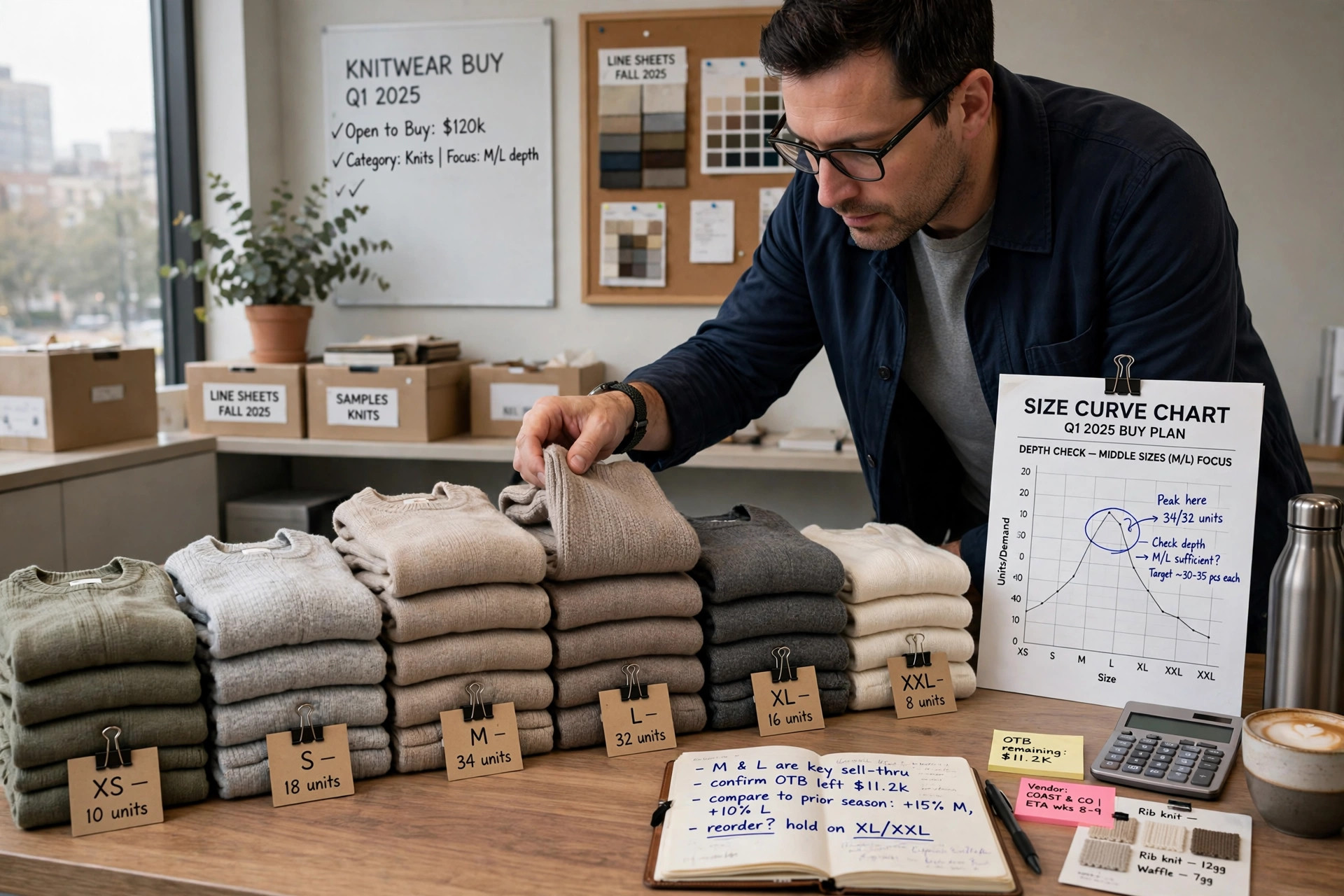
A style's total units are only the start. They must be split by size in the proportions customers actually buy, and that split — the size curve — comes from the department's own sales history, by category and often by store group. A typical curve for a women's core style might look like this:
| Size | XS | S | M | L | XL |
|---|---|---|---|---|---|
| Share of units | 5% | 20% | 35% | 25% | 15% |
On a 1,000-unit buy, that curve orders 50 / 200 / 350 / 250 / 150 units. Curves are bells, not lines, and they differ: footwear, menswear, plus-size and regional ranges all peak in different places. The Clothing Sizing & Fit Guide covers the technical side of sizing itself; the buying side is applying the right curve and then reading the results — a style whose mediums vanish in week two while extra-larges sit untouched is telling the buyer the curve was wrong, which is information for the reorder and for next season's plan. Broken size runs are also why a style can post a respectable overall sell-through rate while still disappointing: the units that remain are the units nobody wanted.
Color and Flow
Two smaller decisions complete the plan. Color ratios split each style's units across its colors — core colors (black, navy, white, grey) usually taking the majority, fashion colors a tested minority — using the same history-based logic as sizes. And flow decides when options land: a season's assortment is phased across drops so the rail stays fresh, early depth backs proven themes, and later phases can react to what the first weeks taught. Flow is where assortment planning hands over to in-season management — the plan deliberately leaves later phases flexible enough to chase what is working.
Continue Through the Guide
Common Questions
What is the difference between breadth and depth in an assortment?
Breadth is the number of different options — styles, colors, categories — a store offers. Depth is how many units it holds of each one, across sizes. A fixed budget forces a trade-off: wider assortments give customers more choice but risk shallow stock in each style; deeper assortments protect availability in proven styles but offer less variety. Most buying skill lives in setting that balance category by category.
What is an option plan?
An option plan (or range plan) is the assortment expressed as a counted framework: how many options the department will carry in each category and price tier, and what each option is expected to sell. It is built before individual styles are chosen, so that buying appointments fill a planned structure instead of accumulating whatever looked good in the showroom.
What is a size curve?
A size curve is the percentage distribution of sizes within a buy — for example 5% extra-small, 20% small, 35% medium, 25% large, 15% extra-large. It comes from the department's actual sales history by size, varies by category, store and region, and is applied to each style's total units so the buy arrives in the proportions customers actually purchase.
Why do stores run out of medium sizes first?
Because the middle sizes sell fastest — the size curve is a bell, not a line. If a buy is spread evenly across sizes, or copied from a curve that does not match the store's customers, the peak sizes break while the extremes remain, and the style's sell-through and margin suffer even though units are still on the rail.
Back to the Guide
This page is one of six in the Retail Buying & Merchandise Planning Guide — return to the hub for the full buying cycle, from the six-month plan to the final markdown.