The Archetypes
Seven Types, Described Plainly
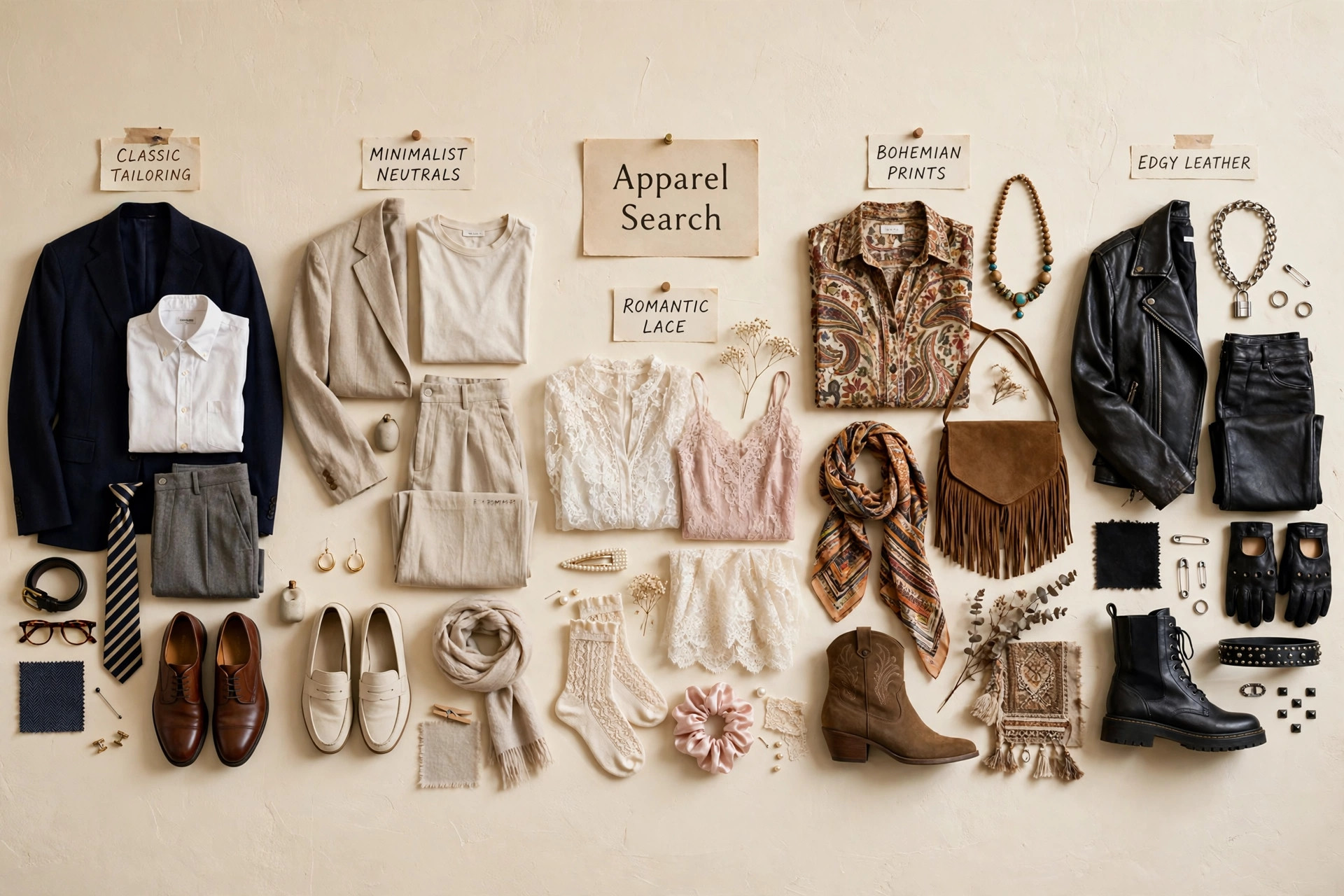
Style types are best understood as vocabularies. Each archetype below names a family of shapes, fabrics, colors and details that hang together, so that saying “classic” or “bohemian” communicates a whole rail of clothing in one word. Used well, a type gives you candidate words for the three-word method and a shortcut for describing what you are looking for. Used badly, it becomes a box — a costume you perform instead of a pattern you live in.
Classic style favors tailored shapes, neutral colors and pieces that ignore seasons: the blazer, the straight trouser, the white shirt, the trench. Minimalist style strips further — fewer pieces, plain surfaces, a tight palette, interest carried by proportion and fabric rather than detail. Romantic style softens everything: fluid fabrics, gentle color, lace, ruffles and movement. Bohemian style layers the handmade and the traveled — prints, embroidery, fringe, natural fibers, jewelry with a story.
More Types
Edgy, Preppy, Sporty — and the Blends Between
Edgy style introduces friction on purpose: black as a base, leather and hardware, sharp or oversized silhouettes, one element that slightly disagrees with the rest. Preppy style borrows from school and sport uniforms — polo shirts, loafers, stripes, crests, navy and white — kept neat and cheerful. Sporty style builds outfits from athletic clothing worn as everyday dress: sneakers as the default shoe, technical fabrics, caps, and silhouettes designed for movement, a close cousin of the looks tracked in fashion subcultures, where group identity often starts with exactly this kind of shared uniform.
Few people are purely one type, and the blends are usually the interesting part. Classic with an edgy shoe is a different wardrobe from classic with a romantic blouse, though both start from the same base. When you audit your own closet using the method in the find your personal style guide, you will usually find one dominant type, one supporting type, and a handful of pieces that belong to neither — those outliers are either your signature spice or your shopping mistakes, and your three words will tell you which.
Using a Type
A Starting Vocabulary, Not a Box
Find Your Dominant Type
Count, do not guess. The type that describes the largest share of what you actually wore last month is your base — it reflects your climate, your work and your habits, not just your taste.
Find Your Supporting Type
The second-largest share is your modifier. Write the two together — minimalist-bohemian, classic-sporty — and notice how much more precisely the pair describes your rail than either word alone.
Borrow Deliberately
From any other type, borrow single elements rather than whole outfits: the edgy boot, the romantic blouse, the preppy stripe. One borrowed element per outfit keeps the blend yours instead of turning it into fancy dress.
Let Color Confirm It
Each type leans on a palette. Check yours against the seasonal color analysis guide — if your type says soft and romantic but your best colors say bold contrast, adjust the type’s palette, not your face.
The point of naming a type is communication and search: it helps you brief a tailor, brief a friend shopping for you, or filter a rail quickly. It should never overrule the evidence of your own wardrobe. If the audit says relaxed knits and the quiz says dramatic tailoring, believe the audit — quizzes describe aspirations, and aspirations already have their own slot in the three-word method.
Types in Practice
From Label to Laundry Basket
A type earns its keep at the level of the weekly wash, not the mood board. Classic and minimalist types concentrate spending on fabric and fit because their pieces are plain and worn constantly. Romantic and bohemian types need more variety in texture and print, so their budgets spread across more, lighter pieces. Sporty types should protect the shoe and outerwear budget, since those items carry the look and the mileage — the same logic the men’s capsule wardrobe guide applies when it builds a small rotation around repeat wear.
Finally, expect your type to drift. Most people migrate one step at a time — classic toward minimalist as life simplifies, sporty toward classic as work formalizes — and the drift is healthy. Re-run the audit yearly, keep the words current, and let the type label follow behind as a description. The moment the label starts leading and the wardrobe starts apologizing, the tool has become the box this page warns against. The closet declutter guide is the reset button for exactly that situation.
Questions
Common Questions
What are the main personal style types?
The types most often used are classic, minimalist, romantic, bohemian, edgy, preppy and sporty. Each describes a family of shapes, fabrics and colors that hang together. Most people are a blend — one dominant type with a second supporting type — rather than a single pure type.
Can I have more than one style type?
Yes, and most people do. A dominant type plus a supporting type, written together such as classic-sporty or minimalist-romantic, usually describes a real wardrobe far better than one label. Borrow single elements from other types one at a time so the blend stays coherent.
What if no style type fits me?
Then skip the label and keep the words. Types are only a vocabulary shortcut; the three-word method and your outfit formulas do the actual work of filtering purchases and building outfits. If your audit produces clear words and formulas, you have a personal style whether or not an archetype name matches it.
More to Explore
Search Apparel Search